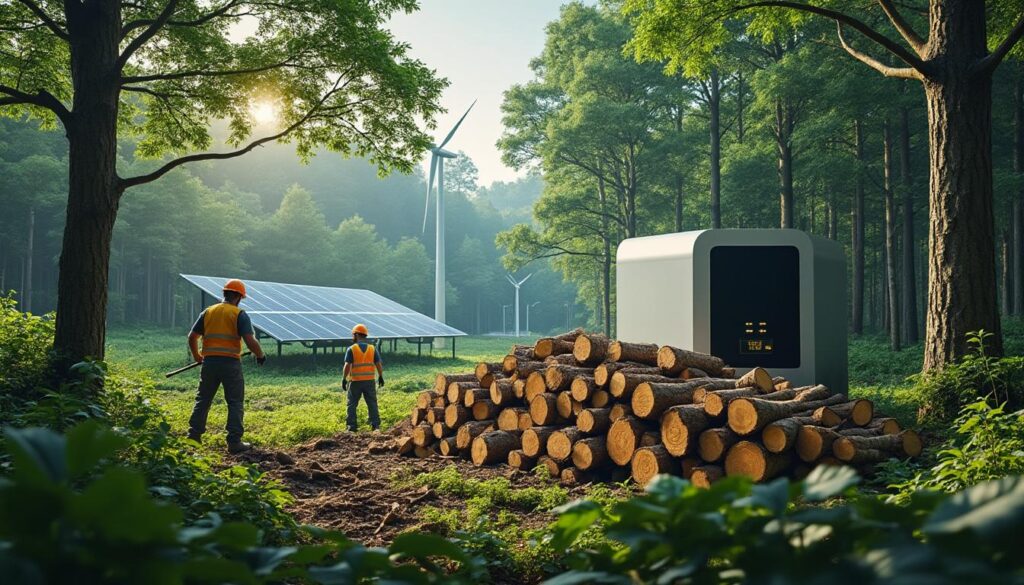
Renewable energy projects need to walk hand in hand with wildlife protection. When most habitats are already modified, the location and design of wind and solar plants make all the difference.
| Short on time? Here are the essentials: ⏱️ | ||
|---|---|---|
| ✅ | Site selection before technology | Prioritize already degraded or productive areas of low ecological value 🌾 to reduce conflicts and lengthy permits. |
| ✅ | Use open data and early screening | Species maps, corridors, and Renewable Acceleration Zones (ZAR) 🔎 avoid delays and disapprovals. |
| ✅ | Design with biodiversity safeguards | Curtailment for birds, agrivoltaics, wildlife crossings, responsible decommissioning ♻️ reduce real impacts. |
| ✅ | Social participation from the start | “Nothing about us without us” 🗣️: clear contracts, fair income, and informed consent reduce conflicts. |
Solar and wind plant projects must preserve biodiversity: territorial planning and ZAR to reduce conflicts
When territory is accurately read, renewable projects become faster, cheaper, and fairer. In Portugal and the European Union, the advancement of Renewable Acceleration Zones (ZAR) emerges as a practical tool to direct investments to areas with lower ecological sensitivity.
This approach addresses a recurring problem: tenders focused only on connection points force proposals in areas where permits cannot subsequently be obtained. Zoning data with areas for species protection, ecological corridors, and cumulative risks change the game, as they guide promoters before the first draft.
Mapping that avoids delays: public information and safer decisions
Conservation institutions have started to provide high-resolution, free, and updatable maps with layers on priority species, habitats, soil carbon, and ecosystem services. This transparency reduces uncertainties and encourages projects on already transformed lands — such as extensive agricultural lands, industrial areas, decommissioned quarries, and logistics parks.
At the same time, treating forests solely as “carbon factories” is a mistake. Assessment should consider biodiversity, water, soil, and connectivity. This integrated view is already imposed on international agendas, bringing together climate and biodiversity commitments.
- 🗺️ Prioritize desktop screening with official layers and citizen science data (eBird, iNaturalist).
- 📍 Define preferred zones based on prior degradation and low diversity.
- 🤝 Combine environmental licensing with local land use pacts.
- 🔁 Apply adaptive management: design, measure, adjust, improve.
| Tool/Rule 🧭 | Purpose 🌱 | Practical advantage ⚙️ |
|---|---|---|
| ZAR (EU) | Delimit areas with low sensitivity | Faster permits and reduced risk ✅ |
| Species maps | Identify biodiversity hotspots | Avoid conflicts before the project 🔍 |
| Ecological corridors | Ensure fauna connectivity | Less mortality and fragmentation 🦔 |
| Soil and water maps | Protect peatlands and wetlands | Avoid hidden emissions and siltation 💧 |
Realistic example: a rural municipality with intensive pastures and inactive quarries. By overlaying maps, a promoter identified 600 hectares without significant natural values, connected to the grid and outside migratory routes. The project was adjusted for an agrivoltaic system with corridors for wildlife and retention basins, reducing impact and accelerating local acceptance.
Key outcome: when planning based on open data, biodiversity is preserved and the energy transition is accelerated.

Smart location: avoid sensitive areas and redesign where biodiversity has already lost ground
With most habitats already modified in several countries, responsible site selection involves three questions: where not to build, where to build with adjustments, and where it’s preferable to concentrate investment. The answer combines science, mapping, and good territorial sense.
Natural reserves, protected areas, Key Biodiversity Areas, and World Heritage sites should be immediately excluded. In extensive agricultural use zones, the solution may be to reconcile agricultural production and energy, maintaining the habitat mosaic and avoiding large “carpets” of panels with no ecological permeability.
Practical screening criteria and micro-locational considerations
For wind farms, adapting the layout to the topography and the predominant wind direction facilitates buffer zones for birds and bats. For photovoltaics, ecological corridors every 200–300 meters, slopes with native flora, and permeable fencing minimize barrier effects.
In both cases, distancing from populated areas, water lines, and cultural sites avoids conflicts. No one wants an iconic ridge covered with equipment: landscape is also heritage.
- 🦅 Avoid migration routes (IBAs, radar/observation data).
- 🌿 Exclude priority habitats (peatlands, dunes, native forests).
- 🏭 Prefer transformed areas (industry, quarries, logistics, agricultural plots).
- 🚫 Set minimum distances from populated areas and cultural sites.
- 🛣️ Utilize existing infrastructures for access and cabling.
| Area 🌍 | Why to avoid ❗ | Viable alternative ✅ | Ecological benefit 🐾 |
|---|---|---|---|
| Parks/Reserves | High sensitivity and connectivity | Brownfields and quarries | No additional fragmentation |
| Migratory routes | Collision/mortality risk | Micro-siting outside the corridor | Less critical stopovers |
| Peatlands and floodplains | Carbon and water regulation | Poor agricultural soils | Avoid soil emissions |
| Iconic landscapes | Visual and social impact | Industrial zones | Community acceptance |
An illustrative case: in a cereal plain, a promoter intended to build an 80 MW wind farm. The radar and observation study identified crane passage in two valleys. Repositioning three turbines and creating a 1.5 km corridor eliminated the conflict and reduced the risk of collisions. The extra CAPEX for cables was compensated by faster licensing.
Whenever possible, reconciling with agricultural uses and maintaining mosaics of native vegetation guarantee energy and life. This is the basis for a development that does not compromise natural heritage.
Design and operation measures that enhance biodiversity in solar and wind plants
There is a set of technical solutions that, when incorporated from the outset, reduce impacts and even generate net biodiversity gains. The key is to integrate engineering, ecology, and maintenance with clear goals and continuous monitoring.
For wind farms, operational adjustments during critical migration windows or low winds save thousands of birds and bats over the life of the plant. For solar plants, terrain design and appropriate vegetation transform energy platforms into refuges for pollinating insects and small vertebrates.
From paper to the field: solutions that work
The measures below are already practiced in successful projects and have a proportionally low cost compared to the environmental gain and reduction of reputational risk. It is advisable to contract each one, with defined indicators and responsibilities.
- 🛑 Seasonal curtailment and “shutdown-on-demand” during migration peaks.
- 🌬️ Adjust cut-in speed to reduce bat mortality.
- 🕳️ Wildlife passages under internal roads and permeable fencing.
- 🌼 Strips of native flora and extensive maintenance (light grazing).
- 💧 Retention basins and swales to control runoff and sediments.
- 🔧 Decommissioning and recycling plan with financial surety.
| Measure 🔩 | Application ⚡ | Impact on biodiversity 🐝 | Relative cost 💶 |
|---|---|---|---|
| Targeted curtailment | Wind farms | Reduces bird collisions | Medium (software/monitoring) |
| Higher cut-in speed | Wind farms | Decreases bat mortality | Low to medium |
| Corridors and native flora | PV plants | Increases pollinators | Low |
| Swales and basins | Both | Protects water lines | Low |
| Decommissioning with surety | Both | Prevents environmental liabilities | Medium |
Case study: in a 50 MW photovoltaic project in a low-productivity agricultural area, the promoter replaced gravel with native vegetation, created 6 m free strips every 250 m, and implemented rotational grazing. In two years, the presence of pollinators and insectivorous birds doubled. OPEX decreased by swapping mowers for ecological management.
At any latitude, the principle is the same: design to produce energy and restore ecological functions.
Social-environmental safeguards: fair contracts, informed consent, and conflict prevention
The energy transition is only legitimate when it also benefits those living in the territories. Guidelines created by affected communities and independent organizations solidified objective safeguards: contractual transparency, fair income, free and informed consent, grievance mechanisms, and return of local benefits.
In countries with strong expansion, legislative proposals have emerged to protect smallholders and traditional communities, establishing deadlines, contractual limits, and prohibitions on abusive clauses. The goal is simple: clean energy without predatory practices.
How to ensure an agreement that respects people and nature
Promoters who arrive early, listen, and share information clearly manage risks and gain legitimacy. Open meetings, public records, printed maps, and accessible language replace distrust with cooperation. Participation in all phases reduces litigation and accelerates the project.
- 📝 Clear contracts explained in community assemblies.
- 💶 Leasing with fair income and transparent adjustments.
- 🏫 Local benefits: technical training, useful works, social energy.
- 📣 Independent grievance channel with response in a defined timeframe.
- 🧭 Free and informed consent before final licenses.
| Recommended clause 📜 | Community benefit 🤝 | Error to avoid ⚠️ |
|---|---|---|
| Total contract transparency | Trust and predictability | Opaque confidentiality |
| Income with fair indexing | Protects purchasing power | Excessive terms without review |
| Grievance mechanism | Resolves conflicts early | Response without timeframes |
| Local benefits plans | Support for public services | Vague promises |
Practical example: in a wind farm in northeastern Brazil, the community established an agreement with tiered income, a fund for water and sanitation, and a priority for local employment. The project advanced with less resistance and more local pride. When the project respects those in the territory, biodiversity protection gains allies.
Monitoring, open data, and net biodiversity gains: measuring for continuous improvement
Once implemented, the project does not end: the decisive phase begins. Independent monitoring, open data, and adaptive management ensure that the agreed goals are met. Acoustic sensors, thermal cameras, drones, and citizen science form a network of evidence that guides seasonal and structural adjustments.
The recommended strategy is to define Key Biodiversity Indicators (KBIs), goals, and action triggers. If bird mortality exceeds the threshold, curtailment is activated; if native flora does not establish, management is adapted; if erosion occurs, basins and slopes are reinforced. All with public records and external audits.
Monitoring plan that works in practice
To work, the plan needs a calendar, responsibilities, replicable methods, and publication. Open platforms and institutional portals reduce information asymmetry and generate trust. Publicizing the data also inspires other projects to improve.
- 📅 Annual calendar with migration and breeding windows.
- 🧪 Standardized methods (transects, fixed points, protocols).
- 🌐 Public portal with reports and databases.
- 🧭 Clear and automatable management triggers.
- 🔁 Periodic independent audits.
| Indicator 🧿 | Method 🔬 | Frequency ⏳ | Trigger/action 🚦 |
|---|---|---|---|
| Bird mortality | Standardized inspections | Weekly during migration | Immediate curtailment |
| Bat activity | Ultrasonic detectors | Seasonally nocturnal | Increase cut-in speed |
| Native flora coverage | Transects and photo points | Quarterly | Adapted reseeding |
| Water quality | Turbidity measures | After heavy rains | Redo swales/basins |
An operator that publishes data on an open portal, invites universities for independent analyses, and adjusts operations demonstrates real commitment. Society notices when there is transparency and when there is only marketing. And reference platforms, such as Ecopassivehouses.pt, help citizens understand the essentials: clean energy and biodiversity can grow together if the territory is the starting point.
The final message to take to any project is simple: choose the right place, design with nature, and always measure — this is how energy is produced without impoverishing life on the planet.
Source: www.publico.pt