The United States announced the suspension of five major offshore wind energy projects on the East Coast, citing reasons of national security and potential interference with radars. The decision, announced on December 22, 2025, reignited the debate between energy innovation, defense, and regulatory stability.
| Short on time? Here’s the gist: ⏱️ | |
|---|---|
| ✅ Point | Summary |
| ✅ Key decision ⚖️ | Suspension of 5 offshore wind projects due to alleged radar interference and risks to national security. |
| ✅ Affected projects 🌊 | Revolution Wind and Sunrise Wind (Ørsted), Vineyard Wind 1 (Avangrid/CIP), Coastal Virginia Offshore Wind (Dominion) and Empire Wind 1 (Equinor). |
| ✅ Good practice 🧭 | Design parks with radar corridors, low reflectivity materials, and mapped emergency routes with the Pentagon. |
| ✅ Error to avoid 🚫 | Ignoring electromagnetic compatibility studies in the licensing phase and early technical dialogue with Defense. |
| ✅ Bonus 💡 | While the megaprojects await, reduce home consumption with efficiency, self-consumption, and smart load management. |
Suspension of offshore wind projects in the U.S.: what changes for the energy transition
The suspension affected Revolution Wind and Sunrise Wind (Ørsted), Vineyard Wind 1 (Avangrid/Copenhagen Infrastructure Partners), Coastal Virginia Offshore Wind (Dominion Energy) and Empire Wind 1 (Equinor). These enterprises form the heart of the first major offshore wind corridor in the United States, with contracts and infrastructures at advanced stages, from monopile foundations to export cables.
The Department of the Interior explained that the measure addresses complaints from the Pentagon: large-scale blade movement and highly reflective towers could create echoes on radars and confuse coastal surveillance systems. The suspension was presented as a “window of time” to negotiate mitigation with lessees and states. For the market, however, the news was immediate: shares of Ørsted fell by more than 12% on the day, with Dominion and Equinor also declining.
The political reactions were strong. The governor of New York, Kathy Hochul, classified the decision as unjustified, recalling the skilled jobs and the industrial chain built in the region. In Congress, Democrats leading energy and environment committees warned: they will only support a licensing reform in 2026 if the setback on offshore wind is reversed. States like Connecticut, via Attorney General William Tong, are assessing legal measures.
For consumers, the immediate impact is not a blackout, but a shakeup in cost trajectories. Dominion emphasized that the Virginia park was already a centerpiece for the reliability of the grid serving military bases and major artificial intelligence data centers. Ørsted estimated delivering energy to about 1 million homes in three states starting next year. Without these “blue electrons,” local systems may remain more exposed to volatile natural gas and price spikes.
Recent history helps to read the moment. There had been previous stop orders — like on Revolution Wind — reversed by federal judges. Empire Wind even resumed after talks with New York and the green light for a pipeline. This push-and-pull regulatory environment generated uncertainty: Ørsted raised $9.4 billion to support projects in the U.S. in an adverse environment, a financial cost that translates into tariffs more sensitive to delays.
Amid the noise, a distinction is essential: radar risk does not eliminate the viability of offshore; it points to design and coordination gaps that need a clear pathway. When geometries, materials, and layouts are adjusted to the defense ecosystem, turbines can coexist with radars, patrol routes, and air corridors. The debate, therefore, is not “if,” but “how and where.”
Key idea: the suspension is a temporary brake that highlights the need for technical integration with defense and networks, without negating the role of offshore in coastal decarbonization.
National security and radar interference: how to align defense and clean energy
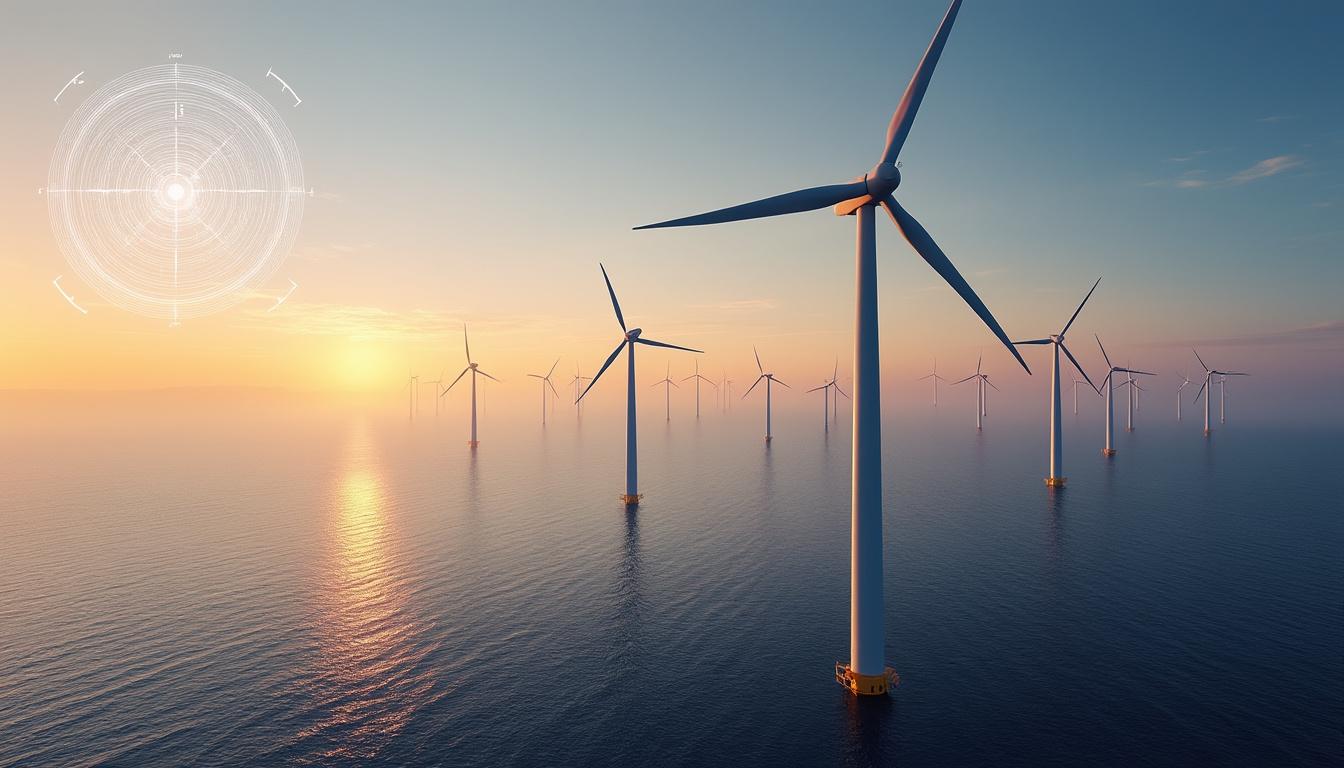
Surveillance fleets operate with radars of different bands and detection algorithms. Blades over 100 meters, with high radar cross-section (RCS), generate signatures that can be confused with low-altitude targets. Add to this the towers that function like reflectors, creating a “noise” that degrades the operator’s image. The good news: there are mitigation pathways tested in Northern Europe and the North Sea.
Technical mitigation strategies
First, micro-siting and radar corridors: design “windows” free between turbine clusters for clean beam passage, respecting sight lines of military installations. Second, low electromagnetic reflectivity materials and coatings for nacelles and towers, reducing RCS. Third, software and filters in radar, with dynamic echo models that “know” the park and discount repetitive signatures.
Governance and protocol with Defense
It’s not just engineering. An operational protocol defines emergency routes, prior alerts for maintenance, asset database, and controlled access to telemetry. In North Sea projects, with the Navy and Coast Guard, this coordination shortens licenses and reduces litigation. The same can be replicated on the East Coast, integrating navies, FAA, Coast Guard, and regional operators (ISOs).
Practical example
Imagine a corridor between Revolution Wind and Sunrise Wind shifted 5 degrees south, freeing the line of sight of a coastal radar. This reduces echoes, allowing detection of low-flying drones, which were cited as additional concerns by federal authorities. In parallel, a pilot program of RAM coating on 10 towers can quantify the gain in dB and calibrate future requirements without stalling the entire portfolio.
If the question is “is it worth it to adapt?”, the answer is affirmative when systemic benefits are observed: fewer emissions near urban hubs, more price stability, and a layer of security built hand in hand with Defense. The additional cost dilutes in scale and saves years of uncertainty.
Key idea: radar and offshore wind are not incompatible; they require detailed engineering, clear protocols, and institutional commitment for smooth migrations.
Economic and industrial impact: jobs, factories, and electricity bills under suspension
The U.S. offshore wind ecosystem gained traction: shipyards for jackets, underwater cable factories, assembly terminals in ports like New Bedford and Norfolk. A portfolio suspension increases the risk of line shutdowns, loss of skilled labor, and cost increases due to “waiting costs.” Companies that structured debts and orders become exposed to financial timing.
The effect on the final tariff is indirect, but real. When schedules slip, the cost of capital rises, and supply contracts may require renegotiation. In the short term, this preserves greater reliance on fossil gas — sensitive to international shocks — maintaining volatility. Dominion warned that the grid’s reliability in Virginia suffers, including for critical loads like data centers and military facilities that require firm and clean energy.
On the other hand, political and market pressure can accelerate solutions. If dialogue with the Pentagon becomes a national “compatibility checklist,” subsequent projects enter better sized, with less litigation and more reliable schedules. Investors price predictability; each clear rule removes percentage points from the cost of capital.
Case study: a nacelle manufacturer in Rhode Island negotiated flexible shifts and retraining to maintain teams during a previous freeze. Talent retention avoided months of rehire when construction resumed after a court decision. In parallel, an assembly port adapted layout to incorporate RCS tests still on land, shortening commissioning at sea.
For families and small businesses, the message is pragmatic. Tariffs do not spike overnight, but each delay in clean infrastructure postpones the buffering effect against peaks. Coastal states with decarbonization targets will see goals pressured, and this may delay savings that would come from stable offshore megawatts combined with storage.
- 🔌 Track your bill composition: check the weight of gas vs. renewables and identify where to act.
- 🛠️ Take advantage of local incentives for thermal insulation, heat pumps, and solar panels — they mitigate system uncertainties.
- 📈 If you are a facility manager, evaluate virtual PPAs and demand response to reduce exposure to peaks.
Key idea: regulatory predictability is as valuable as installed megawatts; it stabilizes chains, jobs, and your electricity bill.
While megaprojects wait: concrete steps for a more efficient and resilient home
Large wind farms are essential but do not replace domestic measures that reduce consumption, strengthen comfort, and lower emissions. A neighborhood in Providence, for example, structured a “efficiency micro-route”: three simple steps that any family can replicate without deep renovations and with quick returns.
Step 1: seal invisible losses
Sealing around window frames, correcting leaks, and thermal curtains reduce heating and cooling loads. Community teams trained neighbors to do the “incense test”: a stick near cracks reveals drafts. Low costs, immediate gains.
Step 2: efficient heating and cooling
Replacing old systems with inverter heat pumps increases COP and reduces peaks on the grid. In the cold climates of New England, low-temperature models already operate with remarkable efficiency. The combination with smart thermostats shifts consumption to off-peak hours.
Step 3: strategic self-consumption
Roofs with photovoltaics and small residential batteries create resilience. Even without additional offshore, the sum of thousands of roofs reduces pressure on the system. In coastal cities, “community solar” programs help those without their own area.
For those looking to go further, there’s the trio of “low risk, high return”: replacing bulbs with LED, weatherproofing doors, and adjusting water heating to 50–55 °C. In six months, an average family sees a drop of 10–20% in consumption, which offsets part of the systemic uncertainty brought by large-scale suspensions.
No matter what the short-term future holds for offshore, an efficient home remains the fastest and safest buffer. Key idea: efficiency and self-consumption are the “first power plant” of your home — they deliver today the gains that big projects will bring only tomorrow.
Regulatory and design lessons: accelerating with legal certainty and smart design
The recent American experience shows three lessons that deserve to be integrated into the clean infrastructure development cycle. The first is to incorporate electromagnetic compatibility assessments into the EIA/RIMA from the beginning, mapping radars, routes, and lines of sight. The second is a standard memorandum of understanding between promoters and Defense, with defined KPIs and deadlines. The third is data transparency on public portals, to reduce litigation and increase social trust.
On the design front, portfolios with distributed clusters and internal distances modulated by radar corridors tend to be licensed better than continuous blocks. Materials with lower RCS should migrate from pilots to reference specifications. And operators can hire “shadow teams” of cybersecurity and aviation to validate risk scenarios beyond the radar, such as drone swarms, also cited by authorities.
It is worth highlighting the role of cities and ports. Assembly terminals that integrate electromagnetic testing yards and air traffic simulation offer practical evidence before any seabed drilling. Early tests avoid last-minute surprises and build bridges with local military institutions.
Within a horizon of 12–18 months, a clear pipeline with mitigation milestones and joint audits would allow projects to resume without sacrificing safety. This is the point of convergence: predictability for investors, robustness for Defense, and benefits for consumers. Offshore wind does not need to be completely halted; it needs to be better integrated into the American coastal context.
Key idea: legal certainty stems from clear rules and applied engineering; when both move together, projects advance and society reaps the benefits.
Source: www.publico.pt