New England is preparing a joint auction for offshore wind energy with expectations of record participation, mobilizing experienced developers and a mature supply chain after a strong recovery in the sector in 2024.
For those observing the energy transition through the lens of efficient housing, this move can mean more stable, predictable, and clean electricity, driving heat pumps, low-consumption buildings, and energy-resilient neighborhoods.
Short on time? Here’s the gist:
| ✅ Key Points ⚡ | Why It Matters 🧭 |
|---|---|
| ✅ Large participation in the MA-CT-RI joint auction | Attracts Iberdrola/Avangrid, Engie, Orsted, and partners like CIP, increasing competition and the quality of proposals 💼 |
| ✅ Mature projects ready for re-offering | Park City (804 MW) and Commonwealth (1,232 MW) can move forward with more realistic contractual conditions 🏗️ |
| ✅ Benefits for efficient homes | More stable rates and integration with heat pumps, storage, and smart charging 🚗🔋 |
| ✅ Applied European lessons | Two-phase models and CfD-type contracts help to lock in costs and reduce risks, as already seen in the UK 🇬🇧 |
Offshore Wind Energy Auction in New England: Why Participation Will Be Record-Breaking
The joint auction prepared by Massachusetts, Connecticut, and Rhode Island arises from a practical realization: regional cooperation is the most efficient way to unlock projects, share port infrastructures, and negotiate supply contracts with lower risk. After 2023 was marked by cancellations and estimated accounting losses of about $9.1 billion across various markets, 2024 brought a turning point in the U.S., with accelerated construction and the first energy from Vineyard Wind 1 recorded in January.
In this new context, proposals from experienced European groups are expected: Avangrid/Iberdrola, Engie, Orsted, and partnerships with funds like Copenhagen Infrastructure Partners (CIP). There is also interest from companies like BP and EDP, which have signaled eligible projects for the region’s contracting windows. By federating demand, the trio MA-CT-RI reduces regulatory fragmentation, adds scale, and creates conditions for more competitive pricing.
Two projects that symbolize this rebirth are Park City (804 MW) and Commonwealth Wind (1,232 MW), both from Avangrid, whose re-offer with adjusted financial parameters could restore traction to the timelines. The very delivery of Vineyard Wind 1 — about 806 MW and an approximate investment of $4 billion — demonstrates the concrete advancement of engineering, logistics, and assembly ports along the New England coast. For reference, on average, 1 MW of offshore wind powers about 500 homes in the U.S., providing a direct metric of the potential impact on local communities.
Not all recent experiences have been linear. Orsted, a global leader, maintained projects in New England, but canceled contracts in other states (New York, New Jersey, and Maryland) due to chain cost shocks: higher steel prices, logistical restrictions, and elevated interest rates. These lessons prompted improvements in contractual design and strengthened risk mitigation. Today, proposals tend to include more realistic price scaling, adjustment clauses, and phased timelines, reducing the likelihood of breakdowns.
Another factor increasing participation is the maturity of the regional supply chain. Ports like New Bedford and facilities at Quonset Point have been re-equipped to receive large nacelles, blades, and towers. Safety and qualification training (GWO) creates a local workforce ready for offshore operations. With fierce competition and ready logistical assets, the auction is likely to attract solid bids, with credible timelines and commitments to local content balanced with industrial reality.
Lastly, there is the climatic and regulatory dimension. The demand for electric decarbonization and more ambitious state goals align with the joint auction. Integration with grid and shared coastal transmission initiatives dilutes bottlenecks. This combination of factors — cooperative governance, technical maturity, and a stable demand horizon — explains why participation should be broad and qualitative. In summary, there is fertile ground for a virtuous cycle of trust, pricing, and delivery.
For the reader, the practical point is clear: the more competition and maturity of projects, the greater the likelihood of more predictable energy and new opportunities for efficient buildings to take advantage of this stability.
Offshore Wind Energy and Efficient Housing: How It Translates to Your Bill and Comfort
A robust auction in New England is not just a sector topic: it directly reflects on the comfort and cost of living for those living in new, rehabilitated, or multifamily buildings. More predictable electricity prices allow for planning investments in heat pumps, high-performance insulation, and mechanical ventilation with heat recovery without the fear of extreme volatility. The practical consequence? More thermal comfort, better indoor air quality, and lower emissions.
Heat Pumps, Time-of-Use Rates, and Wind at Sea
Heat pumps work best when integrated with time-of-use rates and a stable supply. With offshore wind, the production curve at night and seasonally aligns with heating needs during many cold periods. By programming the heat pump to preheat the house during lower price windows, it is possible to reduce consumption peaks and smooth out bills. In condominiums, the same reasoning applies to common areas, indoor pools, and garages with electric vehicle charging.
Home Storage and Smart Management
Small residential batteries and thermal storage hot water systems act as buffers. During hours of high wind production, it is feasible to charge batteries or heat water tanks, using this energy during times of lower wind. Smart meters and management applications already allow for automating the process with simple rules. In passive buildings, this synergy is even more effective, as thermal inertia and an efficient envelope extend comfort for more hours without resorting to power peaks.
Practical Example: “Atlantic House” in Providence
Imagine a four-apartment building in Providence, rehabilitated with additional insulation on the envelope, triple-glazed windows, and air-water heat pumps. The condominium management adopts a plan with: time-of-use rates, shared chargers for bikes and electric cars, and a central boiler with a 500-liter reserve. During windy nights, the house preheats the apartments and the boiler; in the morning, the 10 kWh battery covers the breakfast peak. Result: constant comfort, lower mechanical noise, stabilized bill, and a significantly lower carbon footprint.
In summary, offshore wind is not just a pretty picture on the horizon. It is a concrete tool for efficient housing to reach its full potential, ensuring stable comfort and controlled costs, with real gains for families and communities.
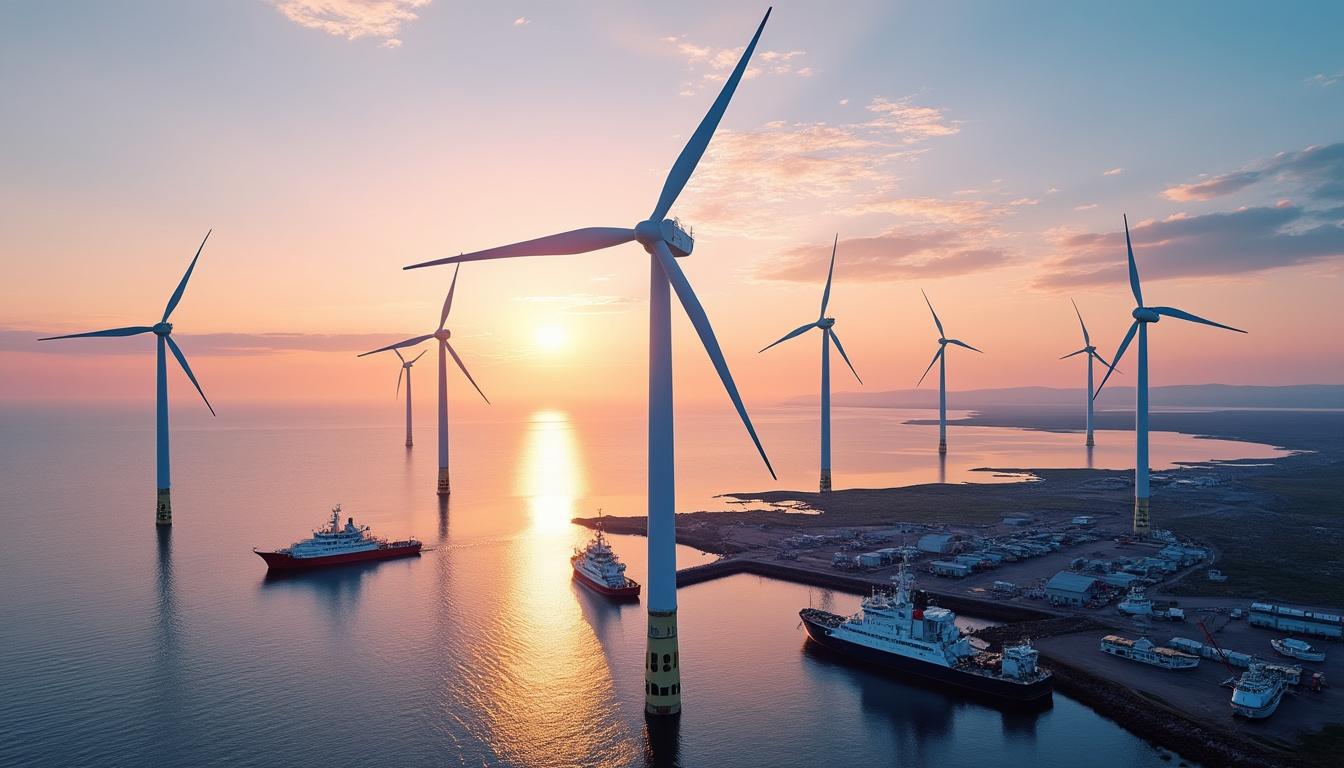
To understand the assembly stages and the operating windows that influence energy availability, it’s worth exploring audiovisual materials that showcase docks, installation vessels, and logistics of blades and nacelles in ports like New Bedford.
Auction Models and Applied European Lessons for New England
The best offshore auctions balance competition with risk management. In Europe, there has been a consolidation of the use of contracts for difference (CfD), which set a reference price for the energy sold, protecting both consumers and developers against volatility. In parallel, some countries have adopted auctions in two phases: first, rights to the seabed; then, supply contracts. This separation clarifies responsibilities, accelerates licensing, and avoids overlap of risks.
The UK, for example, achieved significant results, with an auction securing around 8.4 GW in new capacity and competitive prices. When this type of design is well-calibrated, the supply chain gains predictability, facilitating investments in tower, blade, and cable manufacturing. On the consumer side, CfDs act as a “buffer” against prices, reducing tariff shocks and ensuring levelized costs over the project life cycle.
How does this translate in the MA-CT-RI reality? The region learned from the turbulence of 2023 that static contractual clauses, disconnected from steel costs, logistics, and financing, tend to fail. The new windows emphasize phased timelines, openness to conditioned adjustment mechanisms, and prior integration with grid planning to avoid bottlenecks at the coast. The clearer the roles between those who obtain the seabed area, those who build, and those who sell the energy, the smoother the execution.
There is also the topic of local content. It is desirable for ports, shipyards, and assembly centers to multiply jobs and regional technical skills. However, rigid targets disconnected from current capacity can increase project costs and delay deliveries. The balance lies in progressive targets, incentives for training, and multi-year supply contracts that instill confidence in manufacturers and subcontractors.
For the reader interested in efficient buildings, the message is direct: stable contracts and a predictable industrial chain help to lock in the cost of electricity that will heat homes with heat pumps in the coming decades. Well-designed auctions today mean affordable comfort tomorrow.
For those wishing to delve into the contractual design and engineering behind offshore parks, content on “CfD offshore wind UK” and risk analyses may be particularly useful for comparison with the reality of New England.
Supply Chain, Ports, and Green Jobs: Economic Activation from the Auction
The success of an auction in New England depends on the strength of ports, logistics, and technical training. New Bedford, with reinforced docks for heavy loads, and Quonset Point, with a track record in component assembly, have already proved capable in recent installation campaigns. When the auction points to a consistent pipeline of projects, these infrastructures plan shifts, contracts, and equipment with greater confidence, reducing costs and delays.
On the ground, this translates to skilled jobs: turbine technicians, divers, high-voltage electricians, crane operators, captains, and specialized crews. The international safety standard (GWO) has been the reference, and regional training programs make the local workforce more competitive. Each installed turbine mobilizes a long supply chain: steel, composites, submarine cables, offshore substations, O&M logistics, specialized insurance, and environmental monitoring.
The experience of 2023 provided a warning: fragmented global supply chains and peaks in steel and maritime transportation costs can collapse margins. In response, manufacturers and developers opened fronts for long-term contracts with critical suppliers and dual-sourced solutions for sensitive components. At the same time, there is a movement toward light reindustrialization around ports, with final assembly closer to the installation site to mitigate logistical risks.
For sustainable construction on land, this dynamism has positive side effects. Companies that learn to manage quality, timelines, and safety in offshore projects transfer practices to efficient buildings, from just-in-time logistics to digital modeling of works. Materials such as engineered wood and low-carbon concretes come into the spotlight, as the pressure to reduce emissions reaches the entire built environment chain. It is a virtuous cycle: clean energy fueling greener factories, which in turn provide solutions for low-consumption homes and neighborhoods.
Cooperation between states also stimulates complementary investments in transmission and large-scale storage. Coastal interconnections, conversion hubs, and upgrades to substations improve the quality of supply for cities and residential areas. When the grid is improved, connected buildings reap the benefits: fewer micro-outs, less need to oversize equipment, and more stability for the operation of heat pumps and efficient ventilation.
The final insight here is simple: auctions that generate a reliable pipeline activate green jobs, consolidate skills, and drive innovation throughout construction. The sea wins, the land wins, and families expecting comfort with controlled bills win.
How Consumers, Municipalities, and Designers Can Prepare Now
As offshore wind consolidates, there are immediate decisions that reduce costs and enhance the comfort of homes. Below, a set of practical steps that align the house with the clean electricity that will arrive on a larger scale:
- 🔧 Plan for electrification: prioritize efficient heat pumps, induction stoves, and water heating with high COP.
- 🧠 Adopt smart management: set up simple automations during lower-cost hours to preheat or charge batteries.
- 🔋 Consider storage: residential or thermal batteries act as buffers for wind variability.
- 🪟 Optimize the envelope: insulation, airtightness, and efficient windows amplify the effect of each clean kWh.
- 🏘️ Coordinate in the condominium: sharing chargers, collective rates, and usage rules reduce peaks and conflicts.
- 📊 Monitor: track consumption and temperatures; small adjustments yield significant savings.
- 🤝 Talk to the municipality: encourage plans for microgrids, charging hubs, and incentives for energy rehabilitation.
Municipalities can map critical buildings (schools, health centers) to integrate backup systems with batteries and demand response contracts. Designers have the opportunity to specify ventilation with heat recovery, shading, and low-impact materials, aligning architecture and energy. For everyone, the watchword is to prepare the house to operate flexibly, taking advantage of an increasingly clean and stable grid.
If there is one simple action to take today, it is to check the rate plan and install a smart timer to adjust non-critical loads to the cheapest hours. Small steps, big results — especially when the wind outside is blowing in favor.
Source: finance.yahoo.com