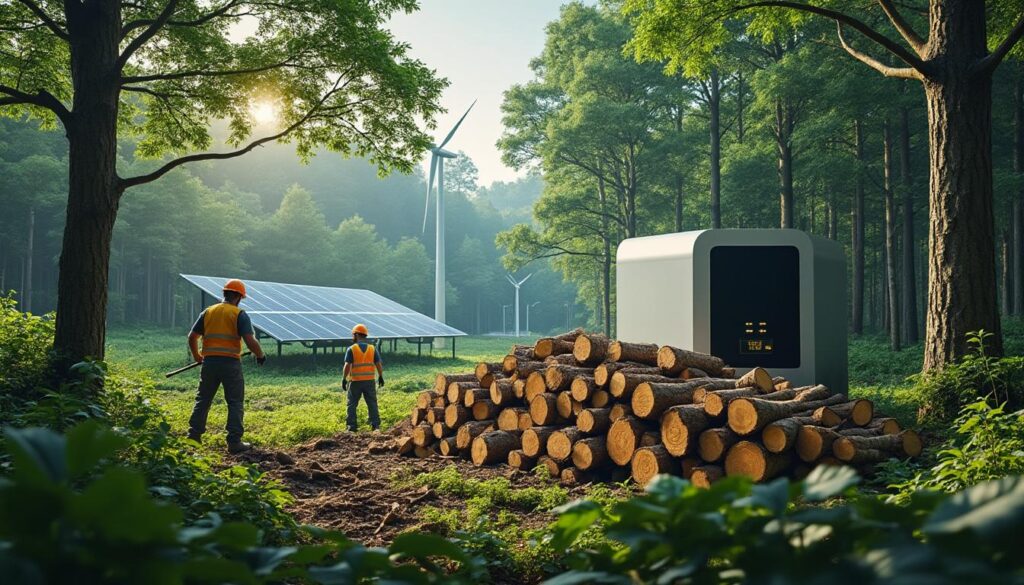
The expansion of BioSmart’s UPAC in São Bartolomeu de Messines is a clear example of how the industry can accelerate the energy transition with well-founded technical decisions.
This advancement reinforces renewable energy production in the Algarve and demonstrates that efficiency, operational stability, and emission reduction can go hand in hand with common sense and concrete results.
| Short on time? Here’s the gist: |
|---|
| ✅ Capacity expanded to 94.44 kWp ⚡ — over 40% of electricity needs covered by photovoltaic 🌞 |
| ✅ 114 new panels 🧩 — expansion from 23.76 kWp (2020) to an optimized self-consumption system 📈 |
| ✅ Less 21 tCO₂/year 🌍 — equivalent to ~548 trees 🌳 in carbon capture |
| ✅ Cost stability 💶 — less exposure to electric market volatility and greater operational predictability |
Expansion of UPAC in São Bartolomeu de Messines: 94.44 kWp for self-consumption with immediate impact
In São Bartolomeu de Messines, BioSmart completed the expansion of its Self-Consumption Production Unit (UPAC), raising the installed capacity to 94.44 kWp. The leap is significant when compared to the previous system, active since July 2020, with 23.76 kWp. This enhancement comes with the installation of 114 photovoltaic panels, configured to maximize self-consumption in an industrial setting and reduce losses from grid injection.
The sizing was fine-tuned to the load curve of the production center, prioritizing the solar hours of highest activity. The result? More than 40% of the electrical needs are now met with clean energy, providing technical and financial benefits that translate into lower carbon intensity per ton of material valued. Practically, the operation gains robustness and predictability at a time when electricity in the wholesale market remains volatile.
To make this tangible, imagine the routine of Marta, operations manager at EcoParque. Previously, the peaks of ventilation and process control relied entirely on the grid. Now, the periods of highest irradiation cover a good part of these consumptions with photovoltaics, reducing costs and background noise in daily management. With real-time monitoring, the team can align intensive tasks — such as aeration, pile transfer, and biofilter management — with windows of higher solar production.
What changes with the new UPAC
An industrial UPAC is not just a set of panels on a roof. It is a system that communicates with the operation, optimizing flows and consumptions. When well-designed, it reduces payback time and increases energy resilience. The expansion in Messines follows this principle: it generates during the day what the unit needs most and reduces reliance on fossil electricity.
- 🌞 Effective solar coverage: panels oriented to maximize production during peak hours.
- 🧠 Active consumption management: adjusting aeration and ventilation to solar windows reduces grid peaks.
- 🔌 Less unpaid injection: total priority to self-consumption for economic efficiency.
- 🛠️ Predictable maintenance: seasonal plans to ensure performance above expectations.
- 📊 Measurement and verification: production/consumption dashboards facilitate quick decisions.
This is the type of intervention that creates operational and environmental value at the same time. And when the load curve “embraces” the solar curve, the result is real efficiency, not just rhetoric.
| Indicator 🔎 | Before (2020) ⏳ | Now 🚀 | Key Benefit ✅ |
|---|---|---|---|
| Installed capacity | 23.76 kWp | 94.44 kWp | More solar production during peak hours ⚡ |
| No. of panels | — | 114 | Simplified modularity and maintenance 🔧 |
| % electric needs | — | > 40% | Less dependence on the grid 🔌 |
| Operational integration | Basic | Optimized | Better load/solar alignment ☀️ |
In summary: the new UPAC is not just more power; it is more intelligence applied to the daily operation of the unit.

BioSmart’s renewable energy reduces emissions and reinforces decarbonization goals
The reinforcement to 94.44 kWp translates into less 21 tons of CO₂ per year compared to the reference scenario. For those looking for concrete imagery, this value is equivalent to the contribution of about 548 trees in terms of carbon capture. More than numbers, it involves an industrial operation with a progressively smaller footprint, aligned with national decarbonization goals and the technical common sense of consuming where it is produced.
This environmental gain has a direct reflection on reputation and regulatory compliance. Units that process organics and value waste already deal with demanding emissions and environmental performance criteria. Reducing indirect emissions associated with purchased electricity (Scope 2) is a quick and measurable way to improve overall performance, focusing on process priorities: quality of the compost, odor control, and energy efficiency.
Why 21 tCO₂/year makes a difference
In the context of continuous operations, 21 tons per year represent a consistent reduction, repeated every year of the system’s lifespan. Considering a typical lifespan of 20 to 25 years, the accumulated contribution is significant, especially when combined with other measures, such as high-efficiency motors and intelligent ventilation control. And when the marginal cost of reduction per ton compares favorably with other measures, the UPAC becomes a “cornerstone” of the climate strategy.
- 🌍 Direct impact: less Scope 2 emissions without altering process quality.
- 📉 Facilitated ESG reporting: clear and auditable metrics on an annual basis.
- 🌳 Understandable equivalences: trees and kilometers not traveled help communicate internally.
- 🔁 Compound effect: gains accumulated over decades of operation.
- 🧩 Synergies: combinations with motor efficiency and variable speed drives.
In a hypothetical internal study that Marta uses to communicate results to the team, the table below helps translate environmental benefits into language accessible to different departments:
| Metric 🌱 | Estimated Value 📏 | Visual Equivalence 👀 | Note 📌 |
|---|---|---|---|
| Avoided emissions | ≈ 21 tCO₂/year | 🚛 ~150,000 km avoided in a light vehicle | Based on average emission factors |
| Tree equivalence | ≈ 548 trees | 🌳 Symbolic urban reforestation | Supports communication with the community |
| Clean energy generated | Variable by irradiation | ☀️ Peaks during central hours | Maximizes local self-consumption |
For those who wish to delve into how industrial UPACs operate and good integration practices with processes, technical videos and real demonstrations can be useful.
By observing comparable cases, it becomes easier to plan improvements such as: adjusting operating windows, integrating inverters and reviewing the positioning of the inverters to optimize cabling and losses.
Energy autonomy and cost stability: less volatility, more predictability
In practice, the expansion to 94.44 kWp means reducing the “exposure” to fluctuating electricity prices, especially at critical hours. Even with indexed tariffs that may benefit from occasional low prices, predictability is an operational trump card. The UPAC delivers electricity when the sun rises — and the operation knows this in advance. Thus, management adjusts energy-intensive processes, reducing average costs and smoothing peak procurement.
The combined effect of self-consumption and load management translates into better utilization of photovoltaics. In scenarios studied by Marta’s team, simply relocating intensive aeration tasks to the 10am–4pm window brought clear reductions in energy acquired from the grid, without compromising the quality of the compost. When the operational calendar is friendly to the sun, the system performs better, without additional costs.
Best practices to extract value from self-consumption
Self-consumption is more than just installing panels; it is daily practice. And small changes bring big gains. A quarterly preventive maintenance plan, an annual review of the electrical layout, and operator training for data reading create habits that, at the end of the year, translate into savings and stability.
- 📅 Load planning: concentrate intensive tasks during sunny hours.
- 🧭 Active monitoring: use alerts to adjust production/consumption deviations.
- 🔋 Explore future storage: evaluate batteries when the nighttime curve justifies.
- 📐 Layout review: minimize shading, optimize tilt.
- 👩🏫 Team training: read data and decide based on indicators.
To support decisions, a scenario framework helps visualize how the operation responds to different consumption profiles. Let’s see a useful simplification for internal alignment:
| Scenario 🔮 | Self-consumption ⚡ | Electric expense 💶 | Operational tip 🧩 |
|---|---|---|---|
| Base without optimization | Medium | Average | Map peaks and move tasks to 10am–4pm ⏱️ |
| With load optimization | High | Low | Daily coordination between operation and energy 🤝 |
| With battery (future) | High/night | Low/stable | Feasible if significant nighttime consumption exists 🌙 |
Between predictability and cost, the right balance comes from reliable data and operational discipline. This is how the UPAC becomes a “shield” against market volatility.
EcoParque Algarve: synergies between solar energy, composting, and odor control with biofilter
BioSmart operates in the Algarve a unit for treating organic matter often referred to as EcoParque Algarve, with a composting greenhouse and biofilter for treating processed air. The air is put under negative pressure and guided entirely to the biofilter, significantly reducing odors and improving relations with the surroundings. This infrastructure, associated with treatment and valorization contracts — including sewage sludge managed in the region — requires continuous and reliable electricity.
In this context, the expanded UPAC provides clean electricity for ventilation systems, aeration, and environmental control, mitigating base consumption that would otherwise depend on the grid. When the energy needed to move air in the composting process is produced on-site, the energy ratio per treated ton decreases and the operation becomes more competitive. The synergy is direct: the more efficient the air and pile treatment process, the more valuable the locally generated kWh from the sun.
Refined process and practical benefits
With photovoltaic expansion, Marta reorganized the aeration routine, maintaining the quality of the compost and reducing energy purchases during expensive periods. The fans and control systems operate under a “solar-first” logic: during hours of highest radiation, higher load tasks are prioritized; in the remaining hours, only the necessary minimums are maintained. The biofilter, a central piece in odor control, operates stably thanks to this balance.
- 🌀 Reliable ventilation: air under negative pressure at lower energy cost.
- 🌬️ Efficient biofilter: stable operating conditions improve performance.
- ♻️ Organic valorization: clean energy accompanies the composting cycle.
- 🏞️ Less impact on surroundings: quieter and more sustainable operation.
- 🔁 Continuous integration: energy, odors, and product quality under the same plan.
To better visualize the integration between process steps and energy needs, the table below organizes the essentials:
| Process step 🧪 | Typical consumption ⚡ | Role of UPAC ☀️ | Outcome 🏁 |
|---|---|---|---|
| Aeration/ventilation | Medium-high | Coverage during solar hours | Less energy from the grid 🔌 |
| Odor control (biofilter) | Continuous | Support for base load | Stable performance 🌿 |
| Pile movement | Variable | Scheduled for 10am–4pm | Cost optimization 💶 |
If you want to see examples of composting and biofilters in operation, there are good technical records available.
Intelligent integration is not a luxury: it is pragmatism applied to the environment and the budget.
Grupo NOV Ambiente & Energia: ecosystem that accelerates the transition and roadmap to replicate a UPAC
BioSmart is part of the Grupo NOV Ambiente & Energia, a business universe headquartered in Leiria that operates from North to South of the country. Within the same group, Bioenergias and Treciver operate with complementary activities in renewable energy, infrastructure management, and environmental management. The portfolio ranges from renewable electric production (such as wind) to landfill operations (MSW, inert waste, and construction debris), waste transport and packaging, composting and valorization of organics and by-products, wastewater treatment and supply systems, electromechanical engineering, maintenance, and energy efficiency consulting.
This ecosystem explains the technical coherence of the expansion of the UPAC in Messines: energy, operation, and environment are conceived as a system. It is the type of approach that allows replication in other production centers, as long as the reality of each installation is respected — load curve, shading, electrical infrastructure, and environmental goals. For those planning to follow a similar path, a step-by-step roadmap facilitates decisions and avoids common mistakes.
How to replicate with technical and economic safety
The secret is to combine rigorous diagnosis with pragmatic implementation. Below are steps and good practices that any industrial unit can adapt to its scale. If they apply just half of them, they will already be reducing risks and shortening the path to tangible results.
- 🗺️ Energy diagnosis: measure loads by circuit and map peaks by hour.
- 🛰️ Solar assessment: evaluate orientations, seasonal shadows, and roofing structure.
- 📐 Self-consumption sizing: avoid oversizing that pushes energy to the grid.
- 🔌 Electrical integration: well-positioned inverters and optimized cabling reduce losses.
- 🛡️ Safety and maintenance: quarterly preventive plans and annual audits.
- 📑 Licensing and compliance: align with UPAC requirements and applicable standards.
- 📊 M&V and reporting: production/consumption dashboards and KPIs for avoided CO₂.
The following table summarizes a practical roadmap, focusing on the essentials and the results:
| Step 🧭 | Objective 🎯 | Tools/actions 🧰 | Expected result ✅ |
|---|---|---|---|
| 1. Measure | Understand consumption | 15 min logs; load separation | Clear load curve 📈 |
| 2. Study | Map solar potential | Shadow simulation | Photovoltaic layout 👓 |
| 3. Size | Maximize self-consumption | PV+consumption models | Optimized power ⚡ |
| 4. Integrate | Minimize losses | Cabling and inverters | High yield 🔧 |
| 5. Operate | Align loads | Scheduling 10 am–4 pm | Less grid purchases 💶 |
| 6. Improve | Continuous tuning | KPIs, maintenance, training | Sustained performance 🏁 |
To delve deeper into sustainable construction, efficiency, and integration of renewables in operations, it is worth exploring practical content and real cases at Ecopassivehouses.pt, a space entirely dedicated to applicable ideas for habitat and energy.
If you want to take a step now: identify three loads that can be shifted to solar hours and set a two-week test — small adjustments today open the door to big results tomorrow.
Source: planetalgarve.com