The agricultural sector now has a concrete opportunity to reduce energy costs and strengthen resilience: 15 million euros have been allocated for photovoltaic solar energy initiatives in rural areas. This boost opens doors for agrivoltaic projects, storage, and self-consumption, prioritizing applications capable of starting this year.
| Short on time? Here’s the bottom line: |
|---|
| ✅ 15 million € for cooperatives, producer associations, and irrigators to invest in photovoltaics, batteries, and self-consumption 🌞 |
| ✅ Agrovoltaic projects allow crop production + electricity in the same area, with controlled shading and better water management 🌿 |
| ✅ Avoid mistakes: applications without load studies, irrigation licenses, or maintenance plans tend to be rejected ⚠️ |
| ✅ Bonus: parallel opportunities from the Environmental Fund include incentives for electric vehicles and compensation for large consumers ⚡ |
Boosted Agriculture: 15 million allocated to solar energy initiatives — who benefits and how to access
The announcement from the Ministry of Environment and Energy channels 15 million euros to accelerate photovoltaic solar energy projects in the agricultural sector. The measure covers cooperatives, organizations, and associations of agricultural producers, as well as irrigators, focusing on solutions for self-consumption, battery storage, and Renewable Energy Communities (REC). The objective is simple and pragmatic: to generate structural savings, reduce price risks, and make operations more resilient to droughts and heat waves.
A key criterion valued is the ability to execute by the end of the year, favoring mature applications, with completed feasibility studies and licenses underway. Projects that demonstrate an impact on water efficiency (e.g., photovoltaic irrigation), reduction of fertilizers via shaded microclimates, and integration into REC tend to score better, as they align energy transition and agricultural productivity. Why does this matter? Because energy is not an isolated cost: it influences irrigation, cooling, processing, and even the management of routines in the field.
The Environmental Fund is at the center of this dynamic. With revenue exceeding 1.2 billion euros in 2025 — from taxation on petroleum products, energy, and the CESE — the public instrument reinforces the capacity to respond to highly sought-after programs. In addition to the agriculture package, the 2nd phase of the incentive for purchasing electric vehicles is planned, along with 25 million euros to compensate large electricity consumers in light of the costs of the European emissions market. Additionally, there is a pathway to 2030 with 275 million euros to promote industrial competitiveness, generating synergies in value chains.
In practice, the producer asks: “What type of project is eligible?” Typical examples include micro-power plants of 30–200 kWp on warehouse rooftops with batteries to buffer peaks; solar systems dedicated to drip irrigation; photovoltaic carports that protect tractors; and agrivoltaic parks with elevated structures that accommodate short-cycle crops. The fictional Vale do Sol Cooperative illustrates: in three pavilions, it installs 150 kWp, integrates 120 kWh of batteries, and reconfigures the setup for collective self-consumption among pavilions and cold chambers. Projected outcome? A 48% reduction in the bill and greater predictability in irrigation at the end of the day.
A strategic note: applications that promote water use efficiency, technical training of cooperators, and monitoring measures (consumption telemetry, soil sensors) communicate better public and economic value. Digital tools, now accessible and inexpensive, help demonstrate performance. And this weighs in the decision-making moment.
Key message of this phase: those who present a clear, executable, and useful project for the agricultural sector will have a real advantage.
Agrivoltaics: producing food and electricity in the same field
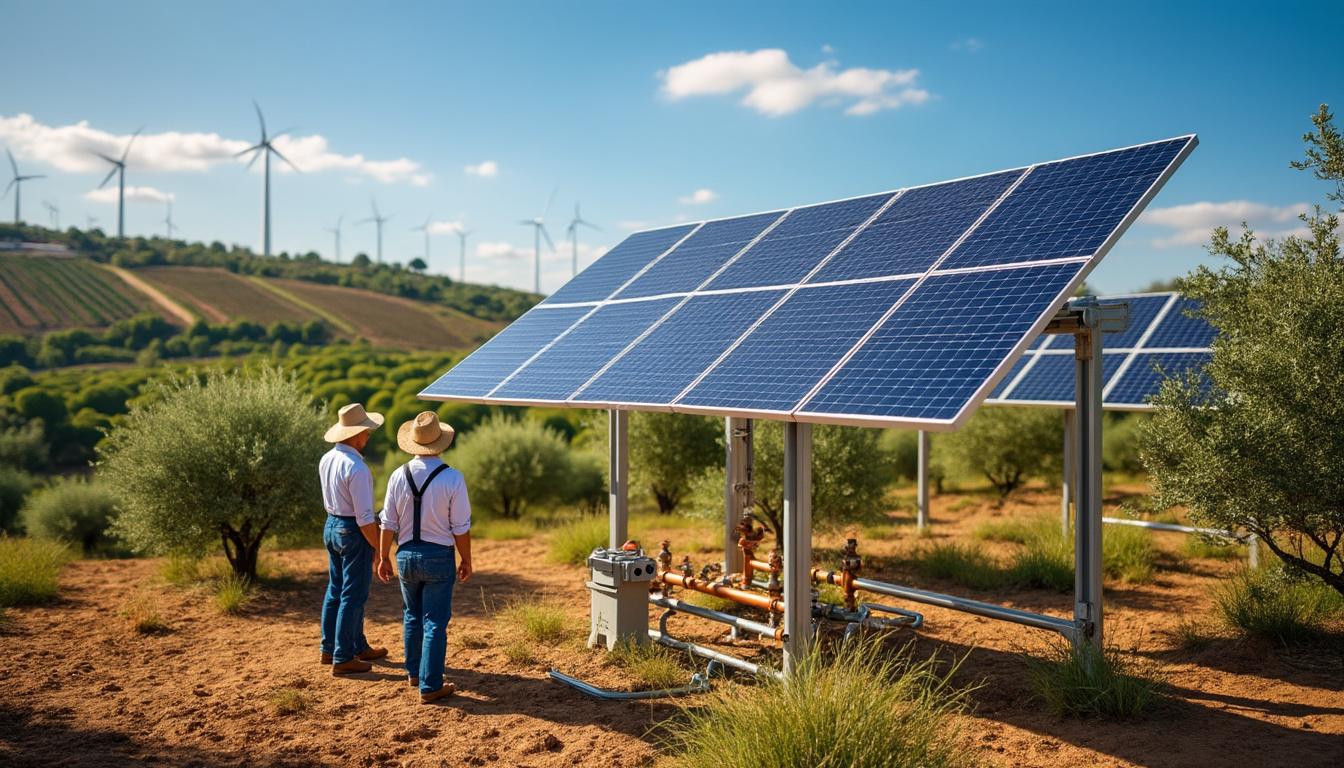
Agrivoltaics — the combination of agricultural cultivation with electricity production — is establishing itself as a dual-purpose solution: it generates clean energy and creates microclimates that are more favorable, especially in hot summers. Partial shade reduces thermal stress on plants, decreases evaporation, and can stabilize yields in sensitive crops like lettuce, strawberries, tomatoes, and herbs. The secret lies in the design of the structure: height, orientation, spacing, and transparency define light, rain, and air circulation.
Intelligent shading and agronomic gains
European studies indicate that partial shading between 20% and 40% can preserve soil moisture and reduce irrigation needs without compromising photosynthesis. In Mediterranean climates, this balance is gold. Imagine rows of elevated panels, between 3 and 5 meters high, with regular spacing that allows tractors and manual harvesting. There are solutions with semi-transparent modules and tilt controls that optimize light throughout the day. During periods of extreme heat, the photovoltaic canopy mitigates temperature peaks that would otherwise scorch leaves and fruits.
Practical examples are multiplying. In Japan and Germany, agrivoltaics have matured in peri-urban areas, while in France, pilot plots combining vineyards and photovoltaics have emerged, with improvements in fruit quality during severe summers. In Brazil, demonstrative projects showed potential for simultaneous production of 1.5 MW in agricultural areas, signaling a global trend. The common denominator is agronomic planning: choosing appropriate crops, adjusting planting times, and calibrating module density for each latitude.
Compatibility of operations in the field
A common objection is the fear of maneuvering difficulties. The answer lies in the design: clear spans, slim foundations, and technical passages designed from the outset. Structures at 4 m high allow for targeted spraying, harvesting, and equipment circulation. Drainage is designed to avoid channeling excess water towards the lines. In plots with livestock, lower protection is used to prevent contact with cables and inverters. And there’s also a bonus: under the structures, boxes, pallets, or detachable mini-greenhouses can be stored.
By way of illustration, the fictional Horta do Futuro, a farm in Alentejo, reorganized 2 hectares with elevated structures and sectorized drip irrigation. The low-growing tomatoes benefited from less scorching; the generated electricity powered pumps, warehouses, and part of the village through collective self-consumption. The producer began selling excess at regulated prices during low load periods, while the cooperative monitored performance with soil sensors and smart meters. The cycle closes when energy stabilizes costs and water is used sparingly.
If the question is “does it make sense for all crops?”, the answer is no. Extensive grains may take less advantage of shading. However, in horticulture, young fruit farming, and summer pastures, the gains are clear. The decisive point: wELL-designed agrivoltaics improve margins and protect production in extreme years.
Irrigation with solar energy: water when needed, energy bill under control
Irrigation is the silent energy line item that weighs on bills and shift management. By migrating to photovoltaic pumping, the producer starts to “plant” kilowatts in the field, freeing itself from tariff volatility. There are two main models: direct pumping (PV powers the pump during sunlight hours, with a storage tank or pond) and PV with batteries (for nighttime pressurization, fertigation, and peak culture times). The choice depends on the water profile, topography, and network availability.
Simple and effective technical decision
The path can be pragmatic: size the power according to the water column, necessary flow, and hours of operation during critical periods. The rule of thumb is to match PV with the pump in a modular way to allow for expansion. In small properties, a system of 10–30 kWp dedicated to drip irrigation reduces costs and increases autonomy. In larger operations, 50–200 kWp with frequency converters provide stable pressure without hydraulic “hammering”.
- 🌞 Define the strategy: accumulation tank for daytime pumping or batteries for nighttime irrigation?
- 🚜 Prioritize efficiency: drip irrigation, moisture sensors, and independent sectors reduce consumption.
- 🧠 Automate: pressure controllers and smart valves prevent waste.
- 🛡️ Protect the system: filters, pump drought protection, and preventive maintenance.
- 📊 Monitor: flow meters and telemetry confirm savings and facilitate project reporting.
The hypothetical case of the Vale do Sol Cooperative is illustrative. Over 180 hectares, the entity installed 120 kWp dedicated to pond pumping, combined with 60 kWh of batteries for nighttime starting pressures. Drip irrigation, which was previously irregular, gained consistency; electricity consumption nearly halved during summers; and tomato and melon production showed less variation in size during heat waves. Simple and well-calibrated controllers did the rest.
Compared to other regions, Latin American initiatives have accelerated solar irrigation programs for small producers when the grid is unstable. The parallel serves to reinforce one idea: technology is mature and costs have fallen. In Portugal, the confluence of funds and technical knowledge creates the right moment to standardize robust and replicable solutions.
A practical recommendation: prioritize components with local technical assistance and clear warranties. Real savings come from systems that operate during the critical harvest, not from “bargains” that fail when they are most needed. In summary, solar irrigation is a productive investment when designed to fit the water and culture.
Practical roadmap for successful applications to the 15 million
Disputed resources require solid applications, easy to understand and quick to execute. A roadmap helps turn intention into approval and completed work. Below is a step-by-step guide for cooperatives and irrigator associations wishing to secure new support for agricultural solar energy.
Seven steps that make a difference
- Energy and water diagnosis 🔍 — Assess consumption by sector (irrigation, cooling, processing), hourly profiles, seasonality, and reduction targets. Do the same with water volumes, pressures, and shifts.
- Pre-sizing photovoltaic 📐 — Compare three scenarios: pure self-consumption, PV + batteries, and elevated agrivoltaics. Estimate monthly generation and matches with the load. Avoid oversizing without a surplus strategy.
- Licensing and easements 🧾 — Anticipate irrigation authorizations, land use, and access. Projects with clear licensing paths gain priority due to feasibility by the end of the year.
- Economic model 💶 — Build a simple P&L: CAPEX, OPEX, savings per displaced kWh, revenue from surplus, annual maintenance. Simulate electricity and water price scenarios.
- Project governance 🧩 — Define responsibilities, timeline, procurement, and maintenance plan. In REC, clarify sharing and billing rules among members.
- Application documentation 🗂️ — Attach studies, plans, quotations, cooperative minutes, and evidence of impact. Use direct language and measurable objectives.
- Execution and monitoring 🛠️ — After approval, maintain records of production, consumption, and water. A system that is measured, improves.
Errors to avoid? Underestimating supply timelines, failing to signal risks (e.g., clay soil requiring special foundations), and ignoring operator training. Best practices include pressure tests before summer, O&M contracts with KPIs, and dashboards accessible to cooperative members. Whenever possible, prioritize equipment with a track record and close assistance.
For inspiration and accessible technical material, consult guides and practical cases at Ecopassivehouses.pt. Sharing experiences reduces repeated mistakes and accelerates the learning curve on the ground.
Operational summary: well-explained projects, with measurable impact and scheduled work, have a green light.
Collective self-consumption and Renewable Energy Communities in agriculture: savings, resilience, and new revenue
Transforming energy into a community asset multiplies benefits. In collective self-consumption, generation on a warehouse rooftop can supply cooling, offices, and, through sharing coefficients, pumping in adjacent batches. Meanwhile, Renewable Energy Communities (REC) allow neighbors, irrigators, and small producers to share production and savings, with clear governance and transparent metrics. Electricity ceases to be an individual cost and becomes a project of the territory.
Simple architecture, concrete effects
The basis is a generation core (PV on rooftop or ground), smart meters, and a sharing platform that defines percentages for each member. There are models where energy is sold internally at predictable prices, mitigating tariff peaks. In irrigated areas, coordinating irrigation schedules with windows of higher solar production increases the self-consumption index, reducing the need for bulky batteries. When irrigation is nighttime due to agronomy, batteries or elevated tanks come into the design.
Illustrative example: the fictitious CER Regantes de Montemor brings together three associations and two small tomato processors. It installs 500 kWp distributed across rooftops and 200 kWh of batteries in two key locations. A sharing arrangement of 40% for Association A (pumping), 35% for the cooling of the cooperative, and 25% for small members is defined. The joint energy bill decreases, and the cash surplus is reinvested in moisture sensors and more efficient fertigation lines.
The public ecosystem pushes in the right direction. In addition to the 15 million euros announced for agriculture, there are 25 million euros in additional support for large consumers to compensate for emissions market costs, benefiting agri-industrial chains. And by 2030, 275 million euros will function as a lever for competitiveness, allowing packaging, cooling, and processing factories to advance in efficiency and renewables. This macro coherence is essential for the countryside and industry to pull the country in the same direction.
On an international level, Brazil has debated and approved specific credit lines for solar energy in family agriculture, facilitating access for small producers to photovoltaic equipment and agroforestry systems. Portugal continues with its own instruments and, looking outward, gathers valuable lessons on micro-financing, technical assistance, and standardization of solutions. The convergence is clear: clean energy as a condition for food resilience.
To advance without stumbling, some strategic decisions deserve attention: define the sharing rule right from the start, choose a reliable digital platform, ensure exit and entry clauses for members, and adjust accounting to accurately reflect energy flow. By doing so, the community stops “buying electricity” and begins to manage an asset, with predictability and autonomy. In summary, when energy is organized in a community, agriculture gains financial muscle and operational stability.
Source: jornaleconomico.sapo.pt