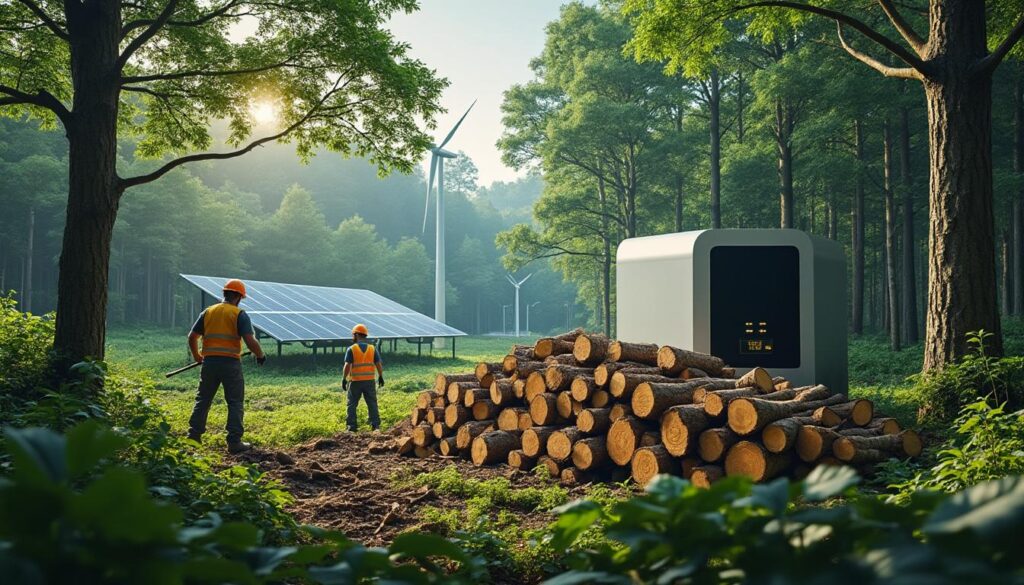
The election of Miguel Marques to the vice-presidency of the Municipal Section for Renewable Energies of the ANMP opens a window of opportunity for Oleiros and for all the territories that want to accelerate the energy transition intelligently and with local benefits. The subject is institutional, but the impacts reach your home, your bill, and the quality of the territory where you live.
Short on time? Here’s the gist:
| ✅ Key point | 🌿 Practical value |
|---|---|
| Vice-presidency of Miguel Marques in the Municipal Section for Renewable Energies | More voice for inland municipalities and focus on local benefits of renewables 💡 |
| New Board: Ana Rita Dias (presidency) and Eduardo Tavares (vice) | Experienced team to negotiate IMI of electricity generation centers and compensations ⚖️ |
| Priority: IMI for dams, wind farms, and photovoltaic systems | Fairer municipal revenues to invest in rehabilitation and efficiency 🏘️ |
| Political agenda: hearing with Environment and Energy | Pressure for financial compensation and clear rules on high voltage lines ⚡ |
Oleiros and the new vice-presidency of the ANMP: what it means for families and the territory
Miguel Marques, president of the Oleiros Municipality, was elected on January 23 as the vice-president of the Municipal Section for Renewable Energies of the ANMP for the mandate 2026-2029. The board includes Ana Rita Dias (Vila Pouca de Aguiar) as president and Eduardo Tavares (Alfândega da Fé) as vice-president. The board members are Marta Prates (Reguengos de Monsaraz) and João Silva Cruz (Mangualde). This composition signals geographic balance and experience in territories with a strong presence of wind, photovoltaic, and dam projects — exactly where the discussion about compensation and regulation is most urgent.
Why does this matter to those thinking about renovating their homes, joining an energy community, or installing photovoltaics? Because the Section will influence how municipalities obtain and channel revenues associated with the IMI of electricity generation centers, how they negotiate compensations for energy infrastructures, and how they create municipal programs that reach families. Institutional ambition is only worthwhile if it generates real projects: solar roofs in schools, thermal rehabilitation of vulnerable neighborhoods, support for self-consumption, and efficient pumping in water networks.
Imagine the following scenario in Oleiros: part of the IMI revenue from a wind farm is channeled into a “Comfortable Homes Fund,” providing free energy audits and support for installing cork insulation or high-performance windows. In parallel, the municipality calls on the network management company to discuss high voltage lines and plan green corridors and buffer zones that preserve acoustic and landscape comfort. Good public policy is this: every megawatt installed translates into better quality of life for those who live here.
When the Section schedules a hearing with the Minister of Environment and the Secretary of State for Energy, it is not a symbolic gesture. It is the arena where formulas for financial compensation to municipalities are clarified, including the passage of very high voltage lines and land occupation for dams. For citizens, this means predictability: knowing that their parish will have funding for energy efficiency of municipal buildings, smart LED public lighting, and urban shading plans that reduce heat islands.
There is also a decisive point: the example. When inland municipalities, like Oleiros, take the lead in renewables, they signal that the transition is not a privilege of metropolises. With planning, passive architecture, and energy communities, the interior can be a living laboratory. The vice-presidency now assumed can align technical priorities (regulations, licensing, training of installers) with proximity policies (energy counters, assistance in sizing systems). The result? Less bureaucratic noise, more well-executed works, and homes that spend less and are worth more.
If the political momentum is right, 2026 may be remembered as the year public machinery adjusted its lens: fewer abstract megawatts, more useful kilowatt-hours heating rooms, ventilating schools, and charging vehicles without crushing family budgets. That is the north: energy that solves real-life problems.
IMI of electricity generation centers: how to turn tax revenue into housing comfort and efficiency
Among the priorities of the Section is the Municipal Property Tax (IMI) applied to electricity generation centers — dams, wind farms, and photovoltaic plants. At first glance, this is a technical issue. In practice, it defines the ability of each municipal chamber to invest stably in thermal insulation, rehabilitation, and self-consumption projects. The predictability of revenue is what allows the creation of multiannual programs, with clear rules and simple applications for families.
How does it work? Energy production assets, while properties affected by economic activity, generate a taxable base that, if well managed, can represent millions of euros over the life cycle of the ventures. The key is methodology: updated registration, coherent assessments, and contracts that foresee compensation mechanisms when there is deactivation, repowering, or changes to the layout of high voltage lines. Without this, revenues become volatile; with this, stable funds for local public policy are created.
What does an efficient municipality do with this money? It prioritizes efficiency with measurable returns. Concrete examples that speak for themselves: replacement of single-glazed windows with thermal break frames in municipal neighborhoods; installation of heat pumps in swimming pools and pavilions; energy communities in schools with batteries sized for daytime self-consumption; and “sun and shade” programs with photovoltaic pergolas that generate electricity while creating urban comfort.
An illustrative case: the hypothetical “Ribeira School” receives 50 kW of photovoltaics with microinverters, financed by a Renewable IMI Fund. Teachers monitor the production on a public panel, and the annual savings fund mechanical ventilation with heat recovery. The result adds pedagogy, comfort, and reduced bills. All of this comes from a simple rule: when energy passes through the territory, it returns value to the territory.
There are frequent mistakes to avoid. Announcing works without a prior energy audit; buying equipment without considering life cycles; and ignoring preventive maintenance. The solution lies in specifications that require performance (kWh saved, temperature and CO₂ in occupied areas) and not just installed capacity. Assessment criteria weighted for thermal quality and ease of operation protect public investment and the comfort of the end users.
Communication also matters. A municipal energy portal, featuring maps of renewable assets, impact reports, and a calendar of competitions, builds trust. Citizens understand where the revenue comes from and how it translates into projects they feel in their daily lives. Transparency is efficiency: it reduces disputes, speeds up timelines, and attracts better proposals.
In summary, the IMI of electricity generation centers is only “new money” if it turns into recurring savings and real comfort. And this is measured in fewer kilowatts purchased, less air conditioning compensating for design problems, and more buildings that operate independently thanks to well-applied passive principles.
Compensations for renewables and high voltage lines: territorial justice and quality of life
Another area of work for the Section is the financial compensation process to municipalities for the installed renewable energy systems in their territories, including the passage of high and very high voltage lines. The goal is clear: to ensure that the infrastructure serving the country does not disproportionately penalize those who give it space. This is territorial justice applied to energy.
Compensating well means looking beyond the check. It involves environmental measures (ecological corridors, reforestation with native species), acoustic and landscape barriers where necessary, mobility improvement plans, and above all, investment in energy efficiency that reduces expenses for families and municipalities. When a line crosses a valley, it can finance thermal rehabilitation of exposed homes, replace public lighting with LED systems with remote control, and equip the school park with adequate shading and natural ventilation.
In practice, negotiating well requires a method. First, map direct impacts (layout, noise, servitudes) and indirect impacts (landscape perception, limitations on future construction). Then, quantify: land opportunity cost, productivity losses, and mitigation measures. Finally, translate into an agreement with performance indicators: number of rehabilitated homes, kWh saved in public equipment, reduced maximum temperatures in parks and schools. Without metrics, compensation becomes rhetoric; with metrics, it becomes concrete transformation.
A useful narrative is that of the fictional “Aldeia da Lomba.” The passage of a line brought fears. The municipality proposed a package: microfunds to improve the surroundings of exposed homes, installation of shade trees along pedestrian paths, creation of a demonstration center for collective self-consumption with real-time measurement. In two years, the energy “that crosses” became the energy “that improves” — because the agreement required visible results.
For you, considering investing in your home, the advice is clear: when projects are announced in the municipality, look for official channels and participate in public consultations. Municipalities that listen early better define the exclusion maps, choose more suitable constructive solutions, and often increase the envelope of compensations. Informed citizens improve contracts.
From an institutional standpoint, the decision to request hearings with the Ministry of Environment and Secretary of State for Energy places this issue at the center of the agenda. This accelerates legal clarifications, avoids case-by-case arbitration, and creates a national standard for compensation that explicitly includes efficiency and rehabilitation targets. When the rule is good, private projects adapt and the territory benefits.
The final idea is simple: circulating energy should generate local value. And local value is measured in thermal comfort, lighter bills, and public spaces where people want to be. That is what transforms infrastructure into quality of life.
Energy communities and municipal self-consumption: practical steps to start now
With the vice-presidency of Oleiros in the Section of the ANMP, the model of energy communities and collective self-consumption in municipal assets gains strength. They are quick to implement when rooftops are available and there is organizational will. They work well in schools, pavilions, and care homes, bringing a dual advantage: savings and energy literacy.
How to structure a local energy community
The roadmap is straightforward. First, inventory rooftops with good solar orientation, minimal shading, and structure capable of supporting the additional weight. Second, size the installation considering the consumption profile of nearby loads (pumps, kitchens, lighting), prioritizing self-consumption. Third, define governance: residents’ association, local cooperative, or the municipality itself as promoter, with clear sharing contracts.
Fourth, choose components with lifecycle criteria: modules with solid warranties, inverters with good thermal management, fixings compatible with the type of roofing. Fifth, plan operation and maintenance: preventive cleaning, monitoring on an open platform, and monthly KPIs (production, self-consumption, avoided emissions). Finally, link the project to an energy education program — when students, users, and neighbors track the data, the culture of efficiency spreads.
- 🔎 Map rooftops and nearby loads (schools, care homes, swimming pools)
- ⚙️ Size for self-consumption and only then for injection
- 📊 Monitor with simple indicators (kWh, % self-consumption, avoided CO₂)
- 🧰 Plan maintenance and replacements over time
- 🤝 Formalize governance and fair sharing of benefits
Practical example: three schools share 150 kW, with smart meters. At lunchtime, the peak of kitchens is covered by local production; on weekends, part goes to charging the municipal fleet. The intermittent surplus feeds modular batteries that smooth out peaks. In the bill, the savings are reinvested in external shading and cross ventilation — passive solutions that reduce cooling in the summer.
Avoid common pitfalls
The classic mistake is to install “as much as fits” without studying loads and future shading (trees, chimneys, new constructions). Another mistake is to ignore structural compatibility of the roofing. And there’s the temptation to buy the cheapest: a fragile inverter sitting idle in a hot August nullifies gains. The antidote is a simple technical notebook: shadow study, structural memory, specifications for inverter ventilation, and maintenance plan. It’s better to have 90 kW working for 20 years than 120 kW failing in the third summer.
When municipalities focus on well-designed energy communities, public conversation changes. We stop talking about “distant megawatts” to discuss “useful kilowatts here.” And when “here” includes your street, energy becomes a neighborhood and common sense issue.
Passive architecture, natural materials, and local policies: a quick path to comfort and lower bills
Renewables without efficiency is like rain on a coat. The step that determines long-term comfort is bringing passive architecture and natural materials to the center of municipal policies. Oleiros has the heritage, climate, and know-how for it. By aligning incentives of the renewable IMI with rehabilitation programs, a concrete front opens up: cooler houses in summer, warm in winter, and quiet all year round.
Four movements with a big impact
First, a “Right Window” program for window frame replacements with thermal breaks and selective glass, prioritizing homes exposed to noise. Second, “Living Wall”: insulation with expanded cork or plant fibers, paying attention to thermal bridges. Third, “Smart Shade”: external blinds, pergolas, and trees positioned according to seasonal solar analysis. Fourth, “Healthy Air”: well-designed natural ventilation and, where necessary, VMR (mechanical ventilation with recovery) for schools and homes.
All these gestures yield returns when the municipality helps with diagnosis, connects the construction to local workforce training, and simplifies licensing. Here, knowledge platforms, such as Ecopassivehouses.pt, serve as a bridge between technicalities and daily decision-making. The language of construction is spoken: finishing details, tightness tests, choice of materials with low emissions, and simple maintenance.
The hypothetical case of “Casa do Ribeiro” in Oleiros illustrates this. Rehabilitated with cork and lime plaster, it gained shading on the southwest elevation and windows with an adequate solar factor. Without installing air conditioning, peak temperature was reduced by 5–7 ºC in the summer, and heating was reduced by more than 40% in winter. When the roof received 4 kW of photovoltaics, the house was already “light on the load.” The production covers essential equipment, and the virtual battery, in a well-negotiated contract, balances nighttime consumption.
Public policy that prioritizes passive first is less costly and lasts longer. And when the aligned discourse of the ANMP Section reaches municipal regulations, a standard emerges: every euro invested in energy returns as comfort and health. This is how a culture of quality in the built environment is created, with less improvisation and more method.
If you have to remember one idea, remember this: before buying power, buy silence, shade, and insulation. The energy that is not consumed is the cheapest and the cleanest.
Agenda of the Section of Municipalities for Renewable Energies: negotiation, metrics, and results that matter
With the new Board — chaired by Ana Rita Dias and with Miguel Marques and Eduardo Tavares in the vice-presidency, plus Marta Prates and João Silva Cruz as members — the immediate agenda intersects fiscal policy, planning, and execution. The operational priority is to finalize the discussion of the IMI of electricity generation centers with predictable and fair rules; the strategic priority is to ensure that a relevant portion of those revenues becomes proven efficiency in municipalities.
To bring this plan to fruition, three pillars make a difference. The first is data: inventory of renewable assets, georeferenced, with production, lifespan, and fiscal impact. The second is method: procurement guides that prioritize performance, auditing with independent measurements, and transparency in quarterly reports. The third is capacity: training municipal technicians, partnerships with polytechnic institutes, and living laboratories in public buildings to test low-risk solutions.
Results are not requested; they are demanded. Annual targets such as “kWh saved per euro invested,” “percentage of high-certification buildings,” and “number of families supported” guide decisions. Municipalities that publish these indicators attract better proposals and serious partners. This is where institutional dialogue with the Ministry of Environment and the Secretary of State for Energy should anchor: less paperwork, more metrics that matter to citizens.
And what about the citizen? There is a simple action they can take now: apply for a co-financed energy audit when their municipality makes it available. In a few hours, they discover where their home loses energy, which interventions have the highest returns, and how to combine this with self-consumption or with their local energy community. Then, plan the construction in phases: first the passive (shade, insulation, windows), then the technology (heat pump, photovoltaics).
In the end, what remains is a compass: public policies only count when they improve your comfort and your bills. With the leadership now assumed in the ANMP Section, there are conditions to link energy revenues to more efficient homes, with a method that respects the territory and common sense. Today, the concrete action is simple: observe your home in light of the next wave of support and prepare your priority list — the energy transition begins at each person’s door.