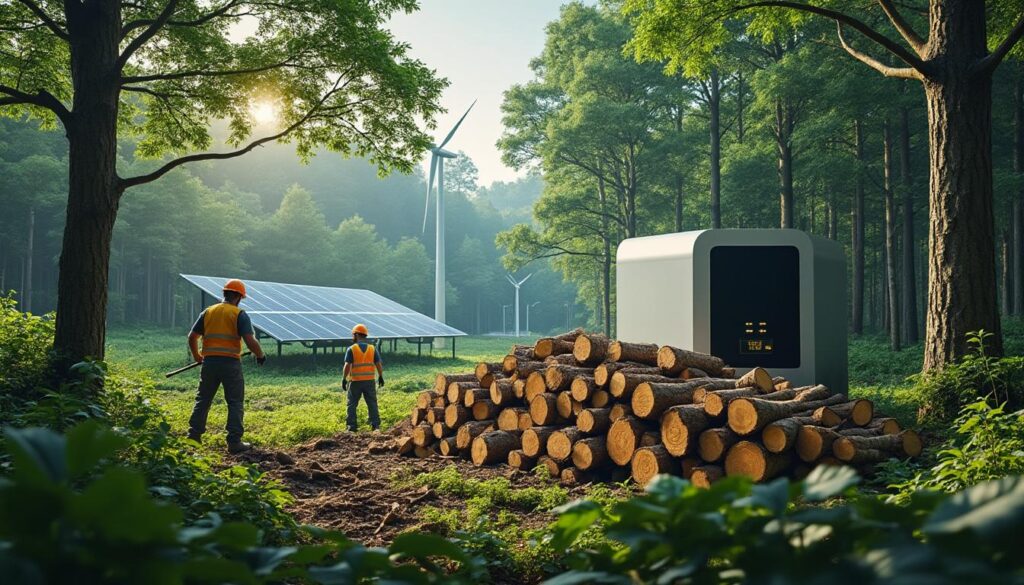
Applications for a new renewable energy fund open this month, with an allocation of 70 million euros for advanced training and innovative actions in energy efficiency and clean sources. It is a concrete opportunity to transform projects into measurable results by 2026.
| Short on time? Here’s the gist: ⏱️ | |
|---|---|
| Key Point ✅ | What you need to know 📌 |
| ✅ 70 M€ available | Focus on advanced training and innovative actions in energy efficiency and renewables 🌱 |
| ✅ Applications already in April | Projects can be submitted by various entities (companies, municipalities, cooperatives, educational institutions) 🏫🏭 |
| ✅ Preparation in 5 steps | Energy diagnosis, goals, team, budget, impact measurement 📊 |
| ✅ Avoid common mistakes | Vague goals, underestimated costs, lack of indicators, poor feasibility ⚠️ |
New renewable energy fund opens applications this month: eligibility, deadlines, and what really counts
The Government confirmed the availability, still in April, of a 70 million euro fund to accelerate the energy transition. The objective is to support advanced training and the progress of innovative actions in energy efficiency and renewable energies, accepting proposals from various entities with measurable and scalable impact.
In practice, this means opening doors to projects that range from the technical training of teams to clean technology pilots in buildings and neighborhoods. By 2026, with the volatility of energy costs and more demanding climate targets, this fund acts as an accelerator for those who already have a solid idea and need financial and technical traction.
Who can apply? The announcement emphasizes that various entities are eligible: companies, municipalities, energy cooperatives, sectoral associations, and educational institutions. This diversity is strategic for creating local value chains, where training converses with work, and innovation moves from the laboratory to rooftops, facades, and microgrids.
What types of initiatives are included here? The framework is clear: advanced training (for example, certification for heat pump installers or designers of passive houses) and innovative actions (for example, deep rehabilitation with natural insulation, photovoltaic systems with batteries, smart load management, and energy communities). The key is to demonstrate verifiable results and replicability.
As for deadlines, the opening in April requires quick organization: start mapping partners, consumption data, and necessary authorizations right away. The typical cycle for a successful application includes pre-diagnosis, definition of goals and indicators, phased budgeting, and a communication plan for results, all supported by technical evidence.
And the funding? The final design will be detailed in the announcement, but it usually comprises support for capacity building (training, scholarships, workshops) and support for implementation (studies, pilots, monitoring, dissemination). The essential thing is to prove additionality: without this fund, the project would be slower, smaller, or wouldn’t happen at all.
Realistic example: a municipality can propose a training program for technical teams and, simultaneously, energetically rehabilitate schools with cork insulation, efficient ventilation, and photovoltaic systems with batteries for self-consumption. The combination of “people + work” multiplies impact and fits within the fund’s mission.
The international context also reinforces the relevance. In Latin America and Brazil, funds for energy transition and capital instruments for clean startups are multiplying, signaling a global trend. Portugal is following this movement by directing resources towards qualification and practical execution.
Bottom line: if you aim to reduce consumption, integrate renewables, and train teams, this is the moment to structure a solid and actionable dossier. The fund values projects that deliver measurable impact in the short term and create skills for the medium term.

How to prepare a winning application for the renewable energy fund: practical steps and criteria
A robust application starts with a simple and objective energy diagnosis. Gather consumption data, hourly profiles, thermal losses, and reduction opportunities. Use real data: bills from the last 12 months, thermographies, and field measurements — this elevates the credibility of the plan and facilitates goal definition.
Then, turn opportunities into goals: “reduce thermal energy by 40% in 24 months”, “produce 60% of consumed electricity for self-consumption”, “train 50 accredited technicians in advanced heat pump technology”. SMART goals (specific, measurable, achievable, relevant, and time-bound) are the language of evaluators.
Structure the dossier logically as a project
Organize the document by problems and solutions. Describe the context, detail the measures (insulation, efficient windows, heat recovery ventilation, photovoltaic systems, smart management), quantify benefits, and list risks with mitigation strategies. Include a timeline by phases and quarterly milestones.
The component of advanced training is not an extra; it is part of the engine. Design modules with learning outcomes, workload, qualified trainers, and assessment. Articulate with the work: trainees apply in practice, with monitoring and feedback.
Realistic budget and impact indicators
A good budget is transparent and phased. Separate materials, labor, design, monitoring, and communication. Anticipate margins for unforeseen technical issues. Associate each line item with indicators: kWh saved, tons of CO2 avoided, number of people trained, certifications issued, and percentage of peak power reduction.
Include a measurement and verification plan: how data will be gathered, with what frequency, and what tools will be used. This reduces uncertainty and facilitates accountability, a critical step in any fund.
Quick checklist to avoid mistakes
- 🧭 Define a project manager with autonomy and a clear timeline.
- 🧾 Gather bills and measurements to support the diagnosis.
- 🎯 Establish SMART goals aligned with the budget and timeline.
- 👩🏫 Integrate advanced training with practical application in the work.
- 📊 Set up indicators and a method for measurement and verification.
- 📣 Prepare a communication plan to disseminate results.
Want to see good practices in action? There are dozens of case studies in community energy and deep rehabilitation that illustrate the sequence from diagnosis to measurement. Search for recent examples and compare methodologies before deciding on your own.
When closing the dossier, validate the alignment with the fund’s priorities: energy efficiency and renewable energies with advanced training supporting delivery. The evaluator needs to read coherence and see a clear trajectory from investment to impact. This coherence, more than rhetoric, earns decisive points.
High impact eligible projects: efficiency, advanced training, and applied innovation in the territory
The new fund favors projects that combine capacity building and technical execution, delivering tangible benefits for people and buildings. The most effective path combines deep energy rehabilitation with renewables and a training plan that creates local autonomy.
Example 1 — Efficient schools: rehabilitating a school with cork insulation, replacement of window frames, heat recovery ventilation, and photovoltaic systems with batteries reduces consumption peaks and improves thermal comfort. In parallel, a training program for municipal technicians and school managers ensures maintenance and intelligent use of systems.
Example 2 — Condominiums with self-consumption: in a condominium of 40 units, the renovation of the facade (facades, roofs) combined with shared solar energy and load management (heat pumps, charging of electric vehicles) reduces bills and emissions. Training of building managers and local installers creates critical mass to replicate the model in other buildings.
Example 3 — Energy communities: cooperatives can plan neighborhood microgrids, with distributed photovoltaic energy, storage, and demand response. Here, the advanced training focuses on system operation, regulation, and business models, ensuring technical and financial sustainability.
The connection between training and work: why insist on this?
Without prepared people, technology does not deliver as promised. Training programs applied in practice create teams capable of adjusting flows, tuning controllers, reading load curves, and diagnosing losses. This avoids the “disappointing performance” that often penalizes well-intentioned projects.
Moreover, training amplifies the return on public investment by staying in the territory. Trained technicians remain active and disseminate good practices, feeding a virtuous cycle of quality and trust in the local market.
What does innovation mean in practice?
To innovate is not just to buy new technology. It is to redesign processes, integrate systems, and measure results. A building that reduces energy by 60% with passive solutions and intelligent control is as innovative as a roof full of panels, if the result is robust and replicable.
Recent international cases show that effective funds prioritize innovation with measurable impact. In Brazil, for example, investment instruments focused on energy transition and low carbon have grown, signaling the same direction: scalable solutions with clear returns.
In summary, what is sought are solutions that improve construction quality, energy literacy, and building resilience. If your project can intersect these three axes, the application gains technical and social traction.
For those assessing options, keep the focus on the triad of comfort + savings + capacity building. It is this balance that allows you to say, with data, that the investment made a difference where it matters most: to people and places.
60-day roadmap: from pre-diagnosis to submission with validated indicators and budget
Time is critical when applications open. A 60-day roadmap helps transform intention into a competitive application, without losing technical precision. Divide it into four bi-weekly blocks, with clear deliverables and quality checkpoints.
Days 1–15: Diagnosis and goals
Collect bills, consumption profiles, plans, and descriptive records. Inspect the site and, if possible, use thermography to map thermal bridges. Set SMART goals, risks, and assumptions. Select outcome indicators (kWh, CO2, indoor comfort, number of trained technicians) and measurement tools.
Days 16–30: Solutions and team
Choose measures with the best cost/benefit ratio and a rational sequence of work (enclosure before active systems). Assemble the team with a technical manager, trainers, installers, and a measurement and verification entity. Validate constructive and schedule compatibilities to avoid interference.
Days 31–45: Budget and risks
Budget by items and phases, anticipate contingencies, and condition payments to performance milestones. Describe risks and mitigation strategies: logistical delays, price variations, licenses, integration of systems. Include a communication plan to share results with users and the community.
Days 46–60: Final dossier and submission
Review technical coherence, validate calculations, confirm authorizations, and letters of commitment from partners. Conduct a critical reading focused on the evaluator: clear objectives, quantified benefits, financial viability, realistic timeline, and well-defined monitoring. Submit in advance to avoid setbacks.
If you want to delve into M&V (measurement and verification) methodologies and see comparable examples, look for updated references and technical videos showcasing instruments and protocols in real use.
By following this roadmap, the application communicates maturity and focus on the essentials: energy results, enduring training, and conscious risk management. This is what differentiates a good project from a fundable project.
Benefits, risks, and return: how to measure economic, social, and environmental impact with the new fund
The return of this fund is not just financial; it is also about comfort, health, and resilience. In the short term, reductions in consumption and self-production relieve family and municipal budgets. In the medium term, trained teams become the backbone of a more qualified and trusted local market.
To measure economic return, calculate payback and levelized cost of energy (LCOE) for the solutions. For social return, measure thermal comfort, indoor air quality, and user satisfaction. For environmental impact, account for avoided CO2 and reduction of power peaks, which impact the grid.
Risks exist and should be addressed head-on: oversizing systems, underestimating thermal envelopes, ignoring maintenance, and neglecting training. The solution lies in simple and rigorous engineering: start with the enclosure, integrate systems coherently, and validate operation with data.
The international context reinforces this direction. Permanent support lines and thematic funds dedicated to energy transition have grown, especially instruments that combine innovation, efficiency, and local supply chains. The convergence points to projects with measurable impact and replicable models.
For those looking to take the next step, it is worthwhile to explore reference resources and technical communities that share lessons learned. Platforms like Ecopassivehouses.pt bring together ideas, examples, and practical guides to apply in your reality, without magic promises, just tested solutions.
Ultimately, what makes a project successful is the alignment between advanced training, well-thought-out work, and transparent monitoring. Start today by gathering data and setting clear goals; the rest is method, discipline, and attention to details that matter most.
Source: cnnportugal.iol.pt