The controversy surrounding the Sophia photovoltaic project is not just technical: it involves territory, biodiversity, local economy, and public trust. To understand the behind-the-scenes of this opposition, it’s worth taking a closer look at impacts, alternatives, and smarter decision-making paths.
Short on time? Here’s the essence:
| ✅ Key Point | 💡 Essence |
|---|---|
| ✅ Territorial impact 🌄 | Proposed area exceeding 520 ha with 425,600 modules and 400 kV lines totaling ~44 km; conflicts with RAN/REN and Geopark Naturtejo. |
| ✅ Sensitive biodiversity 🦅 | Record of 231 vertebrate species; risks to black stork, black vulture, imperial eagle, and bats. |
| ✅ Common mistake ⚠️ | Prioritizing megacenters without prior planning and without a “Green Map,” undervaluing efficiency and energy communities. |
| ✅ Practical alternative 🧭 | Distributing solar on industrial rooftops, degraded areas, and highways; combining with storage and demand management. |
What’s at stake in Sophia: territory, energy, and political backroom dealings
The Sophia photovoltaic project covers Idanha-a-Nova, Penamacor, and Fundão, with an estimated investment of ~€590 M and a capacity of around 867 MWp. In 2025, the Intermunicipal Community of Beira Baixa issued an unfavorable opinion during the public consultation, aligning with the positions of the three directly affected municipalities.
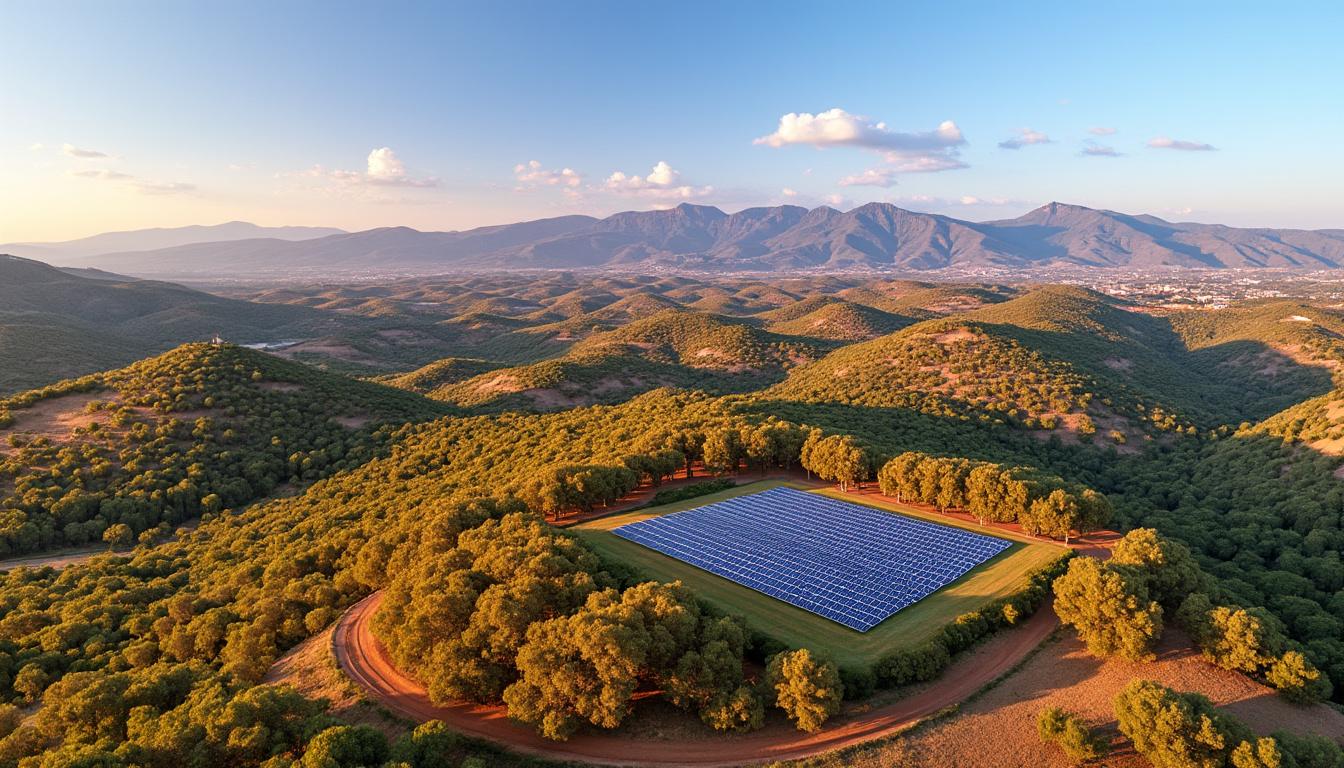
The layout includes 425,600 modules in an area of +520 hectares, two very high voltage lines (400 kV) each approximately 22 km long, crossing agricultural spaces and valleys with ecological connectivity. The scale raises doubts about compatibility with RAN, REN, and the UNESCO Geopark Naturtejo.
Who opposes and why: map of positions and arguments
Several entities — ZERO, FAPAS, Rewilding Portugal, Quercus, the platform Together for Divor, and the party PAN — question the project. The Left Bloc brought the discussion to the European Commission, invoking the Habitats Directive and the Birds Directive. The central criticism: energy transition is crucial, but it cannot advance with irreversible losses in landscape and biodiversity.
- 🌍 Planning: lack of a “Green Map” prioritizing less sensitive areas.
- 🦉 Biodiversity: risks to endangered species and ecological corridors.
- 🏘️ Socio-territorial: effects on agriculture, nature tourism, and local cohesion.
- 🔌 Electrical system: need to assess storage and grid reinforcement to integrate production.
| 🎭 Actor | 🗣️ Position | 🔎 Key Argument |
|---|---|---|
| CIM Beira Baixa 🏛️ | Unfavorable | Scale and continuous artificialization of the landscape with impacts on existing uses. |
| ZERO 🌱 | Unfavorable | EIA with omissions; need for planning and social acceptance. |
| FAPAS 🐗 | Unfavorable | Cutting down 1541 protected trees; loss of montado. |
| Rewilding 🦇 | Unfavorable | 231 vertebrate species; 400 kV lines disrupt connectivity. |
| Naturtejo 🗺️ | Unfavorable | Risk to UNESCO commitments and geological and landscape values. |
In a realistic thread, picture Mr. Miguel, a beekeeper in Fundão. The concern is not solar energy itself; it is the poorly situated scale, which could reduce the meliferous flora and the landscape that attracts agritourism. It is this type of impact that fuels local opposition.
Biodiversity and landscape at the center of the controversy: what the EIA revealed
The Environmental Impact Study (EIA) identified by associations refers to 231 vertebrate species in the affected area. Among them are the black stork, black vulture, imperial eagle, and several species of bats, reptiles, and protected amphibians. In Mediterranean habitats, small displacements can fragment essential ecological corridors for foraging and nesting.
Another sensitive point is the elimination of montados, an ecological system of high value. According to FAPAS, the project would involve the cutting down of 1541 protected trees (holm oaks and cork oaks) and the loss of more than 1 hectare of montado, with effects on soil richness, water retention, and ecosystem services.
Very high voltage lines and ecological connectivity
The two 400 kV lines, each about 22 km long, would cross agricultural areas and riverbanks. For soaring species such as the black vulture, the installation of lines increases the risk of collision and electrocution. Even with warning devices, the mitigation is probabilistic, not eliminatory.
- 🦅 Soarers: changes in flight patterns and risk of collisions.
- 🦇 Bats: sensitive to lighting and noise during construction.
- 🌿 Vegetation: clearings and servitude strips fragment habitats.
- 💧 Waterlines: siltation and temporary disturbance of riverbanks.
| 🦉 Species/Value | 🎯 Sensitivity | 🧩 Main Risk | 🛠️ Possible Mitigation |
|---|---|---|---|
| Black stork 🖤 | High | Disturbance in nesting areas | Exclusion zones and restricted work schedule |
| Black vulture 🦅 | High | Collision with cables | Visual markers; redesigning layout |
| Imperial eagle 👑 | Very high | Loss of hunting area | Buffer zones; functional compensations |
| Bats 🦇 | Medium/High | Lighting and noise | Daytime works; control of lights |
It is true that compensations have been proposed, such as converting ~135 ha of eucalyptus into holm oaks and cork oaks (totaling ~228 ha of compensation). However, entities like Rewilding warn: without demonstrated net biodiversity gains and with irreversible local losses, the balance does not add up.
At the same time, Naturtejo emphasizes the international commitments of UNESCO. The geopark seal depends on landscape integrity and exemplary management. When territorial reputation enters the equation, the decision is not only technical; it is also strategic for the region’s future.
Socially accepted solar energy alternatives: from rooftops to smart territory
The opposition is not to solar energy, but to its location and scale. A practical path is to combine distributed production on rooftops, industrial parks, degraded areas, and infrastructures — and only then consider ground stations when the planning legitimizes them.
In 2025, energy communities and models of collective self-consumption gained traction in Portugal. By bringing production and consumption closer, they reduce losses in the grid and increase social acceptance. For municipalities in Beira Baixa, there are opportunities in schools, pavilions, markets, agricultural warehouses, and municipal venues.
How to prioritize areas and maximize benefits
It is wise to follow a simple hierarchy: rooftops and coverings first; then, industrial parks; next, already artificialized areas (former quarries, closed landfills, highway embankments); finally, rural areas with low ecological value, always with fine assessment.
- 🏭 Industries: large area of coverage, daytime consumption aligned with solar production.
- 🏫 Public buildings: schools and hospitals add social and educational value.
- 🛣️ Infrastructures: coverings in parking lots and along road margins.
- 🧠 Demand management: batteries + smart tariffs = less strain on the grid.
| 🔧 Alternative | 📈 Advantage | ⚠️ Caution | 💶 Business model |
|---|---|---|---|
| Industrial rooftops 🏭 | Lower CAPEX per useful MW; no land use | Old structures require reinforcement | Onsite PPA; self-consumption |
| Parking lots 🚗 | Shade + energy | Integration with chargers | Energy communities |
| Degraded areas 🏜️ | Recovers unproductive areas | Prior environmental remediation | Local auctions; concessions |
| Highway margins 🛣️ | Efficient linear use | Safety and maintenance | Public-private partnerships |
In the narrative, Mrs. Helena, a cheese producer in Penamacor, joined a local energy community, installing 80 kW on the rooftop of her cheese shop and sharing surplus with neighbors. The result? Lower bills, without losing landscape or rural tourism clients. This is the type of example that unlocks consensus.
Before ground stations, it’s always worth testing the potential of rooftops in the municipality. Often, the “invisible MW” in buildings resolves much of the equation.
Scrutiny of the EIA and public participation: where the process can improve
Organizations such as ZERO point out omissions and biased conclusions in the EIA. When the analysis underestimates cumulative effects, ecological corridors, and the seasonality of species, the risk of misaligned decisions increases. This is where good governance makes all the difference.
Another bottleneck is the decision sequence: giant projects arrive before dedicated planning (the promised “Green Map”). Without clear guidelines, conflict arises. In 2025, expectations for this instrument are high — and legitimate.
Tools for a truly robust EIA
There are simple practices that elevate the quality and social acceptance of projects. Integrating citizen science in fauna inventory, simulating alternative deployment scenarios, and using corridor modeling (e.g., circuit theory) help reduce impacts and litigation.
- 🧪 Seasonal data: sampling at various seasons of the year.
- 🗺️ Scenarios: compare layouts with and without 400 kV lines.
- 🤝 Participation: workshops with farmers and nature guides.
- 📚 Transparency: publish datasets and modeling codes.
| 🧩 Aspect | 🚨 Typical Problem | 🛠️ Concrete Improvement | 🎯 Expected Outcome |
|---|---|---|---|
| Fauna 🦔 | Short sampling | Seasonal campaigns | Realistic impact |
| Network ⚡ | Fixed layouts | Compare alternatives | Less conflict |
| Landscape 🌄 | Simplistic view | 3D simulation | Honest assessment |
| Socioeconomics 👥 | Diffuse benefits | Value-sharing plans | Social license |
When a deputy from the BE asks for clarifications from the European Commission about compliance with the Habitats Directive, it is not mere formality. It is a reminder that environmental no regression is a European principle — and that Portugal needs to align projects with this level of demand.
In summary: solid and participated processes tend to generate better and less contested solutions.
Balanced energy transition: efficiency, storage, and grid planning
The pressure for new megawatts cannot overshadow three pillars that reduce impacts and costs: energy efficiency, storage, and grid planning. Ignoring these factors forces larger projects than necessary and worse located.
In buildings, thermal rehabilitation (insulations, efficient windows, shading) reduces daytime demand and summer peak. In the system, batteries and smart load management smooth fluctuations. In rural contexts, well-designed agrovoltaics can reconcile production with resilient crops.
Closing the equation with less impact
If the national goal is to cut fossil use, the quickest and cheapest way is to not consume what doesn’t need to be consumed. Municipal efficiency programs, combined with energy communities, free up margin for projects in the ground to be smaller and located in appropriate places.
- 💡 Efficiency first: every kWh saved avoids panels and lines.
- 🔋 Storage: community batteries absorb solar peaks.
- 🛰️ Digital: smart meters adjust consumption profiles.
- 🌾 Selective agrovoltaics: useful shade for crops; enhanced biodiversity.
| 🏗️ Measure | 🔎 Effect | 📊 Indicator | 🤝 Social Benefit |
|---|---|---|---|
| Thermal rehabilitation 🧱 | Less base consumption | kWh/m² reduced | Comfort + lower bills |
| Community batteries 🔋 | Smooths solar peak | Hours of autonomy | Less need for lines |
| Dynamic tariffs ⏱️ | Shifts consumption | kW during critical hours | More stable grid |
| Agrovoltaics 🌱 | Soil/energy synergy | Agricultural productivity | Agricultural yield |
The message is clear: the right mix of efficiency + distributed + storage reduces the pressure for megaprojects in sensitive locations. Serious planning is not an obstacle; it is an accelerator of transition.
Practical criteria for better decision-making: an applicable roadmap for the Sophia case
To break the deadlock, it helps to have a set of objective criteria guiding any large photovoltaic central. When everyone knows the rules of the game, the discussion focuses on merit — and not on diffuse perceptions.
Consider a decision “traffic light” with clear weights: biodiversity, landscape, soils and water, infrastructure, local benefits, alternatives. Applied to Sophia, the method reveals where the project needs revision or location change.
Objective checklist for photovoltaic projects on land
Before licensing, a promoter should answer, using public data, simple and verifiable questions. It is the type of discipline that accelerates transition and reduces litigation.
- 🧭 Location: is it outside of RAN/REN and with no UNESCO statuses? If not, justify and compensate with proven net gains.
- 🦋 Biodiversity: mapped and maintained ecological corridors? Redesigned lines to avoid valleys and flight paths of soarers?
- 🚧 Grid: are there connection alternatives with fewer servitudes? Have you assessed local storage?
- 👥 Benefits: is there a value-sharing plan with communities (local social tariff, environmental funds)?
- 🏗️ Alternatives: was the potential of rooftops and degraded areas in the municipality demonstrated?
| 📐 Criterion | ⚖️ Weight | 📝 Minimum Requirement | ✅ Evidence |
|---|---|---|---|
| Biodiversity 🐾 | 30% | No irreversible losses | Models + seasonal data |
| Landscape/UNESCO 🏞️ | 20% | Explicit compatibility | Naturtejo opinion |
| Grid/400 kV lines 🔌 | 20% | Optimized layout | Multi-criteria comparison |
| Alternatives 🔄 | 20% | Robust justification | Inventory rooftops/areas |
| Local benefits 🤝 | 10% | Transparent sharing | Social energy contract |
Practical example: if an alternative scenario shifts 35% of capacity to industrial rooftops, 25% to parking lots, and 40% to a lot on land outside ecological corridors, the project reduces 400 kV lines, maintains territorial cohesion, and increases social license. This is the type of commitment that tends to add winners.
If there is one idea to take away: first the right place, then the megawatt. Clean energy is only complete when it respects the territory.
Source: www.publico.pt