In Portugal, the Portuguese Energy Agency emphasizes that producing more from clean sources is the most direct way to reduce energy costs. The topic has gained traction with more ambitious targets, new planning instruments, and the need for more flexible electrical grids.
Short on time? Here’s the essence:
| ✅ Key Point | 💡 Essence |
|---|---|
| ✅ More renewables, lower bills ⚡ | ADENE reinforces that domestic renewable production tends to reduce the price for consumers, protecting against external shocks. |
| ✅ Clear 2030 targets 🎯 | The PNEC 2030 aims for 51% renewables in final consumption and acceleration of permits in the “Acceleration Areas”. |
| ✅ Flexibility prevents blackouts 🧠 | Storage, demand management, and smart grids mitigate intermittency and stabilize the system. |
| ✅ Sensible transport 🚍 | Smart electrification, hybrids in transition, and a focus on public transport yield quick and fair gains. |
How increasing renewables reduces energy costs in Portugal, according to ADENE
The message is clear: producing more electricity from renewables in Portugal tends to lower the price paid by consumers. This view, reiterated by the president of ADENE, Nelson Lage, rests on two pillars: reducing dependence on imported fossil fuels and taking advantage of lower operating costs of wind, solar, and hydro.
In marginal markets, such as the Iberian one, when the system is supplied by wind farms and solar plants, the marginal price tends to be lower. Over a year, higher renewable participation reduces the average prices in the wholesale market, which gradually filters down to your bill through contracts and regulatory adjustments. Additional protection comes from domestic production: the less gas and coal imported, the lower exposure to international spikes.
However, there are several factors on your bill. Access fees, taxes, network costs, and capacity mechanisms matter. Even so, the trend is unequivocal: more renewables = lower structural costs, especially when combined with efficiency and storage. In the residential sector, photovoltaic self-consumption and energy communities already show reductions of 20–40% in condominium bills when well-sized and actively managed.
What affects the price and how renewables help
Your monthly bill results from a sum of components. Understanding each of them helps plan smarter decisions, from the contracted tariff to investment in local generation.
- 🔌 Energy in the wholesale market: more renewables reduce the marginal price, especially during sunny hours and strong winds.
- 📡 Access tariff for networks: benefits indirectly from lower import needs and congestions mitigated by distributed generation.
- 🏡 Self-consumption: whenever you consume your own energy, you avoid purchase costs and associated fees.
- 🔋 Home storage: improves self-sufficiency, shifts consumption to low-price hours, and provides resilience.
- 🧾 Taxes and fees: do not disappear, but the calculation base decreases when purchasing less from the grid.
A useful thread is the “Solar Cooperative of Serra”, a credible example of a community in a housing neighborhood in Minho. By installing 300 kW of shared photovoltaics, the cooperative scheduled heat pumps and vehicle chargers for peak sunshine hours. The result was a cumulative drop in annual bills and predictability that reassures families.
| ⚙️ Source | 💶 Trend cost | 🌦️ Volatility | 📌 Practical note |
|---|---|---|---|
| Solar photovoltaic ☀️ | Low after investment | Low | Great for self-consumption and communities. |
| Wind 🌬️ | Low-medium | Medium | Nocturnal and winter production balances solar. |
| Hydro 💧 | Low | Dependent on rainfall | Combined with pumping, stabilizes the system. |
| Fossil gas 🔥 | High and volatile | High | Sensitive to international prices. |
If you are thinking of starting, the simplest step is to install a small photovoltaic system with load management (thermal storage, heat pump hot water system, and smart plugs). The path to lower bills involves producing locally and consuming more intelligently.
2030 Goals (PNEC) and RED III: accelerate to 51% renewables in final consumption
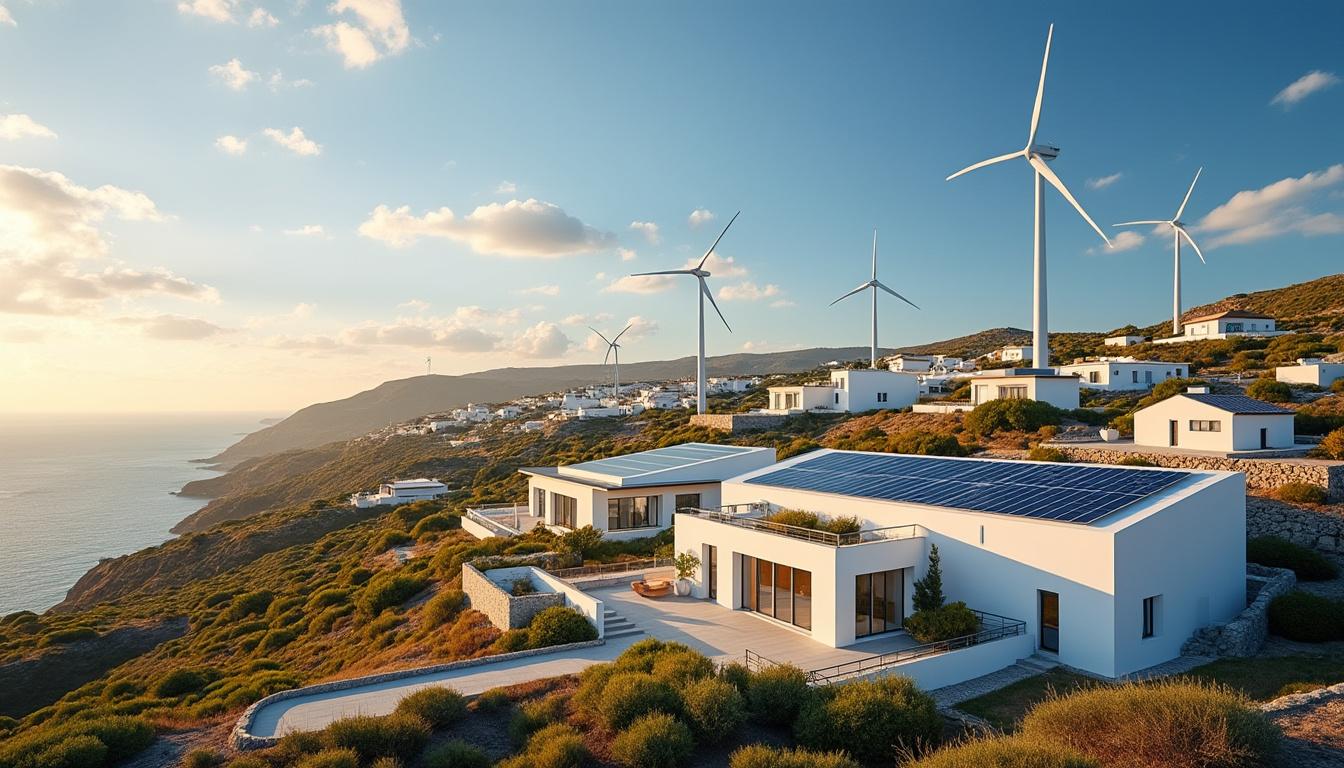
Portugal has revised the PNEC 2030 and raised the ambition: 51% of renewables in final consumption by 2030. The movement aligns with the RED III Directive, which calls for quicker permitting and reinforced networks. The outlook is favorable: between 2014 and 2024, the total installed capacity grew by about 34.9%, and renewable capacity increased by nearly 77.7%, consolidating a solid base for the decade.
To capture this potential, the Acceleration Areas coordinated by LNEG come into play: zones of lower environmental and heritage sensitivity where licensing projects will be faster. This reduces financial costs (less waiting time) and anticipates the entry of cheap energy into the system. The strategy integrates enhancements to interconnections, digitalization of networks, and distributed storage, all essential elements for efficient integration of wind and solar.
Another advantage is the articulation with energy communities. If the country progresses with 3 to 5 GW of collective self-consumption by 2030, neighborhoods and small businesses could lower costs, relieve the network during peak hours, and create a local energy culture. In industrial areas, photovoltaic rooftops and PPA contracts with nearby parks make electricity predictable and competitive.
What to do now to align with 2030
Mapping a step-by-step plan yields consistent results. Municipalities, condominiums, and SMEs can act in parallel, reaping gains within the next 12–24 months.
- 🗺️ Identify projects in Acceleration Areas for quick licensing.
- 🧩 Combine solar + batteries + load management in condominiums and SMEs.
- 🤝 Structure energy communities with clear sharing rules.
- 🔌 Prepare charging infrastructures linked to the building’s sunlight.
- 📈 Consider PPAs of 5–10 years to stabilize energy costs.
| 📅 Year | 🎯 Goal/Milestones | 🛠️ Key Actions | 💥 Expected Impact |
|---|---|---|---|
| 2025 | Faster licensed pipeline | Acceleration Areas and network reinforcement | Decrease in financial costs ⚖️ |
| 2026–2027 | Scale up self-consumption | Communities and local PPAs | More stable prices 📉 |
| 2028–2029 | Widespread storage | Batteries + demand management | Less congestion and peaks 🔋 |
| 2030 | 51% renewables in final consumption | Smart grid operation | Predictable and clean bills ✅ |
The path to 2030 is pragmatic: accelerate where there is less risk, integrate distributed solutions, and ensure that cheap energy reaches the end consumer. This is where policies and local projects intersect.
Flexible grids, storage, and blackouts: lessons to reduce risks without blaming renewables
The blackout in April on the Iberian Peninsula showed how an interconnected system can suffer from “chains of technical failures”. ADENE was clear: renewables were not responsible. The lesson is to strengthen flexibility — from real-time operation to devices in your home — to manage intermittency and rare events.
In practical terms, flexibility means shifting consumption, storing surpluses, and having algorithms balancing production and demand. Batteries, heat pumps with thermal inertia, smart chargers, and “virtual power plants” (VPP) transform thousands of small resources into a large stabilizer. For you, this translates into discounts, incentives, and greater resilience.
Intermittency management that works
The “Atlantic Neighborhood”, a fictional example inspired by real projects on the coast, installed 1 MWh of condominium batteries and hired a flexibility aggregator. In exchange for services to the grid (frequency regulation and fast response), residents received credits on their bill. The result: fewer peaks, more gains, and an almost invisible experience for the user.
- 🕒 Dynamic tariffs: shift washings and cooling to cheap hours.
- 🔋 Storage: save excess solar from noon for dinner.
- 🚗 Bidirectional charging: use the vehicle as the house’s battery.
- 🧠 Aggregators: gather small resources and sell services to the system.
- 🛰️ Forecasting: weather + AI improve daily operations.
| 🧰 Tool | ⚙️ How it operates | 🏆 Benefit | 🌍 Example |
|---|---|---|---|
| Demand management 📶 | Shifts loads to cheap hours | Lower average price | AC and AQS programmed |
| Batteries 🔋 | Store and stabilize power | Fewer peaks and drops | Condominium with 200 kWh |
| VPP 🤝 | Aggregates thousands of households | Revenue from services 🔁 | Solar Cooperative of Serra |
| Interconnections 🌐 | Share surpluses | Resilience | Flows PT–ES at peaks |
Do you want to see how this operates on the ground? There are increasingly public demonstrations and pilot experiences showing technological maturity.
When your home, your condominium, and the grid speak the same language, intermittency ceases to be a problem and becomes an opportunity.
Transport and consumers: smart electrification, hybrids in transition, and focus on public transport
In mobility, messages of caution and ambition coexist. The European goal of banning the sale of combustion cars by 2035 is under debate and, as emphasized by ADENE, may require a more gradual transition. There is space for hybrids as a bridge, but the priority should be to expand quality public transport and create conditions for smart charging at home and at work.
For you, the question is practical: how to spend less per kilometer? The answer combines walking and cycling trips, integrated monthly passes, and, when the car is essential, electrification with the right tariffs and, ideally, charging with sunlight from your roof. In condominiums, installing shared infrastructure — with individual measurement — democratizes access to cheap charging.
Smart charging at home and in the condominium
If you live in an apartment, it’s worth organizing the assembly to approve the electromobility plan. From there, a manager installs the electrical backbone, and each unit joins when they want. In houses, the solution is straightforward: wallbox, bi-hourly tariff, and, if possible, integration with photovoltaics. The algorithm takes care of the rest.
- 🌞 Charging during sunny hours with self-consumption lowers the cost per km.
- 🕘 Using night tariffs stabilizes the bill and protects the grid.
- 🔁 V2H/V2G (when available) turns your car into a flexibility resource.
- 🚍 Prioritize train, metro, and bus in daily routines.
- 🧭 For long trips, plan stops at fast charging only when necessary.
| 🚗 Mode | 💶 Cost per 100 km | 🌫️ Emissions | 📝 Useful note |
|---|---|---|---|
| EV charged at home ⚡ | Low | Very low | With sun, cost drops even more ☀️ |
| Hybrid (HEV/PHEV) 🔌 | Medium-low | Low | Works well as a bridge |
| Combustion ⛽ | High | High | Volatile with fuel prices |
| Public transport 🚍 | Very low | Very low | Best urban cost-benefit |
A fictional condominium in Gaia, “Ribeira Verde”, planned 30 charging points, a bi-hourly contract, and micro-PV on the roof. The result was an average reduction per user and, above all, autonomy to choose the best charging time. Cheaper mobility arises from simple and coordinated decisions.
Industry and green hydrogen: where it makes sense to invest now to cut costs and emissions
Green hydrogen is promising, but it is not a “silver bullet” for everything. ADENE highlights that its immediate role is in industry, especially where it is difficult to electrify directly: high temperatures, chemical processes, and heavy logistics. The prudent strategy is to advance gradually, prioritizing sectors with the highest marginal benefit.
In cement and ceramics, hydrogen blends with gas and then total replacement when feasible reduce emissions and anticipate regulatory targets. In ports, H2 corridors for forklifts and short-distance trucks provide operational robustness. For SMEs, the great opportunity lies first in efficient electrification — industrial heat pumps, high-efficiency motors, and heat recovery — and only later in green molecules, when technical and economic viability is proven.
Practical steps for companies
A layered approach helps reduce costs already in the next investment cycle. Energy audits, PPAs, and active load management create the “electric foundation” that supports the use of hydrogen when it makes sense.
- 🧪 Evaluate processes: where you need >150 ºC and where a heat pump solves it.
- 📄 Close PPAs with solar/wind to lower and stabilize electricity prices.
- 🧱 Test H2 blends in pilot furnaces with rigorous monitoring.
- 🚚 Consider using H2 for internal logistics in port/warehouse.
- 📊 Implement 24/7 monitoring and predictive maintenance.
| 🏭 Use of H2 | 📈 Maturity (2025) | 💶 Relative cost | 🔜 Next step |
|---|---|---|---|
| High temperatures 🔥 | Medium | High | Pilots in furnaces and boilers |
| Heavy transport 🚛 | Low-medium | High | Dedicated logistic corridors |
| Chemical and refining ⚗️ | Medium | High | Gradual replacement of grey H2 |
| SMEs (process heat) 🧰 | Low | Medium-high | Prioritize heat pumps and efficiency |
To delve into cases and trends, it is worthwhile to explore demonstrations and technical interviews that translate technology into practice.
If your company operates in thermal processes, the safest path is: electrify first where possible and reserve hydrogen for the “hard nodes”. An informed decision today saves a lot tomorrow.
Useful resources and next steps
For those who want to move forward without detours, practical guides on eco-friendly materials, self-consumption, and efficient rehabilitation are available at Ecopassivehouses.pt. A simple action you can take now: schedule an energy audit and map where your home or business can generate, store, and save — the cheapest energy is always the one you don’t need to buy.
Source: rr.pt