The cost of electricity from solar and wind has fallen historically, and today it surpasses fossil fuels in price and predictability. For those designing efficient homes, solar neighborhoods, and low-consumption buildings, this changes everything.
| Short on time? Here’s the essential: | |
|---|---|
| ✅ Key points | 💡 What to do now |
| ✅ Solar and wind already have LCOE lower than coal and gas ⚡ | Conduct a pre-study of consumption and roof; compare 3 self-consumption proposals 🔍 |
| ✅ 91% of new renewable projects are cheaper than fossil fuels 💶 | Use contracts with PPA or local cooperatives to lock in stable pricing 📉 |
| ✅ Integration into the grid requires storage and cable reinforcement 🧠 | Plan for batteries and pumping when there is excess and dynamic rates 🔋 |
| ✅ In Portugal, renewables already guarantee large shares of consumption 🌬️☀️💧 | Combine efficiency (insulation) + local production + load management 🏠 |
Renewable Energy: real cost declines show why solar and wind already surpass fossil fuels
There is a simple metric to compare generation technologies: the LCOE (Levelized Cost of Energy), which aggregates investment, operation, and maintenance over the entire lifetime. Looking at this metric from 2009 to 2024, the difference is clear. Photovoltaic solar has fallen from around 496 $/MWh (~55 €/MWh in 2024), while land-based wind dropped from approximately 380 $/MWh to ~49 $/MWh (~45 €/MWh). In contrast, coal and gas have maintained higher and more volatile costs.
This turnaround is driven by three engines: technological innovation, industrial scale, and consistent public policies. More efficient modules, smart inverters, taller wind towers, and optimized blades have reduced the unit cost. Larger production lines have diluted fixed expenses. Competitive auctions and clear decarbonization targets have created predictability for investors.
Even when considering combined cycle gas, whose LCOE fell from around 115 $/MWh to ~74 $/MWh (~68 €/MWh), it remains on average higher than wind and often above large solar projects. Gas peak plants, used during high demand times, have remained among the most expensive, falling from around 186 $/MWh to ~165 $/MWh. Coal also dropped from ~153 $/MWh to ~115 $/MWh (~106 €/MWh), but far from competing with wind and solar.
There are important nuances. Raw material costs and supply chains can fluctuate with geopolitics. Long licensing processes, saturated grid, and system balancing costs raise the final price in certain markets. Still, the trend vector remains favorable for renewables. At the same time, organizations like IRENA emphasize that 91% of new green plants are already cheaper than fossil fuel alternatives, and that only in 2024, the avoided costs in fossil fuels reached ~397 billion euros — a huge relief for consumers and importing countries.
For homes and buildings, the effect is direct: self-consumption projects and mini-plants are now financially viable over a shorter horizon and with lower risk. For municipalities, PPAs with wind and solar provide tariff predictability for 10–20 years, reducing exposure to gas shocks. And for those planning territory, the role of grids, storage, and demand management is reinforced as an “invisible factory” that transforms cheap energy into useful energy.
| ⚗️ Technology | 2009 (€/MWh) | 2024 (€/MWh) | 📉 Variation |
|---|---|---|---|
| ☀️ Solar PV | ~456 | ~55 | ⬇️ ~−88% |
| 🌬️ Land-based wind | ~350 | ~45 | ⬇️ > −70% |
| 🔥 Gas (combined cycle) | ~106 | ~68 | ⬇️ moderate |
| ⚡ Gas (peak) | ~171 | ~152 | ⬇️ slight |
| 🪨 Coal | ~141 | ~106 | ⬇️ limited |
Practical result: when it comes to price per MWh over the lifetime, solar and wind have already won the race — and with a comfortable margin.
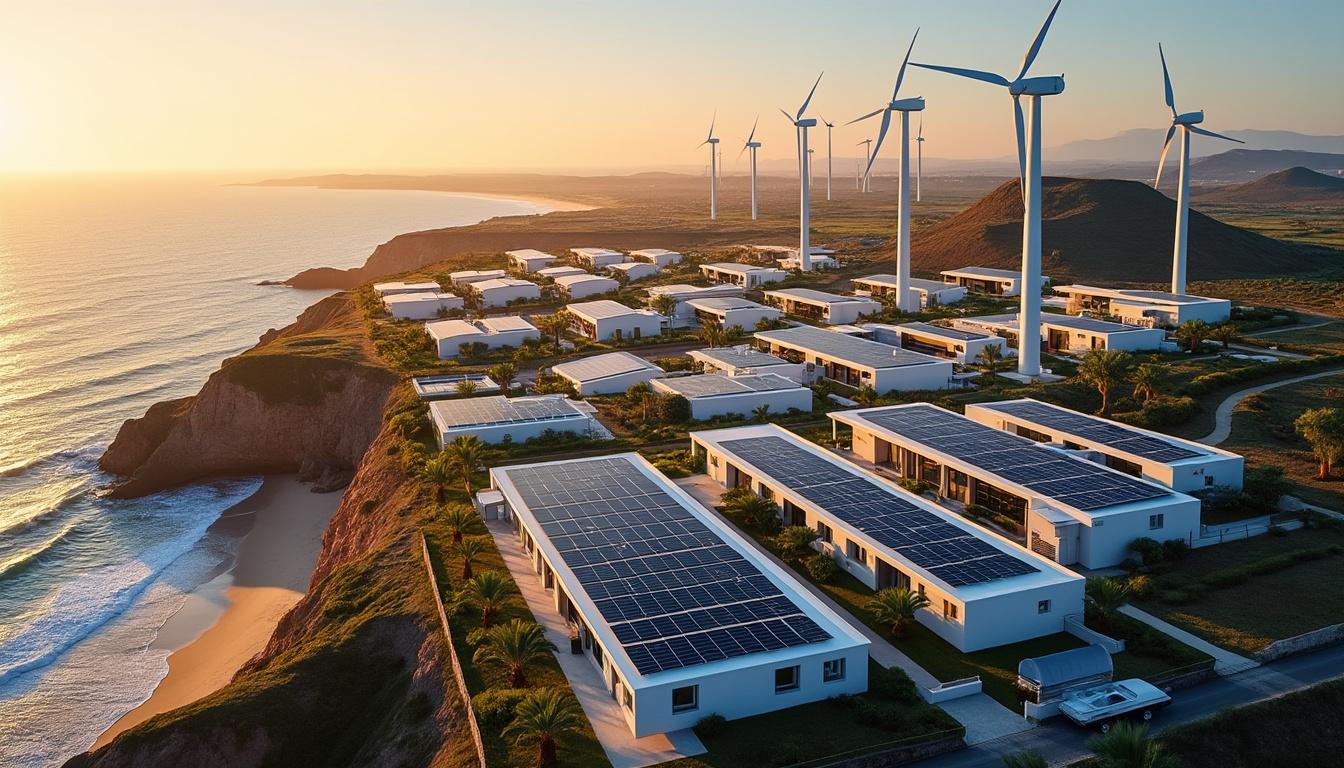
From cost per MWh to your bill: turning the advantage of solar and wind into lower bills
If the LCOE of renewables has fallen, why haven’t some bills decreased yet? Because the final bill includes grid, fees, taxes, and system balancing. The good news is there is room for action. The combination of efficiency, self-consumption, and load management allows families and businesses to capture the cheapest electricity at the right times.
Start with the basics: a consumption diagnosis. Identifying peaks, continuous loads, and displacement potential (e.g., water heaters, heat pumps, vehicle charging) reveals quick opportunities. Next, size the photovoltaic system considering roof orientation, shading, and usage patterns. In many cases, a small battery can already rebalance the daily curve and reduce purchases during expensive hours.
In markets with less remuneration for grid injection or with wire usage tariffs (like regulatory changes observed in Brazil from 2026), the keyword is self-consumption. Scheduling washing machines, pumping water, or charging EVs at noon turns surpluses into savings. Where there are residential PPAs or energy cooperatives, it is possible to lock in stable prices, protecting against gas volatility.
Practical example: “Oliveira House,” 6 kW roof and 5 kWh battery
In a residential neighborhood, a household with average annual consumption installed 6 kW of solar and a 5 kWh battery. By displacing loads (DHW with the heat pump at noon, washing and dishwashing machines during solar windows, EVs on weekends), it raised self-consumption above 70%. With a simple surplus sale contract, the remainder ensured additional return.
The most interesting part is the comfort: a well-insulated house (wood wool, efficient window frames, controlled shading) needs less energy. Thus, every kWh of solar “counts more.” And when mechanical ventilation with heat recovery is integrated, the gain doubles in winter. It’s architecture working for energy — and not the other way around.
- 🧭 Step 1: survey hourly consumption profiles; identify movable loads.
- 🔆 Step 2: size the PV for self-consumption, not for “maximum production” at any cost.
- 🔋 Step 3: evaluate a small battery; focus on reducing purchases during peak hours.
- 🧱 Step 4: invest in insulation, airtightness, and shading — kWh saved is kWh generated.
- 📲 Step 5: use simple automation (timer, smart plugs) to manage loads with sun.
- 🤝 Step 6: compare proposals, check warranties, and preventive maintenance.
Takeaway for your home: where there is a well-oriented roof and daytime use, cheap solar energy turns into tangible savings.
Grid integration: storage, management, and the “paradox” of renewable abundance
When the sun and wind are cheap, a new challenge arises: how to use this energy exactly when it appears? This is where storage, demand flexibility, and grid reinforcements come into play. In several countries, there are days when renewable production is enormous at noon, compressing prices, but quickly drops by late afternoon. The result is peaks in starting fossil plants and sometimes curtailment (shutting down turbines or inverters).
Portugal well demonstrates both sides. There were periods with 73% of consumption covered by renewables in a single day, with hydropower and wind leading. At the same time, notable import balance occurred at other times, indicating that the grid and storage have not yet captured all the local abundance. In a recent December, pumping delivered around 267 GWh and batteries injected only 17 GWh, numbers that reveal room to grow.
What is the practical solution? Three layers: infrastructure, technology, and habits. First, reinforcing cables, substations, and interconnections allows cheap electrons to reach more consumers. Then, using stationary batteries, pumping, and even heat (thermal tanks, DHW) transforms solar surpluses into nighttime energy. Finally, adjusting loads with dynamic tariffs places the washing machine during solar peaks and EV charging outside of peak times.
How to design buildings ready for the future grid
Buildings with a simple “energy brain” play a big role. A small EMS (Energy Management System) orchestrates PV, battery, heat pump, and chargers, prioritizing self-consumption and good timings. With this, a condominium reduces peaks, lowers contracted power costs, and still provides a service to the grid, smoothing the afternoon curve.
For municipalities and industries, microgrids with wind and solar, storage, and flexibility contracts monetize the availability to adjust consumption in minutes. It’s the market paying for stability. The more adjustment capacity exists, the less we will depend on expensive gas in critical moments.
Guiding idea: cheap energy exists, but it needs “pathways and boxes” — grid and storage — to arrive when it’s most necessary.
Exploring real cases of integration speeds up sound decisions. Next, a global overview helps understand the scale of the movement.
Global scenario: 582 GW added, record investments and 91% of new projects cheaper
The world installed about 582 GW of renewable capacity in a single year, raising the total to approximately 4,443 GW. Investment in the transition reached around 2.21 trillion euros (about one-third — ~742 billion euros — directly in renewable technologies). The numbers are striking and explain why costs have fallen: the larger the market, the faster the learning and competition among suppliers.
Official perspectives are clear. The UN advocates that by 2050 it is possible to supply 100% of energy from renewable sources, and IRENA highlights the unavoidable reality: renewables are already, in practice, the lowest cost option for most new installations. At the same time, there’s a short-term goal to meet: jump from 10.3 TW in 2024 to 11.2 TW by 2030. To achieve this, the average growth rate needs to rise from ~15% to ~16.6% per year — a feasible adjustment, as long as licenses accelerate, supply chains remain open, and financing reaches the Global South.
What changes for G20, G7, and consumers
Projections indicate that the G20 will concentrate over 80% of global renewable energy by 2030, while G7 economies are expected to raise their share to about 20% of global capacity. This brings scale to solutions and further reduces costs for technologies like heat pumps, residential batteries, and hybrid inverters. For consumers, it means more attractive long-term contracts and more mature products, with better after-sales service.
The message coming from above is coherent with what is seen on the ground: clean energy is smart economics. It stabilizes prices, reduces risk, cuts imports, and lowers emissions. The opportunity now is to ensure that cost benefits reach the outlet, through modernized grids and simple rules for those wanting to produce and share energy locally.
In summary, the world has already chosen the path. What remains is to accelerate execution so that the low price of renewable MWh translates into lighter bills and more resilient systems.
Portugal in focus: wind, water, and sun lead; grid reinforcement and storage are the next leap
Portugal has experienced days with 73% of consumption covered by renewables, with hydropower around 36%, wind 27%, biomass 5%, and solar 5%. In December, renewable production grew more than 48% compared to the previous year, with thousands of GWh coming from hydropower and wind and a solar contribution already noticeable. Still, the country recorded a import balance of ~4,581 GWh during certain periods, evidence that it is necessary to reinforce interconnections, internal grids, and storage capacity to take advantage of local production peaks.
In operation, production from pumping was around 267 GWh and injection into batteries was 17 GWh, modest numbers for the ambition that the territory allows. Non-renewable production, primarily gas, fell ~16% in one of the analyzed months, but rose in the annual total due to hydrological variability and wind patterns — a reminder that the transition needs redundancies and flexibility.
How to turn this into gains for cities and neighborhoods? The path is pragmatic: accelerate licensing for solar rooftops, encourage energy communities, reinforce local cables, and invest in neighborhood batteries and more pumping. In parallel, promoting dynamic tariffs and digitizing meters gives the right price signal to consumers to shift loads.
Checklist for homes and condominiums ready for the “new normal” energy
- 🏠 Thermal envelope: insulate roofs and facades; efficient glass reduces peaks.
- ☀️ Solar roof: prioritize south/southwest orientation; minimize shading.
- 🔋 Battery: 3–7 kWh already smooth the curve; integrate with simple EMS.
- 🚗 EV: scheduled charging at noon or off-peak night times.
- 🧩 Flexibility: timers and smart plugs for laundry and DHW with heat pump.
- 🤝 Energy community: share surpluses in the neighborhood; improve the self-consumption factor.
- 📑 Contracts: compare PPAs, dynamic tariffs, and surplus sale conditions.
Local cases confirm: when architecture, technology, and management work together, the cheap electricity from the sun and wind transforms into accessible and predictable comfort — exactly what is expected from a country with excellent hydric, wind, and solar resources.
Source: jornaleconomico.sapo.pt