The opposition to mega solar plants in Castelo Branco has grown because the scale and location promise energy benefits, but also delicate environmental and social pressures. This practical guide helps to read what is at stake and points out paths to reduce impacts, without losing focus on the energy transition.
| Short on time? Here’s the essence: | 🔎 Useful summary |
|---|---|
| ✅ Key point #1 | Dimension and location matter — projects like Sophia and Beira Solar Park pose risks to protected landscapes and biodiversity 🦋 |
| ✅ Key point #2 | Mitigation is possible: agrivoltaics, repowering, solar rooftops and degraded land first 🌿 |
| ✅ Key point #3 | Avoid the common mistake: ignoring the EIA or participating late. Demand ecological corridors, buffers, and independent monitoring ⏱️ |
| ✅ Bonus | Protect the local economy: community benefit agreements, low-impact rural tourism, and local technical training 💼 |
Real environmental impacts of mega solar plants in Castelo Branco: soil, water, and biodiversity
In Castelo Branco, the discussion is not “solar, yes or no,” but “where and how.” Two mega projects — Sophia and Beira Solar Park — concentrate the concern of municipalities, environmentalists, and rural communities. Quercus and FAPAS highlight serious impacts if installed in classified areas and landscapes of high ecological value. The UNESCO Geopark entity, Naturtejo, has already issued an unfavorable opinion, emphasizing the irreversible visual impact and the pressure on ecological corridors.
The numbers help to understand the scale. In Penamacor, the Sophia project plans about 200 hectares occupied by panels; in Fundão, in Mata da Rainha, there is talk of over 80 hectares in an almost continuous area. In Idanha-a-Nova, where 85% of the territory is dedicated to hunting zones, the debate is especially sensitive: habitat fragmentation threatens species and interrupts wildlife routes. It is no surprise that Beira Solar Park, rejected by APA last July and now submitted again for EIA, is under tight scrutiny.
There are those who live the tension in their daily lives. Farmers like Clara worry about water, soil, and pollination; new residents, like Laurence, are revitalizing farms and fear seeing agricultural projects strangled by shadows and fences. If the sun of Beira Baixa is worth millions, it cannot be worth everything at the doorstep. The risk is not confined to flora: soil compaction from construction, reduced water infiltration, and the simplification of the ecological mosaic can lead to imperceptible but cumulative losses.
What is at stake in the municipalities of Penamacor, Fundão, and Idanha-a-Nova
The territory has sensitive areas, open views that support nature tourism and agricultural heritage that retain population. The extensive occupation of panels creates three practical challenges: habitat fragmentation, hydrological pressure, and barrier effect on traditional activities. Mitigation requires fine design of the park, active vegetation management, and functional ecological corridors. The absence of these components aggravates conflicts and increases the likelihood of legal and social challenges.
- 🌱 Soil and water: avoid compaction, reinforce retention basins and native hydroseeding practices.
- 🦔 Fauna: ensure wildlife passages and scheduling of work outside nesting seasons.
- 🌾 Rural activities: preserve agricultural paths, water points, and access to plots.
- 👀 Landscape: create visual buffers and limit the height of structures in more exposed fronts.
| Impact 🌍 | Risk ⚠️ | Mitigation ✅ |
|---|---|---|
| Fragmentation of habitat | Loss of ecological continuity 🐇 | 30–50 m corridors with native species 🌳 |
| Local hydrology | Runoff and erosion 💧 | Retention basins + infiltration ditches ♻️ |
| Compacted soil | Lower fertility and infiltration 🌡️ | Prohibition of heavy machinery in wet season ⛔ |
| Landscape | Break of views and tourism 👁️ | Setbacks, green slopes, matte tones of modules 🎨 |
If the priority is clean energy with social acceptance, then smart location and robust mitigation are not optional — they are the foundation of licensing and long-term coexistence.
Solutions to reduce impacts: agrivoltaics, repowering, and “rooftop first” in Castelo Branco
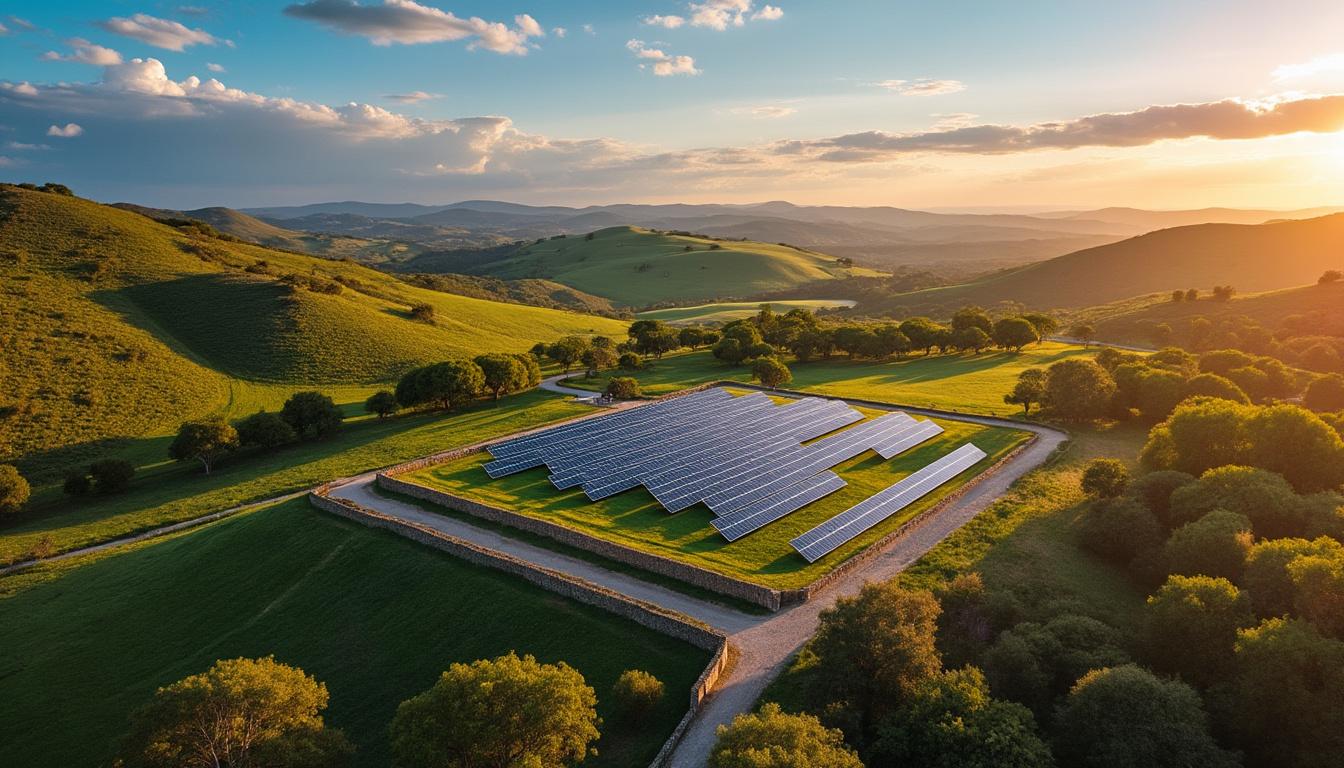
When the scale is daunting, the solution is to prioritize the right in the right place. Three practical hints help reduce the territorial footprint without stalling the energy transition: rooftops and parking lots first, repowering of old plants, and, where it makes sense, agrivoltaics that combine energy production with crops and grazing.
The “rooftop first” approach channels power to industrial, logistics, and school roofs, avoiding the consumption of fertile soil. Repowering replaces old modules with current technology, increasing production per already occupied hectare. And agrivoltaics — elevated and permeable structures — allow controlled shading, useful for crops like heat-sensitive vegetables, reducing evapotranspiration and safeguarding the local agricultural economy.
How to apply this in the Beira Baixa municipalities
Mapping existing surfaces (warehouses, markets, parking lots) can yield discreetly and well-accepted megawatts. In degraded soils or decommissioned quarries, conventional photovoltaic parks make sense with fewer conflicts. In living agricultural valleys, the prudent rule is exclusion or commitment to low-impact agrivoltaics, with monitoring of agricultural productivity.
- 🏢 Rooftops and shading: parking lots with PV create shade and energy.
- 🔄 Repowering: +30–60% production in already occupied areas ⚡
- 🌤️ Agrivoltaics: height >2.5 m, spaced rows, access for tractors.
- 🧪 Monitoring: compare agricultural productivity vs. control areas 📈
- 🗺️ Planning: exclusions for Class A/B soils and priority habitats.
| Solution 🧰 | Benefit 💡 | Local example 📍 |
|---|---|---|
| Rooftop first | Zero soil occupation 🌐 | Warehouses along the A23–CB/Fundão axis 🏗️ |
| Repowering | Less construction, more energy ♻️ | Update existing parks in the region ⚙️ |
| Agrivoltaics | Income + agricultural production 🌾⚡ | Vegetable farms in Fundão 🥬 |
| Degraded soils | Reduced conflict 🕊️ | Old farms and quarries 🪨 |
By combining these strategies, megawatts with a smaller footprint can be gained, maintaining the landscape quality and the productive fabric of the territory.
Local economy, agriculture, and rural tourism: risks and opportunities in Beira Baixa
The fear is not abstract: those who invested in rural tourism, in local products, and in returning to the land do not want to see the value of the territory diluted. In Mata da Rainha, farms restored by new residents energize gardens, artisanal agroindustry, and small-scale lodging. A continuous mesh of panels can reduce visual attractiveness, alter paths, and bring construction noise and heavy traffic. The impact on tourism demand and property prices depends on the design and distance to villages.
However, there are clear opportunities when promoters work with the community. Community benefit agreements (funds for energy efficiency in homes, rehabilitation of paths, support for local associations) and technical training for young people can anchor qualified employment. The Fundão Cherry shows how agricultural value grows when the territory maintains a strong identity; energy projects should reinforce that identity, not replace it.
Practical examples and viable paths
A honey producer in Penamacor can install pollinator-friendly flower strips along ecological corridors, generating nectar and reducing dust. In Idanha, interpretive trails with viewpoints and landscape buffers preserve the appeal of the Geopark. In lease contracts, clauses protecting meadows and agricultural access avoid conflicts. And, of course, transparent compensations linked to verifiable targets — for example, replanting 5 native trees for each pole installed.
- 🤝 Community benefits: annual fund for home energy efficiency.
- 🛣️ Infrastructure: rural path improvements and trail signage.
- 🌸 Ecological quality: pollinator strips and wildlife refuges.
- 🎓 Training: technical courses on solar O&M for local youth.
- 📏 Setbacks: minimum distances to villages and viewpoints.
| Economic theme 💶 | Risk/gain 📊 | Practical measure 🛠️ |
|---|---|---|
| Rural tourism | Risk of demand decline 🏡 | Visual buffers + interpretive trails 👣 |
| Agriculture | Shadows and access 🚜 | Agrivoltaics and dedicated agricultural paths 🚧 |
| Employment | Local opportunity 👷 | Training and hiring quotas 📑 |
| Municipal revenue | Revenues vs. service costs 🧮 | Benefit plans and annual monitoring 🔍 |
When investment strengthens agriculture and tourism, power plants cease to be foreign bodies and begin to integrate with the territory’s vocation.
Public participation and Environmental Impact Assessment: how to act and what to demand in Castelo Branco projects
There is a key moment when the community can shape projects: the Environmental Impact Assessment (EIA). In 2024, the Beira Solar Park was rejected by the APA and resubmitted with a new proposal; in parallel, the Castelo Branco City Council approved, on November 21, 2025, a cautious position on mega-central, reinforcing support for decarbonization but demanding environmental guarantees. Public participation, if informed and proactive, improves projects.
What to ask for? High-resolution habitat mapping, hydrological runoff models with flood scenarios, decommissioning plans with financial guarantees, and independent biodiversity monitoring for five to ten years. Demanding transparency about who operates, timelines, access to data, and complaint mechanisms accelerates the resolution of conflicts.
Practical steps for effective intervention
Organizing around evidence avoids noise and strengthens local positions. Thematic meetings with specialists, field visits, and submission of opinions with georeferenced maps are much more persuasive than simple opinions. Where there is evident conflict — for example, near sensitive areas of the Geopark — recommending concrete locational alternatives assists the process.
- 📅 Monitor deadlines for public consultation and register participation.
- 🗂️ Request technical attachments: hydrology, noise, flora/fauna.
- 🧭 Propose alternatives for location and design.
- 📡 Demand independent monitoring with open data.
- 💶 Advocate for binding community benefits.
| EIA stage 🧩 | What to check 🔍 | Public action ✍️ |
|---|---|---|
| Initial study | Locational alternatives 🗺️ | Suggest degraded soils and rooftops 🏭 |
| Public consultation | Critical impacts ⚠️ | Submit opinion with maps and photos 🖼️ |
| APA declaration | Conditions and mitigation 📜 | Request reinforcement of measures and deadlines ⏳ |
| Post-license | Monitoring and audits 📈 | Demand open data and annual reports 📬 |
With prepared participation, projects tend to emerge better and faster. Information and concrete proposals are the leverage for a quality energy transition.
Landscape and architectural integration: best practices for solar mega plants that respect Beira Baixa
When installation is unavoidable, the difference between conflict and coexistence lies in the details of design. Beira Baixa has harsh light, wide horizons, and resilient flora; integrating panels calls for matte colors, controlled height, green slopes, and living biodiversity corridors. The connection to villages should be made with interpretative paths and discreet signage, reinforcing environmental education and creating small points of interest, rather than opaque walls.
There is also a domestic equation that reduces pressure on the territory: by equipping houses and buildings with efficiency (natural insulation, shading, night ventilation) and solar on rooftops, the demand for large areas decreases. The platform Ecopassivehouses.pt compiles practical and accessible solutions that help reduce consumption without losing comfort, aligning efficiency with local production.
Quality integration checklist
For parks close to sensitive views, the setback from the roadway and villages should be generous, with tree strips of native species (oak, cork oak, strawberry tree) and meliferous undergrowth. The noise from inverters requires enclosure and strategic location. Rainwater drainage should prioritize infiltration and retention, reducing runoff peaks. Finally, landscape restoration during decommissioning needs financial guarantees and a clear timeline.
- 🎨 Materials and colors: matte finishes, without reflections, buried cabling.
- 🌳 Green buffers: 20–50 m with indigenous species.
- 🔇 Noise: protected inverters and construction hours.
- 💧 Water: infiltration ditches, basins, and riparian vegetation.
- ♻️ End of life: decommissioning plan with guarantees.
| Component 🧱 | Good practice 🌟 | Result 👏 |
|---|---|---|
| Panels and supports | Matte tones and contained height 🖤 | Less visual impact 👀 |
| Perimeter | Fences permeable to wildlife 🦊 | Ecological connectivity 🌐 |
| Drainage | Green infrastructure 💚 | Less erosion and flooding 💦 |
| Community | Paths and viewpoints 👣 | Positive appropriation of space 🤝 |
If you need to retain a simple idea to apply now: prioritize rooftops, requalify what exists, and only then choose the right land with exemplary design. This is how solar energy grows in harmony with Beira Baixa and with the lives of those who live there.
Source: sicnoticias.pt