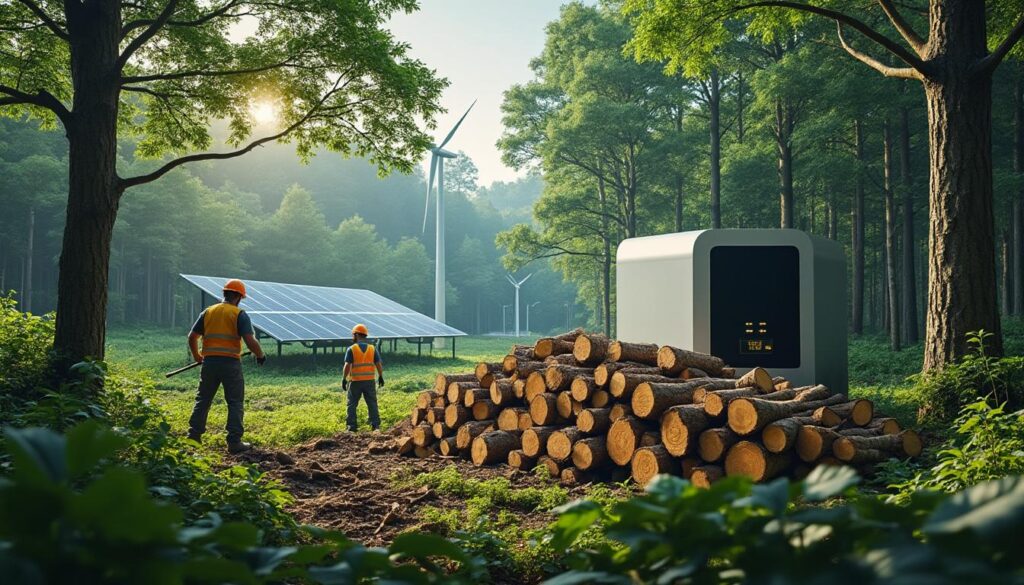
Trusting solely in renewable energy is a noble ambition, but it still collides with technical, economic, and social limits. Lídia Pereira’s public analysis helps refocus the debate: the goal is carbon neutrality with technological diversity, supply security, and fairness for families.
| Short on time? Here’s the essential: | |
|---|---|
| ✅ | Renewables are essential, but intermittency still requires flexibility, storage, and a smart grid ⚡ |
| ✅ | Plan in layers: home efficiency, solar self-consumption, batteries, load management, and participation in energy communities 🏠🔋 |
| ✅ | Avoid dependence on a single resource: combine solar, wind, hydro, and, when it makes sense, renewable gases or thermal heat 🌬️☀️🔥 |
| ✅ | Look at the system: the European energy market, interconnections, and stable rules provide predictability and fairer prices 🌍 |
| 🎁 | Bonus: set up the thermal accumulator as a “thermal battery” and reduce nighttime peaks without losing comfort 🚿 |
Intermittency and energy security: why 100% renewable is still challenging, even with good winds
Intermittency is the first obstacle. Sunlight and wind vary by hour, day, and season, while demand rises and falls with work patterns, weather, and the economy. The result is simple: without flexibility, there are surpluses on sunny days and shortages on cold, windless nights.
Portugal has advantages in hydro and wind, but there are “wind calms” in the summer and reduced inflows in dry years. Even with high renewable production, the system needs to respond to unexpected peaks: a cold front in the late afternoon, a national football game, or a heatwave that switches thousands of air conditioners on at the same time. Relying solely on renewable generation ignores the timing of demand.
This is where Lídia Pereira’s reading is useful: advance with ambition but with pragmatism. The path involves electrification “whenever possible,” without rushed exclusions of complementary low-carbon solutions. The ultimate goal remains steadfast: European carbon neutrality by 2050, with a robust intermediate target of reducing emissions by 90% by 2040, supported by carbon markets with limits and oversight.
In domestic practice, intermittency appears when photovoltaic production drops under clouds and the home needs to cook, heat water, and charge the car at the same time. In a neighborhood, the problem replicates with micro-variations that accumulate and pressure the grid. At the country level, congestion in cables and frequency oscillations require a rapid reserve of power.
What to do to mitigate intermittency in daily life
To reduce risks at home and in the neighborhood, it is advisable to organize consumption and diversify local sources. It doesn’t take a fortune to gain resilience: order and priorities matter as much as installed power.
- 🔌 Use timers to shift washing machines and dishwashers to sunny hours or cheaper rates.
- 🌡️ Turn the thermal accumulator into a “thermal battery”: heat water when the sun is out and use it at night.
- 🪟 Enhance the envelope: shading, efficient openings, and airtightness reduce peaks in climate control.
- 🔋 Consider a modest battery (4–8 kWh) to smooth out the late afternoon, when solar production falls.
- 🤝 Join an energy community to share surpluses and stabilize the neighborhood.
In the design of the national system, Iberian interconnections and a true European energy market help balance surpluses and shortages. Cooperation reduces costs, improves competition, and sends a clear signal for more investment in grids and storage.
| Source ♻️ | Variability | Ideal role | Main challenge |
|---|---|---|---|
| Solar ☀️ | Daily and seasonal | Daytime base and self-consumption | Sunset and winter |
| Wind 🌬️ | Hourly and seasonal | Night and winter coverage | Wind calms |
| Hydro 💧 | Dependent on rain | Regulation and rapid reserve | Prolonged droughts |
| Biomass 🌿 | More stable | Flexible base | Sustainable supply |
Key idea: intermittency is not failure; it is a design fact that requires technical flexibility and management of consumption.

Storage and flexibility: batteries, hydrogen and heat that provide stability to renewables
Without storage, the system is racing against the clock. With the right solutions, renewable production gains “muscle” and responds when the sky changes. There are three useful layers for homes and neighborhoods: electric batteries for hourly balance, thermal storage for daily comfort, and hydrogen/biomethane as a long-term strategic reserve.
Lithium-ion (LFP) batteries dominate the residential scale. They store solar surpluses from 10 AM to 4 PM and return it in the late afternoon. In condominiums, shared batteries reduce contracted power and relieve the local grid. In electric vehicles, V2H/V2G allows the car to be used as a portable reserve, as long as the inverter and the contract with the supplier support it.
For heat, well-insulated tanks accumulate energy for showers and cooking. Radiant floors with thermal inertia smooth temperature variations. In multi-family buildings, a hot water circuit with centralized heat pumps reduces costs and facilitates peak management. It’s a well-known, robust technology with simple maintenance.
For seasonal durations, green hydrogen is gaining traction in industrial ports and logistics clusters. It is not a solution for everything, but it works as a system “insurance” during weeks of renewable scarcity. Biomethane injected into the grid also covers thermal and industrial needs with very reduced emissions, as long as the source is waste and sludge.
How to choose the right storage for your reality
The choice should consider the typical duration of renewable energy shortfalls, efficiency, total cost, and integration with the grid. At home, it has helped to select a simple “package”: 4–8 kWh battery, programmed thermal accumulator, and an inverter ready for V2H. In the neighborhood, a common battery and a flexibility contract with the grid operator provide additional gains.
- 🔋 Prioritize batteries for 2–4 hours of useful autonomy in the late afternoon.
- 🌡️ Schedule water heating between 11 AM and 4 PM to absorb solar energy.
- 🚗 Consider V2H if the vehicle stays parked at home in the evening.
- 🧠 Prefer “grid-forming” inverters with remote updates and monitoring.
- 📈 Negotiate dynamic rates to maximize energy value at the right times.
| Option 🔄 | Typical Duration | Yield | Ideal Use | 2025 Note |
|---|---|---|---|---|
| LFP Battery 🔋 | 2–6 h | ~90–94% | Late afternoons | Stabilized prices and better V2H integration |
| Hot Water 🌡️ | 8–24 h | ~95% thermal | Showers and cooking | Great cost/benefit for self-consumption |
| Hydrogen 💨 | Weeks | 30–45% | Seasonal/industrial | Expansion of pilot projects |
| Biomethane 🌿 | Weeks | High in combustion | Thermal/industry | Scale linked to regional waste |
If you want to see practical cases and tutorials, it’s worth researching solutions implemented in European neighborhoods with good performance.
Tactical conclusion of this part: storing is amplifying — each kWh stored multiplies the usefulness of renewables.
Smart electrical grid and demand management: the “invisible side” that makes renewables reliable
Even with panels and batteries, reliability depends on the grid. Cables, substations, interconnections, and software orchestrate thousands of micro-decisions per minute. A modern grid “listens” to production and demand and adjusts in real time. This is why a more integrated European energy market, advocated by various voices, is vital for fair prices and stability.
Smart meters enable dynamic rates and automatic responses. A simple command can delay the washing machine, pre-empt electric vehicle charging, or lower the temperature of a heat pump by 1 degree for 30 minutes. Thousands of homes making small adjustments form a “virtual power plant” that avoids turning on an expensive and emission-heavy plant.
In Portugal, interconnections with Spain buffer peaks and utilize surpluses. Energy communities in new neighborhoods accelerate local digitalization. Flexibility managers — aggregators — pay residents to shift consumption during critical minutes. The result is equal comfort, but with lower emissions and costs.
Effective demand management tools
There are plug-and-play solutions that help without complicating the routine. The secret is to automate what doesn’t require daily attention and leave easy manual options for the rest. In buildings, centralized systems manage heat pumps, elevators, and lighting with simple algorithms, prioritizing safety and out-of-peak consumption.
- 🧰 Wi-Fi sockets and relays for non-critical loads (AQS, machines, dryers).
- 🌤️ Solar monitoring to trigger loads when production increases.
- 📱 Supplier apps with real-time rates and alerts.
- 🤖 Heat pump controllers with “eco” and “boost” timed modes.
- 🧩 Integration with EVs to charge between 2 AM and 6 AM or during sunny hours.
| Scale 🧭 | Flexibility Measure | Impact | Complexity |
|---|---|---|---|
| Home 🏠 | Schedule AQS and washing machine | ⬇️ peak, ⬆️ self-consumption | Low |
| Building 🏢 | Central management of heat pumps | High during critical hours | Medium |
| Neighborhood 🏘️ | Energy community + shared battery | Stabilizes local grid | Medium/High |
| Country 🌍 | European market and interconnections | More stable price | High (regulatory) |
Key question to remember: if the grid gains “intelligence,” why not let your home participate and be rewarded for it?
Complementary low-carbon technologies: renewable gases, district heat, and technological neutrality
Lídia Pereira’s assertion that “it is not credible to rely only on renewables” does not diminish climate ambition — it makes it more concrete. The point is technological neutrality: using the right solution, at the right time, without dogmas. In 2025, this includes biomethane from waste, green hydrogen in hard-to-electrify sectors, and high-efficiency thermal systems for neighborhoods.
Biomethane utilizes agricultural, urban waste, and sewage sludge. Injected into the grid, it replaces fossil gas and reduces fugitive methane emissions. In existing buildings, a blend of biomethane with hybrid heat pumps accelerates the transition without deep renovations. In professional kitchens and thermal processes, it maintains the flame with a reduced footprint.
Green hydrogen is not a silver bullet. It has losses in electrolysis and reconversion, but compensates in seasonal storage, steelmaking, chemistry, and heavy mobility. In ports with offshore wind, the synthesis of hydrogen and its derivatives (e-methanol, e-ammonia) can stabilize production and export energy in molecular form.
Renewable district heat connects residual biomass boilers, water-water heat pumps, and solar thermal to low-temperature networks. Neighborhoods with good housing density benefit from professionally maintained plants and individual meters. Bills decrease due to scale, and security increases because production is local and flexible.
Policies and investment: predictability matters
Clear EU targets — neutrality by 2050 and a 90% reduction by 2040 — create signals for industry and families. Market mechanisms with limits (such as carbon credits up to ~5% to complement national targets) provide flexibility without opening doors to coal subsidization. European programs have channeled hundreds of millions of euros into clean technologies, with specific calls above 100 million for innovation, and demand transparency in implementation — a condition that enhances trust.
- 🌿 Biomethane for existing buildings and thermal processes.
- 💨 Hydrogen in challenging industries and as seasonal insurance.
- 🔥 Low-temperature district heat in compact neighborhoods.
- 🔌 Electrification where most efficient (heat pumps, mobility).
- 📜 Stable rules and oversight of the carbon market.
| Complement 🧩 | Strength | Limit | Recommended use |
|---|---|---|---|
| Biomethane 🌿 | Utilizes waste | Limited scale | Retrofit and thermal |
| Hydrogen 💨 | Seasonal storage | Energy losses | Industry/peak |
| District heat 🔥 | Economies of scale | Requires density | Compact neighborhoods |
| Nuclear (EU context) ⚛️ | Continuous low carbon | Costs/acceptance | Systemic base |
For those designing or rehabilitating, the message is simple: technological diversity reduces risk and accelerates real decarbonization.
To see technical discussions about these solutions and their contexts, look for comparative analyses with independent data.
Final note from this part: the right technology, in the right place, is what transforms goals into accessible comfort.
From the home to the neighborhood: practical roadmap to reduce dependencies and gain resilience now
In a condominium in Aveiro — let’s call it “Ria Neighborhood” — the residents decided to take action. Solar panels on roofs, a shared battery of 200 kWh, heat pumps, and a small flexibility agreement with the grid operator. In 12 months, the average bill decreased and the neighborhood went through two heatwaves without distress.
To replicate, the secret is to work in layers: first efficiency, then local production, and finally flexibility. The order matters because every euro saved on insulation or shading lasts forever, while equipment has life cycles and upgrades.
12-month roadmap for a home or building
This plan is not dogma; it is a sensible path to 2025 that respects budget and comfort. Adapt it to your building’s and your family’s reality and confirm local rules and support opportunities.
- 🪟 Month 1–2: inspections for leaks, joints, and frames; sealing and simple adjustments.
- 🌞 Month 3–4: summer shading and optimizing solar gains in winter.
- ☀️ Month 5–6: photovoltaic installation with inverter prepared for battery and V2H.
- 🌡️ Month 7–8: heat pump and programmed thermal accumulator; CO2 sensors for ventilation.
- 🔋 Month 9–10: 4–8 kWh battery and integration with dynamic tariff app.
- 🤝 Month 11–12: joining an energy community and flexibility contract.
| Stage 🚀 | Typical Investment | Main Benefit | Practical Tip |
|---|---|---|---|
| Envelope 🧱 | Low to medium | Fewer climate control peaks | Sealing tapes and shades |
| PV + inverter ☀️ | Medium | Daytime self-consumption | Size for 60–80% of the load |
| Heat pump ❄️🔥 | Medium | High efficiency | Optimized heating curves |
| Battery 🔋 | Medium | Stable late afternoons | 4–8 kWh helps a lot |
| Community 🤝 | Low | Sharing and revenue | Clear governance rules |
In neighborhoods, three decisions make a difference: well-thought-out coverage (for solar and shading), a technical room with space for batteries and future piping, and pre-installation for charging points. When it’s time to expand, the infrastructure is already ready and inexpensive.
For inspiration with replicable solutions, look for case studies of Iberian energy communities and reports from grid operators.
Point to consider: resilience is born from the whole — efficiency + production + intelligent management.
Policies, market, and what to expect from COP30: clear rules to accelerate without brakes
Global climate events, such as COP30 in Belém, have a clear role: aligning ambition with operational pragmatism. Leading the European Parliament delegation, Lídia Pereira has emphasized three ideas that matter for homes and neighborhoods: firm targets, technological neutrality, and transparency in financing.
The EU aims for neutrality by 2050, with a ~90% reduction by 2040 compared to 1990 and limited space (up to about 5%) for international credits. The message is twofold: total commitment but with market mechanisms to accommodate different realities. Oversight is the responsibility of the European Commission, and the Parliament has tightened safeguards to avoid disguised subsidies for fossil fuels.
On the fiscal side, the gradual end of tax discounts on fuels follows a logic of just transition — change without shocks to family budgets. At the same time, there are calls for the Environmental Fund to prioritize energy poverty and soft mobility. All of this only works with clear communication: people need to know where the money is going and what projects exist in their municipality.
On the international front, expectations are growing that large emitters will take on mandatory contributions to the global effort. The European Union, which already supports a significant portion of climate financing, needs partners of equal measure to maintain the pace. Energy security and climate walk together as investments in grids, storage, and innovation open space for more renewables, with controlled risk.
What you can expect as a citizen and consumer
The new rules and programs are likely to reward efficiency and flexibility. In contrast, rigid, expensive, and polluting technologies will lose advantages. Those who anticipate reap savings, comfort, and asset value.
- 📉 More dynamic rates and accessible flexibility products.
- 🏘️ Support for energy communities and efficient rehabilitation.
- 🔧 Minimum performance requirements in rehabilitations.
- 🛰️ More digital grids and improved service quality.
- 🔬 Innovation supported by European programs with specific calls above 100 million euros.
| Theme 🧭 | Focused Measure | Expected Benefit | Impact for you |
|---|---|---|---|
| 2040–2050 Targets 🎯 | ~90% reduction by 2040 | Stable roadmap | Long-term planning |
| Carbon market 💱 | Flexibility with limits | Economic efficiency | Transition with controlled cost |
| Fair taxation ⚖️ | Gradual end of discounts | Predictability | Adjustment without shock |
| Financing 🔍 | Reinforced transparency | Public trust | More access to support |
Final message from this section: clear rules plus strong grids = reliable renewables and predictable bills.
Simple action to start today: program your thermal accumulator to heat between 11 AM and 4 PM and activate the “eco” mode of the heat pump. Small gestures, when added together, make renewables work better for you and for all.
Source: www.jn.pt