A new public support arrives at a crucial time to reduce energy costs in agriculture and accelerate the transition to clean sources in farms. The focus is clear: more efficiency, fewer emissions, and increasing energy autonomy in the field.
| Short on time? Here’s the gist: ⏱️ |
|---|
| ✅ 15 million € fund for efficiency and renewable energies in the agricultural sector 🌱 |
| ✅ Support in the form of grants for up to 100% of eligible investment ⚡ |
| ✅ Funded by the Environmental Fund and operated by IFAP 🏛️ |
| ✅ Applications on the IFAP portal after an announcement on the Environmental Fund website 🖥️ |
| ✅ Target projects: modernization of equipment and energy production/storage 🔋 |
15 Million Fund Launched to Boost Energy Efficiency in the Agricultural Sector
The Government is making available 15 million euros to support investments in energy efficiency and renewable energies in agricultural operations. The model is simple and competitive: grant funding, with the possibility of covering up to 100% of eligible investment, reimbursing proven expenses.
The support is funded by the Environmental Fund and will be operated by IFAP, bringing the process closer to the usual beneficiaries in the sector. Who is it for? Agricultural and livestock producers, cooperatives, associations, producer organizations, and irrigation associations, including very distinct realities – from the vintner with a cold room to the dairy operation with a milking parlor and water pumping.
The objective is twofold: to reduce the energy bill and consolidate the sustainability of farms. This happens by modernizing inefficient equipment (motors, pumps, lighting, refrigeration), installing renewable production (photovoltaic, biogas, biomass), and implementing storage (batteries) to manage peaks and self-consumption. The practical result? Fewer kWh purchased, better management of contracted power, and lower emissions.
In a context where climate resilience is decisive, this line promotes mature technological solutions and provides margin to farms, especially on irrigation, refrigeration, and processing bills. The publication of the announcement will define deadlines and criteria; until then, it is worth mapping consumption, preparing budgets, and gathering technical documentation to save time when applications open.
Final insight: the fund prioritizes actual energy impact; projects with structured measurement and verification tend to stand out.
Eligible Projects and Renewable Technologies That Bring More Return to Farms
There is a core of solutions that, in an agricultural context, combine technical performance and competitive payback. The decision matrix should start with the largest consumers: pumping, refrigeration, ventilation, heating water/process, and warehouse lighting. Based on this, the choice follows to renewables and automation.
Photovoltaic solar for self-consumption and irrigation
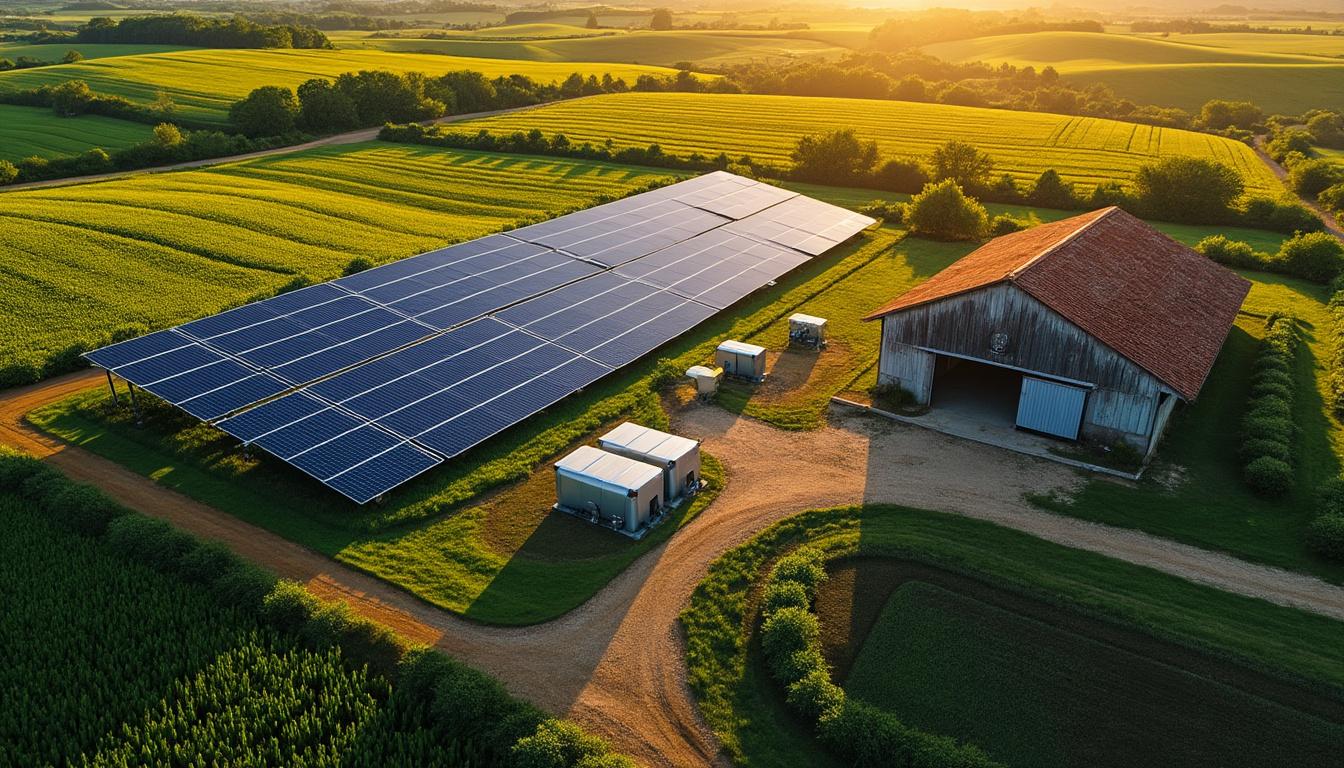
Photovoltaic on rooftops or ground immediately reduces the energy purchased from the grid. In farms with daytime irrigation, the synergy is direct: the sun produces when the pump operates. With batteries, the curve smooths out and peak hours are protected. In warm climates, light shading on roofs also improves thermal efficiency of installations.
Pumps, motors, and variable speed drives
High-efficiency IE3/IE4 motors and variable speed drives in pumps and fans deliver significant savings. Optimized hydraulics (diameters, head losses) and valve maintenance make a difference. Often, a motor upgrade + VSD reduces consumption by 20–40%.
Efficient refrigeration and insulation
For fruits, wine, or dairy products, chambers with variable speed compressors, rapid doors, and insulation in good condition are essential. Recovering heat from the refrigeration cycle for AQS/process reduces waste. Small details, like PVC curtains and seals, pay off quickly.
Biogas and biomass from waste
In livestock, effluents and organic waste can feed biodigesters, generating biogas for heat or cogeneration. In orchards and vineyards, woody biomass can power high-efficiency boilers with appropriate filters. Besides energy, it solves a waste problem.
Digitalization and monitoring
Flow and pressure sensors, smart meters, and energy management platforms allow for adjusting setpoints and detecting leaks. Without measurement, there is no lasting optimization. Simple integrations via Modbus or LoRaWAN are enough to reduce inefficiencies.
- 🔆 Photovoltaic for self-consumption + batteries (peak management) – solid foundation in almost all farms.
- 💧 Variable speed drives in pumping – quick savings and better pressure control.
- ❄️ Modernization of industrial refrigeration – less waste and better preservation.
- 🔥 Biogas/biomass when there are wastes – double benefit: energy and waste management.
- 📊 Energy and water monitoring – data-driven decisions and predictive maintenance.
A realistic example: in a typical “Quinta da Ribeira” in Alentejo, an 80 kWp system with VSDs in the pumps reduced the electricity bill by about 35–45% during the irrigation season, with less mechanical wear. The message is crystal clear: combining efficiency with renewable production multiplies results.
How Much Can You Save? Decision Metrics, Costs, and Returns with the 15 Million Fund
To decide with certainty, it is worth anchoring in clear metrics: simple payback, IRR, and levelized cost of energy (LCOE). With grant support, returns accelerate, often reducing payback by half. Below are three typical and comparable scenarios.
| Project 🚜 | Investment (€) 💶 | Support (%) 🎯 | Annual Savings (€) 💡 | Payback with support ⏳ |
|---|---|---|---|---|
| PV 50 kWp + VSD in irrigation | 70,000 | 80% | 15,000 | ~1 year 🟢 |
| Efficient refrigeration (200 m³ chamber) | 45,000 | 60% | 7,500 | ~2.4 years 🟢 |
| Biogas from effluents (heat/process) | 120,000 | 70% | 20,000 | ~1.8 years 🟢 |
Note that these values are illustrative and depend on consumption profiles, energy prices, and usage hours. Still, the pattern remains: the greater the support, the shorter the return, especially in systems used intensively during production periods. To reinforce financial robustness, it is wise to include maintenance contracts and cleaning plans (in the case of PV), avoiding performance degradation.
A fictitious cooperative, “Vale Verde”, with 150 farmers replaced 20 motors with IE4 models, installed 200 kWp of PV, and integrated LFP batteries of 100 kWh to smooth peaks. With public support, the own CAPEX fell by over 65% and the annual bill decreased by about 38%. The next step? Use monitoring to adjust pumping schedules and further reduce contracted power.
Operational conclusion of this section: combine efficiency + generation + management; it is this triad that sustains lasting savings.
How to Apply at IFAP: Step-by-Step to Not Miss the Timing
The support will be provided through reimbursement of the expenses incurred, up to the full eligible amount. Applications will be submitted on the IFAP portal, following terms and deadlines to be announced on the Environmental Fund website. Preparing before the announcement opens is crucial to not missing the window.
Preparation checklist
- 📂 Gather consumption data (12–24 months) and hourly profiles: bills, flow/pumping records.
- 🧭 Simple energy diagnosis: where most is spent, why, and what measures address the causes.
- 🧾 Comparable budgets (3 proposals when possible) with descriptive memory and savings estimates.
- 📐 Project/feasibility study: power, estimated production, integration with farming operations.
- 🛡️ Licenses and compliances: connection to the grid, safety, waste, noise, among others.
- 💳 Financial plan and schedule: phases of execution and evidence for reimbursement.
Avoid common mistakes: underestimating cabling, ignoring shading, misaligning production/consumption schedules, and forgetting O&M in the budget. A clean dossier accelerates analysis and reduces requests for clarification.
To formalize, follow the announcement on the Environmental Fund and submit the application on the IFAP. Support tools and examples of similar projects in the context of habitat and energy are available at Ecopassivehouses.pt, useful for inspiring simple and robust solutions.
If the goal involves solar irrigation and battery management, it is worth checking technical demonstrations to align expectations for production and motor startup.
The central message of this section: those who prepare the application with data and comparatives get ahead when the announcement opens.
Best Practices for Operation and Maintenance to Ensure Long-Term Results
Well-installed projects can fail due to lack of operation and maintenance. The secret is to create simple, scheduled routines based on indicators. Photovoltaic systems require visual inspection, seasonal cleaning, and tightening checks; pumps require vibration monitoring and alignment; cold chambers need leak tests and thermostat calibrations.
O&M plan that works in the field
Define a quarterly plan with routine tasks and an annual “deep” checklist. Include readings of PV production, battery status (SoH/SoC), pressure/flow records, and checks of idle consumption. A simple alarm in the management software when efficiency drops more than 10% triggers an inspection.
Measure to manage: KPIs to follow
Useful KPIs: kWh/kWp/day, kWh/ton of cold product, kWh/m³ of water pumped, power factor, and equivalent operating hours. Variations warn before failure. The methodology for measurement and verification (for example, aligned with IPMVP) proves savings and helps in dialogue with funders.
Safety, training, and cybersecurity
Train the team for lockout/tagout, working at heights, and electrical procedures. In connected systems, apply strong passwords, firmware updates, and network segmentation. Nothing complex: consistent basics prevent incidents and costly downtimes.
Final daily operation checklist: look at the monitoring application, validate abnormal readings, and log occurrences. A culture of attention saves energy, extends lifespan, and ensures that the investment fulfills its mission.
Record this: O&M is part of the project, not an extra.
If you wish to proceed now, the first step is simple: gather 12 months of energy bills and identify your “top 3” of consumption. With that picture, choosing the right measures and preparing the application at IFAP becomes direct and quick. 🌿
Source: www.ambienteonline.pt