A new boost has arrived in the field: a 15 million euro fund to finance energy efficiency and renewable energies in the agricultural sector, with support from a grant fund that can cover up to 100% of the eligible investment. It is the right opportunity to reduce costs, modernize equipment, and prepare farms for a more resilient future.
The funding is provided by the Environmental Fund and operationalized by the IFAP, with applications submitted through the IFAP portal and rules to be published on the Environmental Fund’s website. For those managing a farm, this means acting strategically: choosing the right measures, technically planning, and verifying results.
Short on time? Here’s the essentials:
| 🔎 Key Points | 💡 What matters to you |
|---|---|
| ✅ Support up to 100% in grant | Reimbursement of eligible expenses, with applications via IFAP 🧾 |
| ✅ Who can apply | Agricultural and livestock producers, cooperatives, associations, and irrigation associations 👩🌾👨🌾 |
| ✅ What is eligible for funding | Modernization of equipment, efficiency in irrigation, refrigeration, ventilation, and energy production/storage ☀️🔋 |
| ✅ Good practice | Conduct a simple energy audit and set savings goals before purchasing 📊 |
15 million fund for agriculture: who can apply, how it works, and how to maximize support
The new public support provides 15 million euros exclusively for energy efficiency and renewable energies in the agricultural sector. It is a grant financing instrument, allowing for the reimbursement of up to 100% of the eligible investment, provided that the rules of the announcement are followed. It finances both the installation and modernization of infrastructures and equipment, focusing on reducing consumption and emissions.
The target audience includes agricultural and agribusiness producers, cooperatives, associations, producer organizations, and irrigation associations. Practically, this ranges from small family farms to collective irrigation perimeters. The operation is managed by the IFAP, while the rules and deadlines will be detailed in an announcement to be published on the Environmental Fund’s website. The application process is digital, with submission on the IFAP portal and documentation proving eligibility, costs, and savings goals.
How to turn this support into concrete results? A secure path begins with a light energy audit. Map where more energy is consumed—irrigation, pumping, refrigeration, warehouse ventilation, milking, greenhouses—and prioritize measures with the best cost/benefit ratio. Examples include: variable frequency drives on pumps, self-consumption photovoltaic (UPAC) sized to the load curve, batteries when profiles justify, LEDs, and smart management of refrigeration with load control and adequate insulation.
At the Quinta da Ribeira (a realistic case inspired by farms in Ribatejo), the monthly energy bill was dominated by two irrigation pumps and an outdated refrigeration chamber. The team chose to install VFDs, replace condensers with high COP models, and implement solar panels for self-consumption. With the fund, the eligible portion was fully reimbursed. The result? 32% savings in kWh in the first year, fewer breakdowns, and more precise irrigation.
From an administrative standpoint, it’s wise to prepare in advance: comparable budgets (ideally three per lot), work schedule, compliance declarations for the equipment, and performance targets in kWh/year. It’s prudent to anticipate realistic deadlines, as reimbursement occurs after the expenditure is incurred, and maintaining an organized technical-financial dossier accelerates the analysis.
To avoid frustrations, align your choices with the evaluation criteria: verifiable energy gains, environmental impact (emission reduction), project maturity, and quality/price ratio. Standard solutions, with recognized performance data and local technical assistance, tend to score better.
Key idea: without diagnosis, there’s no good decision; with clear goals, 100% support becomes a leverage and not a crutch.
Reduce the bill now: energy efficiency measures with quick returns and great impact
Before thinking about panels, many farms can achieve significant cuts with efficiency measures that are low risk and quick to implement. These interventions simplify operations, reduce downtime, and tackle waste. Why pay for energy that doesn’t generate value?
In irrigation systems, the first victory is almost always with variable frequency drives (VFD), which adjust power to the real need and eliminate abrupt starts. Next is hydraulic optimization: check pipe diameters, eliminate bottlenecks, adjust setpoint pressures, and schedule irrigation during off-peak hours. A farm in Baixo Alentejo reduced annual consumption by 18% just by lowering 0.5 bar in the main network and using a VFD with a soft ramp.
In refrigerated warehouses, replacing conventional lighting with LEDs is a classic with accelerated returns, especially when combined with presence sensors and zone control. Upgrades on compressors and fans (high-efficiency EC motors) and better insulation of doors and panels prevent thermal losses and “crazy starts” at the end of the day. A producer of berries who installed air curtains at the loading dock reported -14% in consumption of the chambers in three months.
For greenhouses, smart shading, thermal curtains, and controlled cross-ventilation reduce thermal load during heat waves. High SCOP heat pumps can replace inefficient heaters, especially where there are low-temperature terminals. In livestock farming, milking motors and barn fans with electronic controls adjust to needs, improving animal comfort and productivity.
A practical list helps prioritize:
- ⚡ VFD on pumps and fans: significant cut on peaks and average consumption.
- 💡 LED + sensors: less heat generated and better light output per watt.
- 🧊 Insulation and sealing for cold chambers and tunnels: invisible losses, visible bills.
- 🕒 Time management (irrigation/night, cooling/off-peak): tackle costs per kWh and contracted kW.
- 📊 Monitoring (sub-meters): measure to decide, decide to save.
Note that all these measures are typically eligible in the 15 million fund, as long as they prove gains and use efficient equipment with technical documentation. The secret is to create a coherent package: efficiency first, then generation.
Key idea: tackling waste before producing energy ensures that each renewable watt counts double.
If you prefer to advance in phases, start with “no regrets” solutions (LEDs, VFDs, control, and insulation) and, with optimized consumption, size renewable production based on real data.
Photovoltaic solar, pumping, and batteries: how to size production and storage for maximum autonomy
With efficiency tuned, local electricity production takes the stage. Self-consumption photovoltaic allows generating during the day when agriculture needs it most: pumping, refrigeration during peak reception, and warehouse work. In 2026, self-consumption rules will be mature, and farms with well-sized UPAC will reap the benefits of reducing purchases from the grid and protecting against price volatility.
Sizing begins with the consumption curve. An oil mill or central refrigeration with a nearly constant daytime load pairs with PV without batteries, maximizing self-consumption. Irrigation perimeters with afternoon peaks can take advantage of solar pumping with VFD and reprogrammed shifts. Batteries make sense when there is significant nighttime consumption (cold chambers, milking, barn ventilation) and tariffs with marked differences between peak and off-peak.
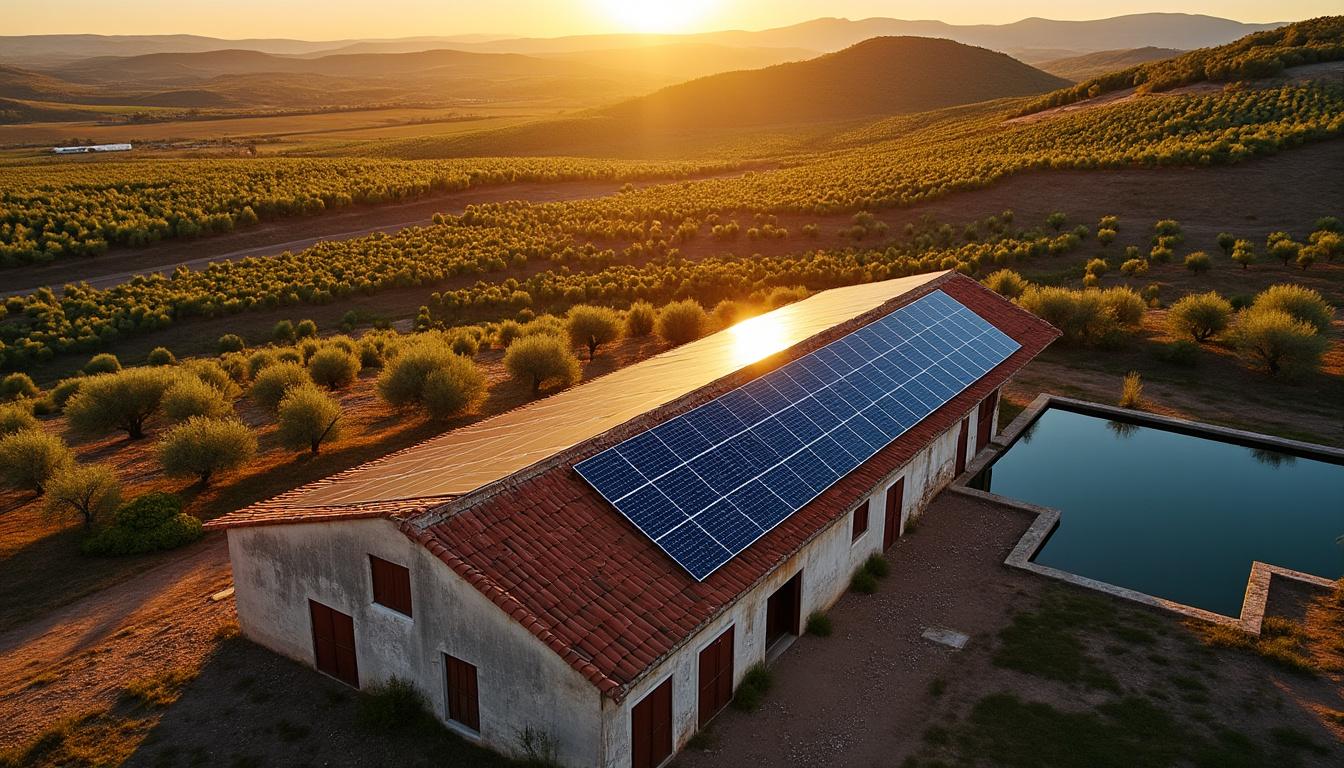
At the Herdade Vale Seco (a scenario inspired by Alentejo), 120 kW of PV cover 62% of annual energy, with VFD on two pumps and 130 kWh of battery for the window from 7 PM to 1 AM. The control software prioritizes self-consumption and smooths spikes, reducing contracted power. The fund supported the entire eligible amount given the alignment with emission reduction goals.
To avoid oversizing, a simple rule applies: kWp ≈ 0.8–1.2 × average daytime load (adjust according to seasonality). In seasonal farms, modular structures and inverters with capacity reserves allow for future expansion without rebuilding everything. In systems with batteries, assess the useful daily cycle and the recommended depth of discharge (DoD) to ensure consistent lifespan.
The fund favors solutions that store and use energy locally. Integrations with monitoring and performance reporting strengthen the application. A simple “before vs. after” tool with monthly graphs, attached to the request, demonstrates technical credibility and facilitates evaluation.
To guide decision-making, here’s a comparison of typical measures:
| 🔧 Measure | 💶 Typical Cost | 📉 Annual Savings | ⏱️ Payback | ✅ Eligible / Coverage |
|---|---|---|---|---|
| Self-consumption PV 100 kWp | 70,000–95,000 € | 18,000–28,000 € | 3–5 years | Yes / up to 100% 🟢 |
| Li-ion battery 100 kWh | 45,000–70,000 € | 7,000–12,000 € | 4–7 years | Yes / up to 100% 🟢 |
| VFD on 45 kW pump | 6,000–10,000 € | 2,000–4,000 € | 2–4 years | Yes / up to 100% 🟢 |
| LED + sensors (warehouse) | 5,000–12,000 € | 1,500–3,500 € | 2–3 years | Yes / up to 100% 🟢 |
These ranges are indicative and vary with power, hours of use, and tariffs. For application purposes, attach descriptive memory, load curve, and production estimates (PV) or cycles (batteries), as well as manufacturer guarantees and maintenance plans.
Key idea: the best power plant is the one on your roof and works at the rhythm of your farm.
Efficient irrigation, refrigeration, and ventilation: where kWh are lost and how to fix them with public support
Irrigation concentrates a large part of the energy consumption in the field, especially when the pressure is higher than necessary or when the system is misadjusted. Start by measuring actual pressure and flow at critical points. In many farms, a reduction of 0.3–0.7 bar, combined with more efficient nozzles and sector programming, generates immediate savings without compromising productivity. VFD and soft starts protect motors and reduce peaks, improving equipment lifespan.
In refrigeration, “invisible” losses can be costly. Doors that do not seal, poorly positioned diffusers, and evaporators with chronic ice build-up all force the compressor to work harder. Correction involves insulation, fast doors, air curtains, and controls to avoid unnecessary defrosting. Compressors with inverters and EC fans optimize performance under partial load, common after the initial cooling phase.
In barn and warehouse ventilation, the goal is to ensure thermal comfort and air quality with minimum kWh. Large diameter fans with efficient motors and temperature/humidity control, combined with cross-ventilation, reduce consumption and improve animal welfare, translating into productivity. In greenhouses, automatic shading and staged extraction prevent over-ventilation.
Consider a representative case: the Cooperative of Vale do Zêzere corrected the irrigation network, replaced sprinklers, introduced VFD, and calibrated pressures. In parallel, they installed fast doors and additional insulation in the storage chamber. Result: -27% energy in the season, fewer breakdowns, and better crop regularity. All with support from the 15 million fund, thanks to a clear technical dossier and before/after measurements.
To maintain gains, preventive maintenance is essential: cleaning filters and evaporators, inspecting valves, calibrating sensors, and checking for leaks. A simple quarterly schedule prevents systems from “slipping” and losing efficiency over time. It’s sensible to include this plan in the application.
Finally, monitoring with sub-meters by circuit (irrigation, refrigeration, lighting, ventilation) provides visibility into what works and what needs adjustment. The data inform decisions and reports, as well as facilitate verification of the funded project.
Key idea: calibrated irrigation, well-sealed refrigeration, and intelligent ventilation are three silent levers that add up to significant savings.
Want to see solutions in action and learn from practical cases? It’s worth exploring audiovisual resources to inspire your plan.
When analyzing real examples, it becomes easier to design a coherent set of measures ready for funding.
IFAP Applications without stress: steps, documents, and metrics that increase the probability of approval
Transforming a good idea into a funded project depends on method. Applications to the IFAP require organization and evidence. With a clear checklist and some key metrics, the process becomes objective and quick, without surprises.
Practical step-by-step
A phased approach helps gain focus and communicate value. This sequence works well for both small farms and larger cooperatives:
- 🧭 Define objectives: reduction of kWh, decrease of contracted power, cut emissions, and operational improvement.
- 📈 Diagnosis: collect bills, hourly profiles, and map the “top 3” consumers (irrigation, refrigeration, ventilation).
- 🧪 Measure baseline: temporary sub-meters for 2-4 weeks when possible.
- 🧩 Design the package: efficiency first (LED, VFD, insulation), then generation (PV) and, if it makes sense, batteries.
- 📑 Document: three comparable budgets per lot, descriptive memory, timeline, and savings estimates.
- 🛡️ Compliance: technical data sheets, CE declarations, guarantees, and evidence of planned maintenance.
- 💻 Submit: application on the IFAP portal, according to the announcement of the Environmental Fund.
- 🔍 Verify: after implementation, gather “before vs. after” data to demonstrate results.
Metrics that count in evaluation
Choose simple and verifiable indicators. Some that work well include: kWh/ha for irrigation; kWh/ton in refrigeration; kWh/liter in milking; % self-consumption in PV; peak power reduction with VFD and batteries. Set an annual target and a campaign target (when seasonal) to show mastery of the context.
It is also useful to attach a simplified Measurement and Verification plan (for example, “before/after” methodology with correction for degree-days in refrigeration or by irrigated hectares), ensuring that evaluators understand how results will be proven. No need to complicate: clarity and coherence are sufficient.
Errors to avoid
- ⚠️ Oversizing PV without a consumption base: creates low-value surpluses and worsens the analysis.
- ⚠️ Ignoring efficiency before generating energy: wastes CAPEX and reduces impact.
- ⚠️ Incomplete documentation: lacking data sheets, guarantees, or comparable budgets.
- ⚠️ Not planning for reimbursement: remember that support is for reimbursement of incurred expenses.
To strengthen the application, include a brief overview of collateral benefits: less noise, fewer breakdowns, better product preservation, animal comfort, operational safety. These improvements translate into tangible gains, even when metering is more difficult.
If you seek inspiration and applied knowledge about housing and energy that is also transferable to the agricultural world, the platform Ecopassivehouses.pt brings together ideas, tested solutions, and practical guides that can help structure projects with criteria.
Key idea: winning applications combine solid numbers, clear documentation, and measures that make sense on the ground.
Source: www.ambienteonline.pt