The acceleration of artificial intelligence has encountered a rather unglamorous and absolutely decisive obstacle: energy. While computing grows exponentially, the electrical grid, transformers, and storage advance at a much slower pace.
This scenario affects the cloud, cities, and homes, but it also opens concrete opportunities for those who want to gain energy autonomy and reduce costs with simple and intelligent measures.
| Short on time? Here’s the essential: |
|---|
| ✅ No energy, no AI ⚡ — data centers are already hitting the limits of the grid in various global hubs. |
| ✅ Reduce, electrify, and produce 🔋 — first cut waste, then heat pumps and battery solar. |
| ✅ Avoid the classic mistake 🚫 — buying equipment before measuring and auditing real consumption. |
| ✅ Power Purchase Agreements (PPAs) and flexibility 🤝 — lock in prices, relieve the grid, and accelerate the transition. |
It is impressive that technology companies are only now recognizing the limitations imposed by energy: where the real bottleneck is
By 2025, it became impossible to hide the physical equation behind every GPU: copper, steel, transformers, lines, maintenance, and time. Computing doubles; the electrical grid does not. This asymmetry, publicly highlighted by leaders in the energy sector, shows in numbers: in countries like Ireland, data centers consume about 20% of electricity and new large-scale connections are only entering the queue for after 2028. Similar situations appear in Singapore and the Northern Virginia corridor, where usable capacity is virtually exhausted.
This is not just a local challenge. Europe still imports about 60% of its energy, and around 74% of the global population lives in countries dependent on external energy. The expansion of AI, which requires continuous loads 24/7 for training and inference, amplifies pressures on already aging networks, with slow licensing processes and insufficient storage. Behind every “state-of-the-art model,” there is a facility that may demand 300 to 500 MW per campus — and with cooling, the need can practically double.
If this reality hinders big tech, it also impacts your neighborhood. As more digital applications become “essential,” the competition for electrons intensifies. The good news? The solution is not a single trick, but a set of coordinated measures: efficiency, electrification, and renewables, layered to intelligently harness every watt.
The hidden physical limit in chips
Three effects appear together: overloaded networks, volatile peak prices, and queues for new projects. The hidden risk is strategic: energy delays transform into product delays and opportunity costs. AI is no longer just a matter of code; it is electrical infrastructure at the center of the strategy.
- ⚡ Physical bottleneck: transformers and substations are not manufactured “on demand”.
- 🧊 Cooling: rejected heat grows with rack density; liquid solutions are gaining ground.
- ⏳ Licenses: network schedules far exceed the sprint of software engineering.
- 🌐 External dependence: geopolitical volatility affects price and availability.
- 🧭 Right direction: electrification + renewables as the axis of energy sovereignty.
| 🔎 Bottleneck | 💥 Impact | 🌍 Example | ⏱️ Horizon |
|---|---|---|---|
| Network capacity | Queues and connection rationing | Ireland 20% consumption by data centers | 2025–2028 |
| Transformers | Long lead time | Urban substations saturated | 12–36 months |
| Cooling | Doubles effective load | Large-scale AI hubs | Continuous |
| Storage | Intermittency without buffer | Wind/solar without battery | Now |
Final insight: AI scales at the speed of available kVA. Without an electrical plan, the digital strategy remains on paper.
Investment in clean energy by big tech: why the competitive advantage is now electrical
Big tech companies are rushing to secure firm and predictable energy. Behind statements about sustainability lies a cold calculation: the levelized cost of solar electricity has dropped by about 65% in the last decade, and the cost of storage has dropped in a similar order over the last six years. Solar and wind are already, in many markets, the cheapest sources. Combined with batteries and long-term contracts (PPAs), they transform volatility into predictability.
The energy “stack” of AI arises: load efficiency, energy contracts, dedicated close production, and modular storage. A typical campus can combine 400 MWp of off-site solar with 200 MW/800 MWh of battery, shifting peaks, buying at night, and selling flexibility to the grid. Add in heat reuse to warm adjacent neighborhoods, and emissions and bills drop.
Behind the scenes, what seemed like “green marketing” becomes financial and energy engineering. PPAs lock in prices for 10–15 years. Demand flexibility monetizes downtime and accelerates licenses. And when the grid does not reach, microgeneration and complementary thermal systems draw the bridge.
Practical tools that tech companies are already using
- 📝 Hybrid PPAs: solar/wind mix for complementary profiles.
- 🔋 Storage: batteries for peak shaving and critical backup.
- 🧠 Active management: shutting down/delaying non-critical loads (training) during expensive hours.
- 🔥 Heat reuse: waste heat from data centers for heating networks.
- 🛰️ Measure everything: fine telemetry from rack to substation to target losses.
| 🧰 Solution | 🎯 Main benefit | 💶 Cost impact | 📈 Maturity |
|---|---|---|---|
| Renewable PPA | Stable price for 10–15 years | Reduction of CAPEX/volatility | High |
| Battery | Peak flexibility | Avoids peak tariffs | Medium-High |
| Heat reuse | Less active cooling | Local thermal revenue | Medium |
| Demand response | Network relief | Compensated for flexibility | High |
When energy becomes a competitive differential, the “time to grid” matters as much as the “time to market.” In saturated markets, whoever secures reliable energy speeds up products, margins, and reputation.
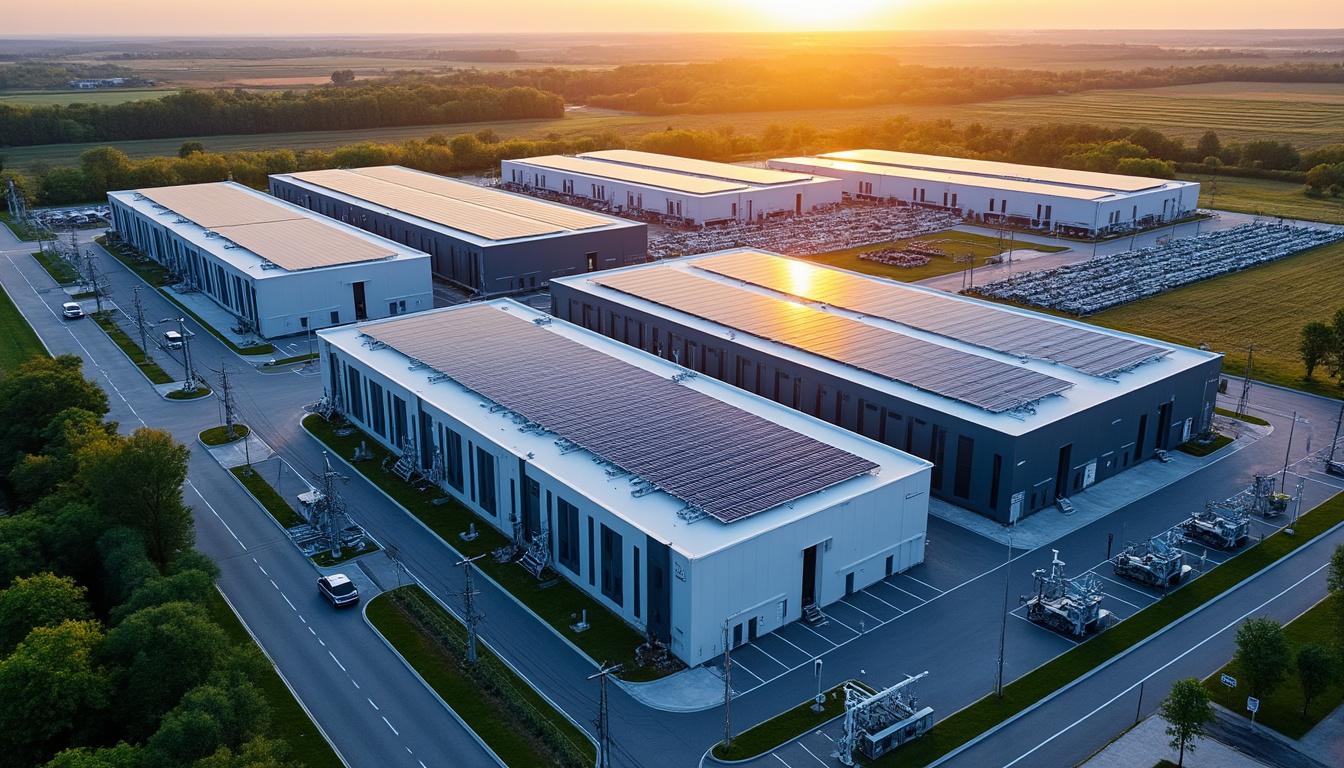
Want to understand the anatomy of a modern energy campus? The research above helps visualize the pillars of efficiency that today decide who scales and who remains on paper.
From the cloud to your home: how energy limitations inspire autonomy in habitat
If energy hinders AI, it also redefines priorities in homes and neighborhoods. Instead of relying on a congested grid, many families are starting with reducing losses, electrifying, and producing locally. With the same reasoning as big tech, but on a domestic scale, they gain comfort, resilience, and predictability.
Three movements bring immediate impact. First, efficiency: insulation, well-executed windows, mechanical ventilation with heat recovery, shading management. Then, electrification: heat pumps for HVAC and DHW, cooking by induction and electric vehicle. Finally, production and storage: solar on the roof and battery sized to the real profile. The result is concrete: an electric car consumes about four times less energy per kilometer than a combustion engine, and the heat pump delivers multiple thermal units per each kWh of electricity.
To illustrate, imagine “Pinhal Neighborhood,” a condominium of 40 units that decides to take action. After an audit, they replace old boilers with heat pumps, install 200 kWp of shared photovoltaics, 400 kWh of community batteries, and pre-wiring for future chargers. The condominium starts managing the load: charging vehicles at night, heating DHW at noon, moving the dryer outside of peak times, and selling weekly excess to the grid, always within regulations. In 18 months, cuts of 35–50% in the common bill become a reality.
Practical gestures that work
- 🧱 Thermal envelope: insulate first; the cheapest energy is the one that is not consumed.
- ❄️ Heat pumps: high COP for heating and cooling with fewer kWh.
- 🌞 Solar + battery: match midday production with night consumption.
- 🚗 Smart charging: schedule by tariff and local production.
- 🧠 Fine measurement: smart meters in key circuits to eliminate waste.
| 🏠 Measure | ⚡ Typical savings | ⏳ Payback period | 💡 Practical note |
|---|---|---|---|
| Insulation + windows | 15–30% | 3–7 years | First step to comfort |
| Heat pump | 30–60% vs. boiler | 3–6 years | HVAC and DHW |
| Solar 3–6 kWp | 25–50% | 4–8 years | Better with battery |
| Battery 5–10 kWh | +10–20% self-consumption | 5–9 years | Arbitrate tariff/production |
To learn and apply on the ground, resources like Ecopassivehouses.pt gather tested practical solutions, without magical promises and with a focus on what works in Portuguese climates. The key lesson: design to reduce, electrify and produce places your house on the right side of the transition.
Networks, licenses, and storage: because “the technology exists, the system is not prepared”
The main obstacle to the transition is not a lack of technology; it is system structure. Aging networks, lengthy licenses, and still timid storage decouple ambition from reality. For those planning a building, a neighborhood, or a campus, the right question shifts from “what equipment” to “how to fit into the system with minimal friction.”
A robust strategy begins by mapping critical nodes: nearby substations, available capacity, expansion schedules, and connection rules. Then, flexibility is designed from the draft: movable loads, modular batteries, three-phase pre-wiring, technical spaces sized for future inverters and panels. In parallel, the regulatory path is defined, seeking approval early, with well-closed executive projects to avoid back and forth.
Cities and companies that move faster simplify the process: one-stop shops, defined timelines, checklists, and digital interoperability between entities. Meanwhile, utilities test inspections with drones and AI, predictive maintenance, and advanced conduits to gain capacity without replacing everything. The result is a “breathable system” that accommodates more renewables and more electrification without collapsing during peaks.
Levers that unlock projects
- 🗂️ Phased licensing: partial authorizations for ready phases.
- 🧰 Modular standards: batteries, inverters, and plug-and-play panels.
- 📡 Smart inspection: drones, robotics, and AI to reduce downtime.
- 🔄 Contractual flexibility: sell/use flexibility and relieve the grid.
- 🏗️ Pre-wiring: prepare today what will connect tomorrow.
| 🏛️ System measure | ⚙️ Effect | ⏱️ Typical time | 📌 Note |
|---|---|---|---|
| One-stop shop | Less bureaucratic friction | Immediate after adoption | Critical digitization |
| Phased license | Operate ready parts | Months | Reduces waiting costs |
| Modular standard | Scale without redoing | Continuous | Facilitates maintenance |
| Demand response | More effective capacity | Fast | Flexibility is compensated |
The message is clear: electrical planning is strategy. Those who treat energy as product infrastructure unlock time, cost, and scale.
Cases of network modernization show how data, standardization, and pragmatism shorten the path from idea to kWh at the point of use.
12-month plan for companies and families: reduce, electrify, and produce methodically
Solutions are not lacking; method is. In 12 months, traction can be gained with a simple and disciplined sequence, both in a business and in a home. The order matters: measure, reduce, electrify, produce, store, and optimize. Skipping steps is costly and frustrates expectations.
For an SME with an office and small production, the plan starts tomorrow. Load audit, reduction goals, smart contracting, solar and battery project, and review of thermal systems. At home, the roadmap is analogous, adjusting scales and budgets. In the end, a routine emerges: monitor, fine-tune, and plan the next improvement, without anxiety or fads.
Practical and actionable roadmap
- 📊 Month 1–2: measure — install measurement by circuits and collect weekly data.
- 🧼 Month 2–4: reduce — address baseline losses: standby, schedules, and envelope.
- 🔥 Month 3–6: electrify — heat pumps and induction where it makes sense.
- 🌞 Month 5–8: produce — solar sized to the real profile, not to the dream.
- 🔋 Month 6–9: store — battery for self-consumption and peak.
- 🧠 Month 9–12: optimize — tariff, scheduling, demand response.
| 📆 Step | 🎯 Goal | 🛠️ Tool | ✅ Deliverable |
|---|---|---|---|
| Measurement | Know the real profile | Submeters, app | Curves and targets |
| Efficiency | Cut baseline | Insulation, adjustments | -10–20% immediate |
| Electrify | Replace fossil fuels | Heat pump | Less CO₂/kWh |
| Produce | Generate locally | Photovoltaics | Self-consumption ↑ |
| Store | Decouple timing | Battery | Peak ↓ |
| Optimize | Fine-tuning | EMS, tariff | Sustainable ROI |
At each step, it is worth repeating: without measurement, there is no management. And without management, the transition becomes accidental. With a method, energy ceases to be uncertainty and becomes an asset.
Action for today: choose a key circuit (DHW or HVAC), install simple measurement, and log one week of data. The rest of the plan starts there. And whenever you need practical inspiration, explore ideas and case studies at Ecopassivehouses.pt.
Source: eco.sapo.pt