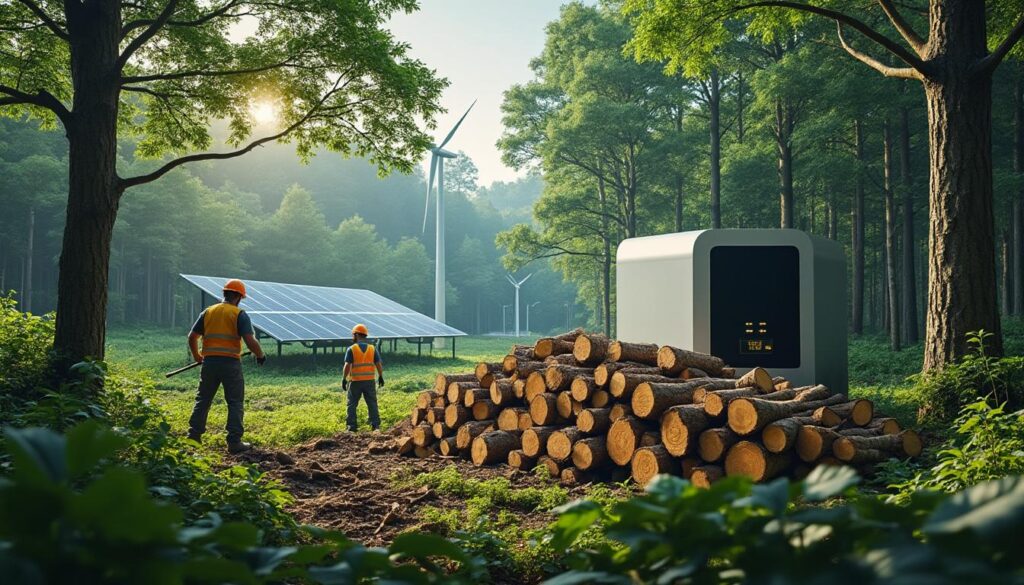
A new European impetus promises to make Renewable Energy Communities simpler, fairer, and more efficient. With Portuguese leadership, the INNO-TREC project aims to unlock the creation and management of local energy with free digital tools designed for real people and neighborhoods.
If you are looking for practical ways to produce, share, and value clean energy in your street or condominium, you will find clear answers, solid data, and actionable steps here.
Short on time? Here’s the essential:
| ✅ Key point ⚡ | What it means for you 🧭 | Quick action today 🛠️ |
|---|---|---|
| FEUP leads the INNO-TREC (5.4 M€) 🏛️ | Free digital tools will simplify the creation and management of REC | Map interested neighbors and consumption profiles |
| Maximum rating (15/15) 🏆 | Project validated among 76 applications, acceptance rate of 3.9% | Set objectives now: self-consumption, savings, resilience |
| Pilots in 6 countries 🌍 | Models tested in Portugal, Greece, Belgium, Ireland, the United Kingdom, and Italy | Choose potential rooftops and check shading |
| Launch in January 2026 🚀 | Progressive results and practical guides during development | Create a working group and a common project email |
INNO-TREC from FEUP: why this project can accelerate renewable energy communities
The INNO-TREC is being coordinated by the Faculty of Engineering of the University of Porto and has been funded by the European Commission with 5.4 million euros. This rare support — with a selection of only 3.9% of proposals in Horizon Europe and a score of 15/15 — indicates scientific rigor and strong potential for social impact.
The aim is straightforward: to create a new generation of free, intuitive web tools aligned with the reality of neighborhoods, condominiums, and small businesses. From the design to the sizing of shared photovoltaic systems, from daily management to maintenance and optimization, everything should fit into a clear platform, with metrics that matter to those who pay the bill.
This vision addresses ground-level pains: confusing legal processes, difficult-to-compare budgets, and a “black box” in the sharing of kWh that erodes trust. For communities that have already tried to organize themselves and fell short, the proposal brings methodology, transparency, and a step-by-step roadmap.
Tangible benefits for neighborhoods and condominiums
For a condominium like “Bairro do Cedro”, where 40 families vary consumption between those who work from home and those who arrive at 8 PM, the value lies in marrying production and usage profiles. An algorithm that simulates scenarios and recommends sharing rules saves planning hours and reduces conflicts among neighbors. At the same time, clear reports assist the building administrator in decision-making and negotiation with suppliers.
The consortium has 20 academic and industrial partners and will be led by professors João Catalão and Cláudio Monteiro. The accumulated experience in projects like EU-DREAM — also rated 15/15 — reinforces confidence that the solutions will not remain on paper. Together, the two projects total nearly 10 million euros in budget, with around 1.2 million directed specifically to FEUP.
- 🔌 Less bureaucracy: ready-to-adapt contract and statute models
- 📈 Robust simulations: sizing that balances cost, production, and self-consumption
- 🤝 Clear rules: sharing of benefits and costs without gray areas
- 🛡️ Resilience: optional integration with batteries and peak management
- 🌱 Scalability: from the building’s roof to the block network
| ⚙️ Challenge | 💡 INNO-TREC Solution | 🎯 Expected Outcome |
|---|---|---|
| Complex legal processes | Ready models and checklists | Less startup time ⏱️ |
| Uncertain sizing | Multi-scenario simulation | Optimized investment 💶 |
| Opaque management | Reports and audits | Trust and adhesion 👥 |
| Daily operation | Alerts and maintenance | High availability 🔁 |
In summary: solid projects overcome barriers when they transform complexity into simple and verifiable routines — this is the concrete promise here.

Free digital tools from INNO-TREC: from study to daily life in your community
The heart of the project is an ecosystem of web tools that guides the entire life cycle of a Renewable Energy Community. From the first draft to operation, the platform should guide choices based on data, not on guesses. For those who want to make informed decisions without spending months comparing spreadsheets, this is the difference between moving forward and giving up.
The typical journey includes four stages: diagnosis, design, implementation, and operation. Each stage requires data and delivers actionable recommendations, with clear language and exportable documentation for assemblies, regulatory bodies, and financiers.
From diagnosis to design: information that turns into decision
It starts by uploading invoices, hourly profiles, and the rooftop map. The tool identifies patterns, peaks, and load-shifting opportunities. Then, it recommends the photovoltaic layout, power, inverters, any batteries, and the most suitable sharing rule for your profile (fixed quota, usage time, social priority, among others).
- 📂 Easy data import from invoices and meters
- 🗺️ Rooftop map with shadows and orientation
- 🧮 Financial simulation with conservative, base, and ambitious scenarios
- ⚖️ Comparison of sharing rules side by side
- 📜 Ready documents for assemblies and regulators
| 🛠️ Module | 📊 Input | 🚀 Useful output |
|---|---|---|
| Diagnosis | Consumptions, invoices, profile | Opportunities map 🌟 |
| Design | Roof, shading | PV layout and optimal power ☀️ |
| Rules | Objectives and profiles | Fair and transparent sharing ⚖️ |
| Financial | Costs and tariffs | Payback and sensitivity 💹 |
| Operation | Telemetry | Alerts and proactive maintenance 🔔 |
In implementation, the tool generates a specifications document with technical and environmental criteria. This reduces deviations, ensures fair comparisons between proposals, and brings durability to the center of decision-making. In operation, panels with KPIs make visible what matters: self-consumption, surpluses, savings, avoided CO₂, and performance by fraction.
For those experimenting with integration with low-consumption devices, it is worth looking at complementary solutions explored in the FEUP ecosystem, such as optimized photovoltaic capture for interiors (DSSC) or portable microgeneration, useful in monitoring and local measurement sensors.
The right tools create the right habits: by aligning data, rules, and practice, the community gains speed without losing control.
Transactional models and energy sharing: fairness, transparency, and local incentives
The big question for any energy community is simple: how to share value in a way that everyone feels fairness and motivation to participate? INNO-TREC will test new transactional mechanisms that balance predictability with flexibility, recognizing differences in consumption and contribution from each member throughout the day and year.
Three lines guide this sharing. First, transparency: every kWh produced and consumed is traceable and auditable. Second, balance: combining base quotas with hourly adjustments avoids chronic distortions. Third, inclusion: rules designed not to exclude those who consume less or who have less investment availability.
Four sharing approaches worth considering
There is no “one size fits all.” What exists is context and objectives. Below, four logics to explore — which the project’s tools should simulate and compare clearly.
- ⚖️ Base quota + hourly adjustment: each member has a minimum and adjusts based on consumption in specific windows
- 🔁 Usage time: those who consume when the sun is shining have priority for sharing and pricing
- 🎯 Social objective: bonuses for vulnerable families based on transparent criteria
- 💠 Smooth internal auction: surpluses distributed by “bids” based on parameters and predefined limits
| 🧩 Model | 👍 Advantage | ⚠️ Attention |
|---|---|---|
| Quota + hour | Stability and perceived fairness | Requires hourly data ⏰ |
| Usage time | Encourages load shifting | Risk of penalizing the absent |
| Social objective | Community cohesion 🤝 | Needs clear criteria |
| Smooth auction | Efficiency in allocation ⚡ | Complexity of explanation |
For the “Bairro do Cedro”, a hybrid quota + usage time worked best in the simulation: a base that guarantees predictability, plus a bonus for those who turn on washing machines between 11 AM and 3 PM. The result? More self-consumption, less conflict, and motivation for efficient habits.
Tracking these flows requires reliable records. Some teams in the consortium are studying digital audit trails and monthly adjustment mechanisms that make sense for condominiums. No coded language: the focus is on dashboards that anyone can understand, with explanations of “if-this-then-that.”
Clear rules create commitment; commitment, in turn, sustains savings and prolonged adhesion.
European pilots of INNO-TREC: what will be tested and what can be replicated at home
Six countries — Portugal, Greece, Belgium, Ireland, the United Kingdom, and Italy — will serve as a testing ground to validate technology, sharing models, and legal arrangements. The diversity of climates, markets, and architectures is an advantage: learning from extremes accelerates the maturity curve.
In Portugal, the focus is expected to be on condominiums and urban neighborhoods, with mixed rooftops and a combination of domestic and service loads. Belgium is likely to test regimes with greater tariff granularity, while Greece offers abundant solar and summer peak challenges. Ireland and the UK bring climatic variability and interest in community batteries; Italy combines historical heritage with photovoltaic ambition.
Three early learnings from the pilots
First, the effect of “the right rule in the right context”: a sharing rule that shines in a city can fail in a rural setting. Second, the importance of maintenance and monitoring: small cumulative losses kill savings. Third, communication: assemblies with educational materials reduce tensions and maintain cohesion.
- 🌍 Climatic diversity as a natural laboratory
- 🧪 Rule comparison in real neighborhoods
- 🧰 Preventive maintenance as routine, not exception
- 🗣️ Pedagogy with simple and objective materials
| 📍 Country | 🔎 Expected focus | 📌 Replicable tip |
|---|---|---|
| Portugal | Urban condominiums and neighborhood management | Start with a pilot block 🧱 |
| Greece | High radiation levels ☀️ | Prioritize daytime loads |
| Belgium | Tariff granularity | Analyze time windows ⏰ |
| Ireland | Climatic variability 🌧️ | Consider battery |
| United Kingdom | Integration with efficiency | Reduce thermal losses |
| Italy | Heritage + PV | Discrete projects 🎨 |
As the pilots progress, there are practices you can adopt already: simple energy audits, adjustment of consumption timings, and small capture solutions for monitoring sensors. The important thing is to create “quick wins” that feed the motivation to invest collectively when the platform is available.
Learning from those experimenting in different climates and rules reduces costly mistakes — and accelerates the maturity of your own community.
How to prepare your community: steps, costs, risks, and time-saving tricks
Setting up a Renewable Energy Community requires method and clarity. It’s not necessary to be a specialist, but it is essential to organize information well and combine technical aspects with human relations. A pragmatic roadmap reduces noise and builds trust from the first email.
The path to follow tends to work in any urban neighborhood: diagnosis, shared vision, preliminary design, formal decision, and operation. At the same time, it is vital to map risks and have a simple plan to address them, from supplier delays to disagreements on sharing rules.
Practical roadmap in 8 steps
Start small, with a pilot block and well-calibrated expectations. Once the routine is refined, scale to other rooftops or blocks. Below is a guide that works for condominiums and cooperatives.
- 📣 Mobilize: create a working group and communication channel
- 📊 Gather data: invoices, hourly profiles, and shading
- 🎯 Define objectives: savings, autonomy, inclusion
- 🧭 Choose sharing rule: compare 2-3 models
- 🧮 Simulate: three scenarios with sensitivity
- 📜 Formalize: statutes, contracts, and responsibilities
- 🛠️ Install: specifications document and technical acceptance
- 📈 Operate: monthly KPIs and maintenance
| 🧱 Stage | ⏱️ Typical time | 💶 Indicative cost | 🔐 Risk and mitigation |
|---|---|---|---|
| Mobilization | 2–4 weeks | Low | Apathy → quick wins ✅ |
| Data and objectives | 3–6 weeks | Low | Incomplete data → checklist 📋 |
| Simulation | 2–3 weeks | Medium | Expectations → scenarios 🎛️ |
| Formalization | 4–8 weeks | Medium | Legal clarity → models 🧾 |
| Installation | 6–12 weeks | High | Delays → penalties ⏳ |
| Operation | Continuous | Low | Losses → maintenance 🔧 |
There are smart shortcuts. Use the platform (when available) to compare rules and export documents. Adopt simple sensors to monitor monthly performance. And combine efficiency in the building with local generation: insulation, well-fitting windows, and efficient appliances multiply the gains of the REC.
Whether with a modest roof or multiple slabs, what matters is the discipline of processes and communication between neighbors — the rest are technical details that good tools help to resolve.
If you can take just one step today: create a working group and collect three electricity bills from each interested party — organized energy starts with simple data and shared objectives.
Source: noticias.up.pt