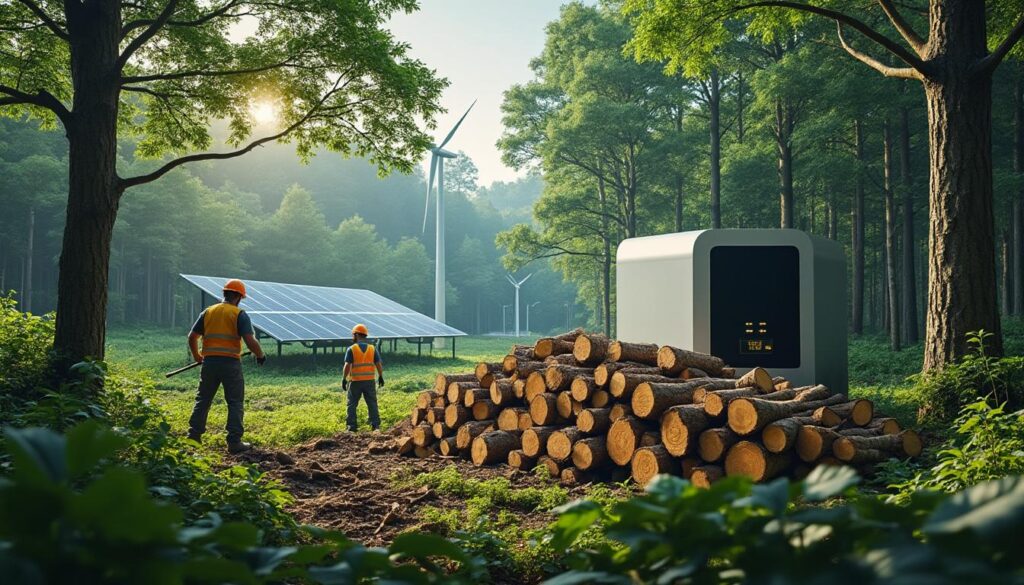
The energy storage has entered a new phase in Central Europe with the announcement of decisive financial support. Greenvolt secures €58.9 million to accelerate an innovative mega battery project in Hungary, a 99 MW/288 MWh system expected to be completed by the first quarter of 2026.
| Short on time? Here’s the gist: ⏱️ |
|---|
| ✅ €58.9M from UniCredit Bank Hungary drive the Buj Project, the largest BESS in Hungary ⚡ |
| ✅ 99 MW / 288 MWh: power to stabilize the grid and integrate more solar and wind 🌬️☀️ |
| ✅ Expected completion by Q1 2026, focusing on flexibility, resilience, and system services 🛡️ |
| ✅ Global pipeline of 14.1 GW (4.7 GW in BESS) strengthens Greenvolt’s European strategy 🌍 |
Greenvolt secures €58.9 million for mega battery project: immediate impact and strategic vision
The financing of €58.9 million obtained from UniCredit Bank Hungary enables the construction, operation, and maintenance of the Buj Project, a battery energy storage system (BESS) with 99 MW/288 MWh in northeastern Hungary. Practically, this represents the future largest battery storage asset in the country, designed to enhance grid flexibility and accommodate growing renewable production. By combining wind and solar with a battery buffer of this magnitude, precious seconds are gained in frequency regulation and full hours of stability during peak consumption.
The financial design follows the logic of project finance, with specific contracts for the asset and clear performance metrics. The goal is to enable the system to respond swiftly to generation variations, ensuring regulation services and hourly energy arbitrage. Greenvolt emphasizes that storage is today an essential pillar of modern energy systems, facilitating a more ambitious incorporation of renewables without compromising supply security.
Why 99 MW/288 MWh makes a difference to the grid
The power of 99 MW defines the instantaneous response capacity: within seconds, the BESS can inject or absorb energy to stabilize frequency. Meanwhile, the 288 MWh translates into autonomy: enough energy to support demand peaks, relieve congestion, and smooth generation ramps. In real scenarios, such as a summer afternoon with abundant photovoltaic production, the system stores surpluses to release them at dusk, when demand spikes and the sun sets.
When considered in terms of homes and neighborhoods, the parallel is immediate: just as a residential battery protects the installation during transitions between charging and generation, a large-scale BESS protects the national grid during transitions between sun, wind, and urban consumption. The difference is the volume and speed, but the logic remains the same: balance.
The Hungarian context and European ambition
In northeastern Hungary, renewable connections have been growing, necessitating greater dynamic management capacity. The Buj Project meets this demand, aligned with the European energy transition and decarbonization goals gaining traction in the domestic energy market. For the financial sector, the operation also represents a sign of maturity: institutions like UniCredit incorporate their assessment of climatic and technological risk, supporting critical infrastructures with clear impact metrics.
This advancement fits within Greenvolt’s broader strategy, with a global pipeline of 14.1 GW in solar, wind, and BESS, of which about 1.7 GW is under construction. In the storage segment, the company positions itself among the leading European promoters, with 4.7 GW in development. The final message is simple: when technology, financing, and regulation point in the same direction, projects come to life and transform the grid.
The expected outcome is clear: more renewables integrated safely and less dependence on fossil sources.
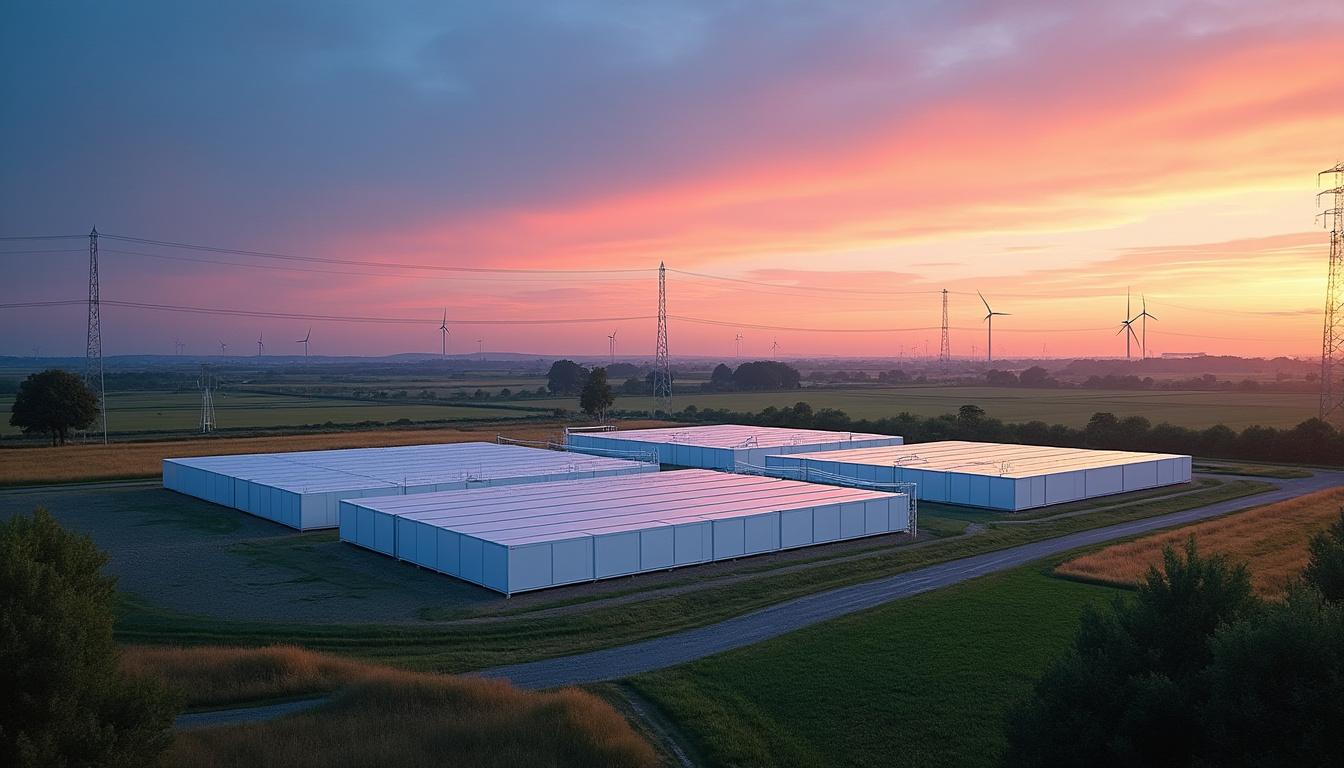
Storage 99 MW/288 MWh: how it stabilizes the grid and reduces costs for consumers
A BESS of this scale offers a range of system services that, until recently, relied mainly on fossil plants in standby. The frequency support (FCR), the automatic reserve (aFRR), and the voltage regulation are the best known. The great advantage? Responses in milliseconds, without local emissions, and with immense precision. For the grid operator, it means predictability; for the consumer, it means more stable electricity bills and fewer tariff spikes associated with congestion.
Imagine a cold late afternoon. Residential consumption increases, wind fluctuates, and photovoltaic is already declining. The BESS comes into action: it releases stored energy, avoids the activation of more expensive peak plants, and stabilizes frequency. Hours later, during a windy midnight with low demand, it recharges, preparing for the next critical window. This cycle repeats daily, softening shocks and allowing for more renewables to enter the mix without compromising stability.
Services that generate value: from the grid to your home
The services provided by a BESS are reflected in systemic costs and also in your bill. In markets with hourly tariffs, the presence of storage helps flatten peaks, reducing volatility. For you, this translates into concrete opportunities: joining bi-hourly or dynamic rates, scheduling loads (like heating hot water, charging the electric vehicle, or running the washing machine) in periods of cheaper and cleaner energy. By aligning consumption habits with the renewable curve, you gain efficiency without losing comfort.
From the technical side, the combination of predictive algorithms (weather, load profiles) and real-time controls allows Buj to orchestrate charging and discharging with precision. It’s the same principle that applies in a well-managed house: an energy manager anticipates photovoltaic production and decides when to prioritize self-consumption, the grid, or the battery. The scale changes, but the logic remains.
Practical example: a typical day with batteries in charge
Morning: strong wind, controlled voltage, and batteries charging to absorb surpluses. Lunch: consumption rises, the BESS smooths the curve to avoid congestion. Late afternoon: photovoltaic declines, the BESS discharges, reducing the use of peak plants. Midnight: with wind and low demand, it recharges again. It’s an energy pendulum that protects the grid and alleviates costs, creating space for more renewables the next day.
Those who follow the energy transition recognize this change: storage has ceased to be an accessory to become infrastructure. And when infrastructure scales up, innovation reaches your home sooner.
What your home can learn from Hungary’s largest BESS: practical steps and smart decisions
There is a direct link between mega projects and the efficient comfort of a home. The Buj demonstrates that the key lies in aligning generation, storage, and usage. In a household, this means sizing solar and batteries to your consumption profile, setting priorities (self-consumption, backup, tariffs), and implementing simple and consistent management.
Sizing with discernment: neither too much nor too little
The common mistake is installing a large battery without understanding consumption patterns. It’s ideal to start by knowing the daily and seasonal curves: peaks in the morning and late in the day? Charging the vehicle at night? Hot water during off-peak hours? From there, one designs a system that covers 70–90% of self-consumption in a balanced manner. In many homes, 5–12 kWh of battery, combined with 3–6 kWp of photovoltaic, already provides a robust jump in efficiency, especially when there is active load management.
Quick checklist to implement now
- 🔎 Review your consumption profile (at least 30 days) and identify peaks.
- ☀️ Size the photovoltaic to cover the base of daytime consumption without chronic excess.
- 🔋 Choose a battery with guaranteed cycles and simple integration with the inverter.
- 🕒 Adopt bi-hourly or dynamic rates and schedule loads during cheaper hours.
- 📱 Use an energy manager to automate priority loads (AC, hot water, EV).
- 🧠 Establish rules: “charge if price Y”.
- 🛡️ Plan for backup for critical loads (lighting, refrigerator, IT) if your area suffers microcuts.
Illustrative case study: “Casa do Vale”
A family with two adults and two children, a heat pump, and an electric vehicle, installed 6 kWp of PV, a 10 kWh battery, and a basic energy manager. By programming the heat pump for the lowest cost hours and shifting laundry to solar periods, they raised self-consumption above 70% and reduced the contracted power. On cloudy days, the battery covers peak dinner time; on windy nights with low prices, it charges to discharge the next morning. It’s the same reasoning as Buj, adapted to the scale of a home.
If your home has a lot of thermal inertia (heavy walls, insulation, efficient ventilation), electrical storage works better with thermal storage (hot water tanks, underfloor heating). Solar energy is “stored” as heat, freeing the electrical battery for shorter and more unpredictable peaks. That’s how high comfort is achieved with low consumption.
Sustainable financing: how €58.9M from UniCredit unlocks useful innovation for consumers
The support from UniCredit Bank Hungary is not just a check; it’s a project finance structure that distributes risks and ties performance to objective metrics. Typically, a BESS is allocated to a SPV (special purpose vehicle) that contracts engineering, supply, and construction (EPC), operation and maintenance (O&M), and defines parameters like minimum availability and response time. Revenues come from energy markets (arbitrage), system services, and, in some cases, capacity or regional flexibility contracts.
From the bank’s perspective, predictability is key: clear contracts, mature technology, and an operator with proven track records. From the promoter’s perspective, leverage is important: less own capital blocked, more speed to scale portfolios. And from the consumer’s perspective, there’s an indirect yet real benefit: with more flexibility assets in the system, the grid undergoes less stress, and price volatility tends to decrease. In European markets, this dynamic is already reflected in system services auctions, where batteries compete cleanly and efficiently with conventional solutions.
What this teaches for condominiums and small businesses
Condominiums and SMEs can mirror this logic on a smaller scale, through energy performance contracts (EPC/ESCO), operational leasing of batteries, or sharing resources in energy communities. By exchanging large investments for predictable payments based on performance, adoption accelerates. A common example: an SME with a cold storage room installs 50 kW of PV and 100 kWh of battery in an “as-a-service” model, cutting demand peaks by 20-40% and improving resilience to microcuts.
Of course, there are risks to manage: battery degradation, regulatory uncertainty, and price variation in the wholesale market. These can be mitigated with maintenance contracts based on State of Health (SoH), conservative revenue forecasts, and diversification (part of the battery committed to stable system services, part to arbitrage). This is precisely how large projects show the way: by professionalizing risk, they unlock capital and create trust to replicate the solution in other parts of the grid.
Overall, the financing of €58.9 million demonstrates how European banking internalizes climatic and technological criteria, moving from rhetoric to tangible assets. When this happens, the effect reaches you in the form of smarter tariffs and more reliable energy services.
European strategy in 2026: from Hungary to the 14.1 GW pipeline and the future of storage
Greenvolt operates in 20 countries across Europe, North America, and Asia, integrating an international portfolio that includes solar, wind, BESS, and sustainable biomass. The weighted pipeline of 14.1 GW — with 4.7 GW in storage — showcases a strategy focused on flexibility as a condition for growing in renewables. By 2026, the European market will treat storage as critical infrastructure, and long-duration solutions (LDES) will also emerge, with multi-hour projects expanding the range of services and depth of arbitrage.
For national grids, the transition observed is twofold. First, digitalization: data, forecasts, and automation orchestrate generation, consumption, and storage with minute granularity. Second, decentralization: energy communities, collective self-consumption, and microgrids coordinate with large assets like Buj. It’s a layered system, where each level — from neighborhood to substation — has a clear role in stability and efficiency.
Why this matters for builders or renovators
Efficient homes are more comfortable and cheaper to operate when the grid is stable and predictable. The advancement of large BESS facilitates the adoption of smart tariffs, enables shared self-consumption in condominiums, and brings new offerings of flexible services (like charging your EV only when there’s local renewable surplus). Those planning new construction or renovation benefit from anticipating simple infrastructures: technical space for batteries, conduits, pre-installation for EVs, and smart home integration that communicates with dynamic tariffs.
The common thread: efficiency with practical sense
The Buj Project is more than an iconic project; it’s a living manual on how to coordinate technology, financing, and smart use. If there’s one simple action to take now, it’s this: assess your consumption profile and discover where a small battery, an energy manager, and adjusted habits can replicate — at your scale — the flexibility gains that today transform the Hungarian grid.
The takeaway message is straightforward: flexibility is comfort, savings, and protected climate. When a 99 MW/288 MWh system points the way, your home has every reason to follow with confident and intelligent steps. 💡
Source: www.publico.pt