After a year of ups and downs in the stock markets and regulation, EDP signals a clear strategy: strengthening its presence in the United States, accelerating in battery storage, and consolidating investments in networks, without giving up financial discipline.
If you are looking to understand the practical impact of this shift – on the company’s accounts, on long-term energy prices, and on opportunities for more efficient buildings – the lines below present the essentials, straight to the point.
| Short on time? Here’s the gist: |
|---|
| ✅ Focus on the USA: core market with visibility until 2030 thanks to incentives and strong demand for data centers ⚡ |
| ✅ Batteries + Networks: a combination to provide stability to wind/solar and capture better prices in PPAs 🔋 |
| ✅ Financial discipline: gradual deleveraging, growing EPS in EDPR, and stable dividends 💼 |
| ✅ Controlled risks: inflation of capex, supply chain, and rates mitigated by contracts and “safe harbor” 🛡️ |
After a rollercoaster year, EDP bets on strengthening in the USA: signals that matter to those thinking about energy
The recent year was anything but linear: in November 2024, the political shock in the USA crashed utility stocks, and the shares of EDPR and EDP followed the movement. A few months later, the narrative changed radically with the extension of renewable incentives until 2030 and the explosion of demand from data centers linked to AI. This “back and forth” seemed like a stress test; the strategic response is now unequivocal.
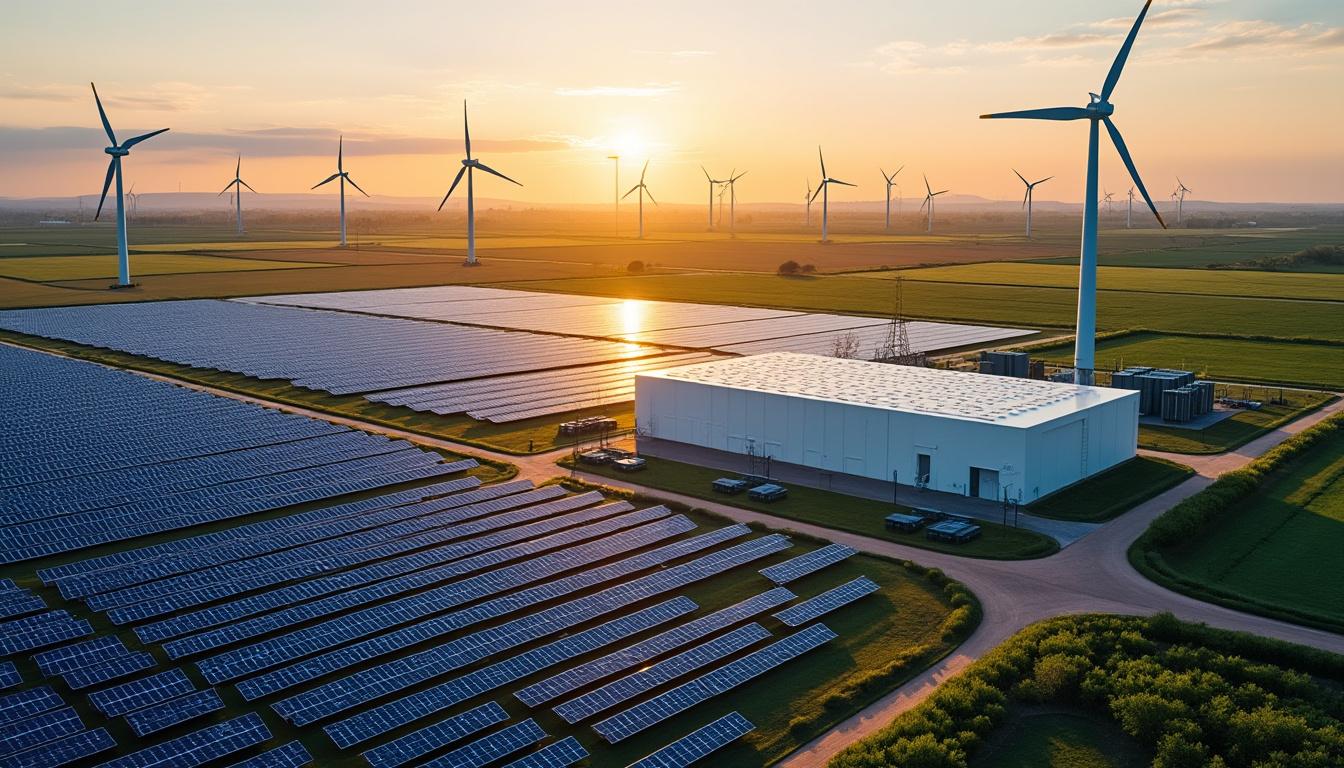
The repositioning is not cosmetic. Teams have prioritized projects that combine solar/wind + batteries, which improves margins and reduces exposure to spot price volatility. For those following the topic at home, the parallel is simple: just as good insulation reduces consumption peaks, batteries level the production of renewables and capture better prices during peak hours.
In the stock market, the journey illustrates the repricing of expectations. EDPR fell from about €11.07 to lows around €6.85 in April, before recovering to the zone of €13.82 in October. EDP rose from about €3.321 to nearly €4.451 in the fall. Annually, the aggregate shows significant gains: for the 2025 estimate, increases around +41.18% (EDPR) and +28.98% (EDP).
The American backdrop helps to explain. In addition to federal incentives, many states maintain ambitious renewable energy targets, and large tech companies demand 24/7 electricity with guarantees of origin. For EDP, this means a more predictable pipeline and more valued PPAs. For those managing buildings, it means progressive access to more stable solutions, with long contracts and price predictability.
Practical indicators to monitor
- 🔎 Pipeline in the USA: projects in “safe harbor” and expansion of corporate PPAs with data centers.
- 🔋 Battery capacity: contracts of 4 to 8 hours that ease pressure during peak hours.
- 🧩 Integration with networks: investments in distribution that reduce losses and improve service quality.
- 📈 Capex discipline: prioritization of projects with positive NPV and risk-adjusted returns.
A guiding thread helps to visualize: “NovaCloud”, a fictional AI operator, needs clean, stable, and scalable energy. By closing a PPA with EDPR and contracting flexibility with batteries, it mitigates price risks, improves its carbon footprint, and meets ESG commitments. It’s not theory; it is the logic that currently governs the market.
| 📅 Milestone | 📊 Signal for the reader | 🔎 Implication |
|---|---|---|
| Drop in Nov/2024 😬 | Averseness to renewables | Temporary pressure on valuations |
| Recovery 2025 🚀 | Visibility until 2030 | Pipeline and PPAs with better prices |
| Focus on the USA 🇺🇸 | Structural demand for AI | Project with more robust NPV |
For those deciding where and how to reside, there’s a clear echo: plan energy as a system (generation, storage, and management). This is the same compass that guides EDP in the USA.
Growth in the USA, PPAs, and incentives until 2030: how EDPR captures value
Analysts converge on one point: demand for energy in the USA is accelerating with the entry of data centers and the electrification of fleets and buildings. The “One Big and Beautiful Bill Act”, passed in mid-2024, extended multi-year incentives and clarified rules without strict retroactivity. The result: greater visibility for project approval and better calibrated capital costs.
In this context, EDPR is “well positioned” to capture PPAs at rising prices and approve projects with attractive NPV. The “safe harbor” agreements established by 2024 are expected to be just the beginning, with positive surprises in 2025 — possibly multiples of the 1.5 GW assured at the end of the previous fiscal year. This sustains additions until 2030, maintaining discipline in the face of potential capex pressures.
How this reaches your building
There’s a cascading effect: corporate PPAs anchor large renewable parks; batteries provide firmness; networks absorb the new capacity. All of this tends to reduce volatility over time. For your building or home, the practical map includes self-consumption, load management (electric car), and smarter contracts with the grid.
- 🧠 For businesses: prefer PPAs with balanced indexing clauses and clearly defined curtailment.
- 🏠 For homes: evaluate tariffs with hourly signals and compatibility with home batteries.
- 🌐 For condominiums: community energy with local sharing provides better use of the grid.
- 📄 Checklist: check SLAs, guarantees of origin, and availability metrics.
As an illustration, “NovaCloud” signed a 15-year PPA, partially indexed to inflation, with demand response options via batteries. It gains budget predictability and reduces emissions; EDPR improves risk-adjusted returns. The local grid, in turn, gains flexibility.
| 🧩 PPA Element | 🎯 Best Practice | ✅ Benefit |
|---|---|---|
| Duration (10–20 years) | Combine fixed + indexed | Risk/return balance |
| 24/7 Profile | Solar/wind + batteries | Less volatility ⏱️ |
| Guarantee of Origin | Independent verification | ESG credibility 🌱 |
Want to explore similar cases? There is solid content detailing how large electrical loads close deals with renewables and storage in the USA, with current examples.
In summary, the combination of incentives, structural demand, and contract engineering creates fertile ground. The decisive factor now is disciplined execution, the theme of the next section.
Battery storage and networks: the duo that stabilizes revenues and improves service
Without batteries and networks, the best solar or wind park stumbles. With them, it becomes a stable revenue platform. EDP already has 3.4 GW of solar and about 0.7 GW in storage in North America, either operational or under construction, and recently secured 70 MW of BESS with a commercial operation start planned for 2026. The goal is simple: to firm production, arbitrate prices between hours, and relieve the grid during peaks.
For the end user, this translates into fewer interruptions and greater tariff predictability. For the company, it represents more resilient margins, especially when PPAs include hourly signals. And for the system, it is the bridge that connects a cleaner matrix to an increasingly digital consumption.
Practical application in buildings
It’s worth viewing the house as a microgrid: generation (panels), domestic storage, load management (electric car, heat pumps), and monitoring. What happens on the EDP level, at large scale, serves as a mirror for local decisions.
- 🔋 Size the BESS: typical targets of 2–6 hours of autonomy cover expensive windows of the day.
- 🌞 Combine with solar: maximize self-consumption and reduce injection during cheap hours.
- 🕰️ Leverage dynamic tariffs: charge off-peak, discharge during peaks.
- 🧭 Integrate with the network: V2H/V2G and energy communities increase overall value.
Projects that combine BESS and networks tend to deliver superior NPV because they mitigate curtailment, participate in ancillary services, and capture hourly spread. This is the rationale behind EDP’s investment in regulated networks in the Iberian Peninsula and Brazil: to reduce technical losses, digitize distribution, and provide intelligence to the energy flow.
| 🔋 Metric | 📐 Rule of Thumb | 💡 Effect |
|---|---|---|
| Duration (h) | 4–8 hours for heavy load | More firmness to the PPA ⏳ |
| Cycles/day | 0.5–1.0 | Optimized lifespan 🔧 |
| Hourly spread | Greater than losses and degradation | Sustainable return 📈 |
The message is direct: balanced systems outperform “brilliant but fragile” systems. In energy, resilience is strategy.
Financial discipline, deleveraging, and dividends: why stability matters
The message to the market is of disciplined investment with gradual deleveraging, preserving flexibility on the balance sheet. A double-digit growth in EPS for EDPR is projected (around 20% compound annually), while EDP stabilizes net income. Dividends should follow similar policies: 60–70% of adjusted net income for EDP and 30–50% for EDPR.
Independent projections offer a coherent picture for 2028: for EDP, EBITDA ~ €5.16 billion, recurring net income ~ €1.32 billion, and net debt ~ €16.2 billion; for EDPR, EBITDA ~ €2.25 billion, net income ~ €600 million, and net debt ~ €7 billion. Asset rotation continues as a lever to recycle capital, without losing focus on renewables.
What to watch (with no noise)
- 🧭 Capital allocation: priority to projects with robust contracts and favorable regulatory timing.
- 📉 Deleveraging: reduce net debt through EBITDA growth and selective divestitures.
- 💸 Stable dividends: predictable policy signals confidence in cash generation.
- 🧪 Execution: capex within budget and timelines met in the USA, Europe, and Brazil.
For the reader managing a household budget, the parallel is intuitive: expense controls, investing where the return is clear, and focusing on efficiency. The same reasoning that makes a passive house a good investment guides an electric company in a transition cycle.
| 📌 Pillar | ⚙️ Mechanism | 🎯 Expected result |
|---|---|---|
| Deleveraging | Asset rotation + operational flow | Lower cost of capital 💼 |
| Capex discipline | NPV>0 and firm contracts | Consistent returns 📈 |
| Dividends | Predictable payout | Investor confidence 🤝 |
To delve deeper, content about “capital markets day” and utility strategies in 2025 offers comparable cases that help contextualize numbers and choices.
Whether in personal or corporate finance, the rule remains: grow with a margin of safety.
Real risks and how to mitigate them: supply chain, tariffs, and capex inflation
In a cycle of high demand, risks don’t disappear; they only change shape. Capex inflation, potential tariffs on equipment, and logistical constraints can pressure schedules. There’s also “regulatory noise” that, at times, creates short-term volatility. The response has been to combine contracts with protections, supplier diversification, and anchoring via batteries and networks.
The safe harbor mechanism in the USA, when well used, locks in incentives for several years and reduces fiscal uncertainty. Furthermore, standardization of projects and value engineering (without sacrificing performance) contain costs. Like in efficient architecture: simplify, modularize, and choose the right materials at the right time.
Pragmatic action plan
- 🧱 Value engineering: standardize layouts of parks and BESS modules to reduce cost per MW.
- 🗺️ Diverse supply chain: multiple sources for panels, inverters, and battery cells.
- 🛡️ Contract clauses: protection against currency fluctuations and clear price indexers.
- 📦 Smart inventory: anticipate critical components to meet incentive windows.
For the reader, this also translates into household choices: compare suppliers, ask for performance guarantees, and forecast maintenance. What protects a 500 MW project also protects a 5 kW system.
| ⚠️ Risk | 🧰 Mitigation | 💎 Effect on the project |
|---|---|---|
| Capex inflation | Standardization + phased contracts | Budget under control 💵 |
| Tariffs/imports | Alternative and local suppliers | Lower delay risk 🚚 |
| Volatile regulation | Safe harbor and long PPAs | Visibility of 10–20 years 🗓️ |
In the end, what separates a good plan from an empty promise is the detail of execution and the coherence between generation, storage, and networks. EDP signals that it is playing on this board with clarity. The same clarity that should be adopted when choosing materials and systems for your home: think of the whole, not just the piece.
If you wish to take a step now: list three electrical consumptions that you can shift to off-peak and then check the feasibility of a small photovoltaic system with battery. To deepen intelligent and sustainable decisions, explore ideas and practical guides at Ecopassivehouses.pt.
Source: eco.sapo.pt