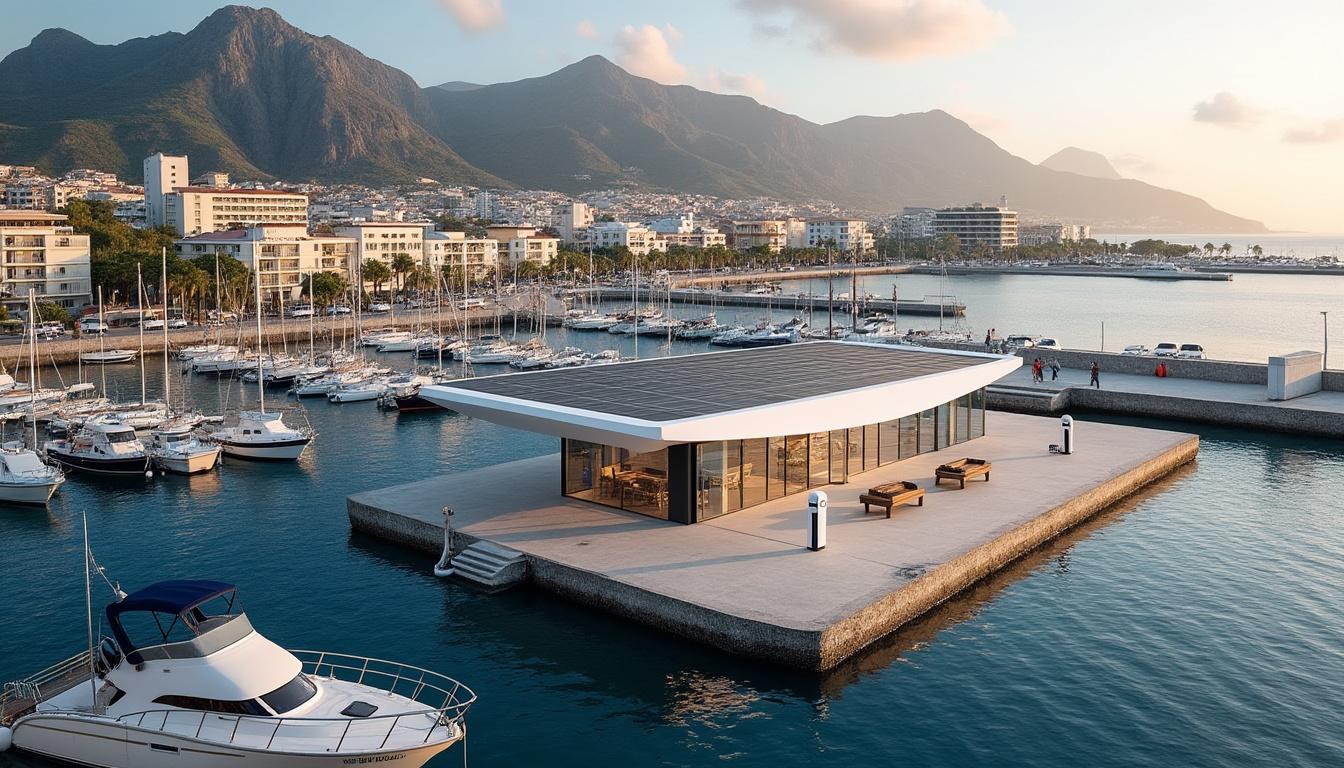
The Port of Funchal has taken a clear step towards clean mobility with the inauguration of a charging station for electric vehicles powered by 100% solar energy. The solution has been successfully tested and integrates into a broader strategy for decarbonization and energy efficiency in the Autonomous Region of Madeira.
| Short on time? Here’s the gist: | |
|---|---|
| ✔️ Key points | Why it matters |
| ✅ Solar energy charging ☀️ | Reduces emissions and operating costs, taking advantage of an abundant resource on the island. |
| ✅ Direct current (DC) ⚡ | More efficient than AC, with shorter charging times and less losses. |
| ✅ Shift2DC Project 🤝 | Full funding and European cooperation to modernize energy infrastructure. |
| ✅ Towards an energy community 🏘️ | Foundation for local sharing of renewable energy and integration with OPS and electric fleets. |
Port of Funchal inaugurates solar charging station: real impact on electric mobility
In the context of a city that has been strengthening the public charging network, the operation of a 100% solar-powered charging station at the Port of Funchal represents more than a symbolic gesture. In a port environment, where fleets operate daily and logistics needs are constant, the availability of clean and efficient charging brings immediate benefits: less local emissions, less noise, and greater predictability of energy costs. It is a clear sign of technological maturity and strategic vision for the region.
The equipment was successfully tested as part of the Shift2DC Project, a European initiative focused on direct current (DC) infrastructures, coordinated by leading entities with dozens of partners from various countries. The installation in Funchal is a concrete example of the type of innovation that transforms policies into practice, positioning ports as living laboratories for energy transition. The choice of DC is not incidental: by reducing unnecessary conversions, overall efficiency increases, and useful charging time decreases, which are central aspects in a port.
According to the port administration, this investment of about 35,000 euros, fully funded by the consortium, meets the current needs of the internal fleet – light vehicles and even an electric forklift – and paves the way for future integrations with digital systems, battery storage, and, above all, Onshore Power Supply (OPS) for moored ships. By aligning vehicle charging with a broader electrification vision, the Port of Funchal avoids technological islands and builds a coherent grid of clean energy.
For you, who drives an electric vehicle or considers making the transition, this type of infrastructure brings a reassuring message: the island is laying the foundations for a more stable mobility, less dependent on fossil fuels, and more aligned with a natural heritage that deserves protection. The solar station at the port adds to the municipal network, already without operational fees beyond consumption and the regulatory tariff, and the professional technical management that several charging points have been consolidating. The greater the density and quality of the network, the easier daily routines become, from refueling on the way home to planning intermunicipal trips.
The milestone achieved in Funchal is not isolated: concurrently, regional entities have conducted energy audits of port buildings and completed studies such as Green Ports Madeira, which identify solutions to decarbonize the three regional ports with OPS infrastructures. The practical result is a pragmatic roadmap, with calibrated investments and clear goals. In daily terms, this translates into less uncertainty, more efficiency, and opportunities to integrate renewable energy where it makes the most sense: close to where it is consumed.
By investing in a functional solar DC station and in energy literacy, the Port of Funchal demonstrates that the transition happens when good engineering combines with measurable objectives. It is a step that reduces the “cost of hesitation” and invites the community to participate – whether by adopting electric vehicles or optimizing charging habits. In simple terms: the right infrastructure, in the right place, changes behaviors.
Charging in direct current (DC) in Funchal: efficiency, times, and costs made clear
The main difference between charging in alternating current (AC) and in direct current (DC) lies in the path that the energy takes to the battery. In AC, the converter of the vehicle determines the real power limit, which often restricts performance. In DC, the conversion happens at the station itself, and the energy reaches the battery more directly, allowing for higher power and lower losses. The result is tangible: shorter times and better utilization of periods of maximum solar production, something especially relevant in a climate like Madeira’s.
To give a practical idea, many vehicles support fast DC charging within ranges that can go from 50 to 150 kW, depending on the model and battery conditions. In a port operation, where the rotation of service vehicles and equipment like forklifts is intense, being able to replenish autonomy in short windows makes all the difference. An operational pause is no longer “dead time” but becomes part of energy planning, leveraging the solar peak around midday to accumulate charge with a lower environmental cost.
Efficiency also translates into less wear on components and a more rational sizing of cables, protections, and storage. By centralizing the “intelligence” of charging at the station, maintenance is simplified, and compatibility with future digital and automation systems is increased. If you think about your home, the logic is similar to installing a quality and well-sized photovoltaic inverter: energy circulates with fewer losses, and the entire system operates more smoothly.
To extract the maximum from these stations, some good practices are universal and avoid frustrations:
- 🔌 Plan the charging between 20% and 80% battery: saves time and preserves the health of the accumulator.
- ☀️ If possible, charge during peak solar production hours: aligns cost and impact with the energy from the station itself.
- 🧊 Avoid arriving with the battery too cold or too hot: thermal management limits power for safety.
- 📲 Use apps for locating and checking the status of stations (e.g., UVE directories): reduces wait times and detours.
- 🧩 Always bring the appropriate cable and confirm the connector: Type 2 for AC and CCS for DC are the most common.
For fleet managers, integrating solar DC with small stationary storage systems can smooth consumption peaks and make charging predictable. In a port environment, the effect is cumulative: less noise, better air quality, and teams working in healthier spaces. And when the energy comes from the rooftop or the neighborhood of the station, the supply chain is short and transparent. In summary: solar DC provides time, stability, and clarity of costs.
Electric fleets and port operations: from forklifts to OPS, an ecosystem that works
The value of this charging station becomes even more evident when observing the daily operation of a port. Among maintenance vehicles, light service vehicles, and electric forklifts, there are short and demanding work cycles, often with stops of just a few minutes. The availability of fast DC charging allows replenishing autonomy without compromising the pace of operations, which is crucial in logistics and security tasks. This efficiency translates into less need for reserve vehicles and a more precise management of the maintenance schedule.
In the medium term, the solar station serves as an integration hub for other pieces of the puzzle, namely Onshore Power Supply (OPS) infrastructures, which provide energy to ships while they are moored. When a ship shuts down its auxiliary engines and receives shore power, emissions and noise in the heart of the city are reduced, improving air quality and acoustic comfort. This is a direct gain for those who live, work, and stroll near the port, and a competitive advantage for the region in terms of responsible tourism and efficient operation.
There is also a powerful demonstration effect. By seeing service vehicles and port equipment charging with local solar energy, private drivers gain confidence to make the leap to electric. On the maintenance side, technical teams become accustomed to readings, protocols, and management software, creating skills that are later replicated at other points on the island. Technology ceases to be an “extra” and becomes an everyday tool, with simple routines: checking the charger’s status, planning charging slots, recording consumption, and cross-referencing data with current solar production.
For many operators, the question is practical: how to balance the fleet’s demand curve with solar generation? The answer involves three layers: schedule management (charging during periods of lower activity and more sun), local storage (batteries that mitigate peaks), and predictive software (that reads patterns and suggests charging sequences). The Funchal station was designed for this evolution, integrating into a regional plan that includes energy audits and digitization of processes, where data moves out of silos and starts supporting concrete decisions.
In summary, when solar DC charging articulates with OPS and digital management, the port ceases to be merely a transport infrastructure and becomes an intelligent energy platform. This paradigm shift directly benefits the city and indirectly every electric driver who relies on a coherent and predictable network. This is how a transition is built that does not rely on slogans, but on services that work.
Shift2DC, Green Ports, and data that counts: the route to an energy community in Funchal
The new station did not appear out of nowhere. It materializes the vision of Shift2DC, a European project funded by the Horizon Europe program, which brings together dozens of partners from 10 countries, including universities, companies, research centers, and public entities, under the coordination of reference technical entities. The focus is clear: modernize infrastructures based on direct current, integrating renewables, storage, and digitization. By choosing Funchal as the stage for a functional test, the consortium points to Madeira as an ideal territory for high-impact and scalable climate solutions.
In parallel, the port administration has completed a set of studies and actions that prepare a more robust electric future. The energy audit refocused attention on what truly consumes and where there are losses, from buildings to lighting and equipment. The Green Ports Madeira study mapped OPS infrastructures for the ports of Funchal, Caniçal, and Porto Santo, defining technical requirements and installation priorities. And the DUAL project emerges as a monitoring basis, collecting environmental indicators that inform decisions with evidence, not just intentions.
What comes next is particularly interesting for the local community: the creation of an energy community centered around the Port of Funchal, where energy produced from renewable sources can be shared among different users within the perimeter, reducing costs and emissions. Practically, this means using the port as an “anchor” for a network that includes businesses, services, and potentially municipal equipment. The multiplier effect is noticeable when connecting solar rooftops, batteries, chargers, and management software in a coherent ecosystem.
This vision joins the municipal reinforcement of the charging network in the city, including dual stations in strategic areas and operation without fees beyond consumption and regulatory tariff. The specialized technical management, ensured by experienced operators, brings the reliability sought when parking and needing energy. For the end user, the combination of advanced port infrastructure and comprehensive urban network translates to confidence: there are alternatives, the system learns from data, and the experience improves month by month.
Those looking for an available and compatible charger can rely on charging point search platforms, such as the directories of UVE, which list location, power, and operational status, helping to avoid unnecessary trips. In an insular territory, where every kilometer counts, updated information is the difference between a frustrating detour and a well-utilized stop. And when the energy that powers your car comes from the sun shining over the bay, mobility ceases to be just transportation and becomes part of a local low-carbon economy.
The guiding thread is simple: data, coordination, and the right infrastructure. The solar DC station at the Port of Funchal is the missing piece to transform studies into practice, opening the door to an energy community that serves people and businesses, with measurable environmental and economic benefits. The island is grateful when technology respects the place and multiplies good decisions.
How to take advantage now: practical steps for you and your electric routine in Funchal
With the solar station up and running and the urban network growing, the best course of action is to organize routines to save time and ensure availability. Defining simple habits gives you predictability and avoids queues during peak hours. At the same time, small daily decisions prolong battery life and optimize costs without sacrificing convenience.
A straightforward roadmap helps you get started today:
- 🗺️ Plan your route with one or two alternative charging points: reduces anxiety and avoids waits.
- ⏱️ Prefer the period of lower traffic (early morning or mid-afternoon): more spots, less time stopped.
- 🔋 Charge during short windows (20–80%): faster and healthier for the battery.
- 📡 Set alerts in charging apps: be notified when a charger becomes available.
- 🌤️ If possible, align your stop with strong solar hours: better utilization of local renewable production.
- 🧾 Keep simple records of consumption and costs: visible = controllable.
For those choosing the type of charging in different contexts, this quick table helps to decide:
| Criterion 🔎 | AC (Alternating Current) 🔌 | DC (Direct Current) ⚡ |
|---|---|---|
| Available time | Ideal for long parking (work/home) | Ideal for short stops and quick rotations |
| Overall efficiency | Depends on the vehicle’s internal charger | Conversion at the station, lower losses |
| Operational costs | Generally lower per kWh | Price per kWh may be higher, but compensates in time |
| Typical cases | Night at home; extended parking | Port; highway; fleets; logistics |
It is worth remembering that the municipal network in Funchal has been growing, with well-distributed points and simplified operation, and technical management at various locations ensures preventive and corrective maintenance to minimize unavailability. By combining this urban fabric with the solar DC station at the port, redundancy is gained: if one point is occupied, there are nearby alternatives. For you, this means autonomy with less uncertainty, and the freedom to use the electric car like any other – only with less emissions and more silence.
If you need to retain just one action: update your charging apps now, mark the most convenient stations, and set alerts; next time you pass by the port, you will have a simple and effective plan waiting.
Source: sapo.pt