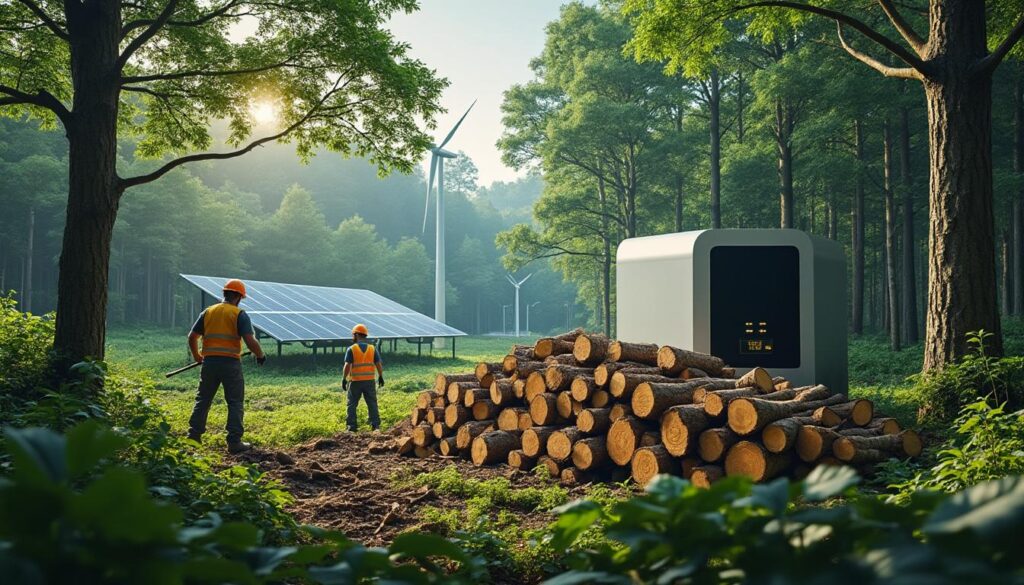
The blackout of April 28 functioned as a true stress test of the Portuguese electrical system: without cyberattacks, without relevant damage, and with a quick restoration, it brought valuable lessons for homes, businesses, and cities.
This guide translates what happened into practical solutions for your home, focusing on efficiency, storage, and energy autonomy, without easy promises and with real examples.
Short on time? Here’s the gist:
| ✅ Key Point | 💡 Essential for you |
|---|---|
| Proven system stability | There was no cyberattack or damage; it was a real test of the system’s safeguards ⚙️ |
| Response and recovery | Portugal restarted with black start and external support to accelerate; high voltage restored quickly ⏱️ |
| Batteries and management | New focus on storage and inertia to stabilize renewables; investment of €137M 🔋 |
| Prepared home | Thermal envelope + ventilation + critical UPS = comfort and safety even without grid 🏡 |
April blackout in Portugal: what happened and why it was not a cyberattack
The incident on April 28 took many by surprise, but it did not reveal structural weaknesses. In parliamentary hearings, the director-general of the Directorate-General for Energy and Geology emphasized that the national electrical system is stable and that the episode served as a real test, with controlled damage and no casualties. The crucial statement was clear: there was no cyberattack, terrorism, or malicious action.
What triggered the failure was a rare combination of factors in the European grid. Experts from the European Network of Transmission System Operators for Electricity pointed to a cascading voltage increase, recorded in southern Spain in the final phase of the event, followed by sudden production shutdowns — particularly renewable — which led to the electrical separation of the Iberian Peninsula from the continental system. When this occurs, synchronization is lost, and critical variables (frequency and voltage) oscillate outside normal limits, requiring automatic and coordinated action.
The step-by-step of the collapse and recovery
Shortly after noon, the Iberian grid began to lose coherence with the continent and entered an oscillating regime. Protection mechanisms shut down assets to prevent greater damage — a normal and desirable defense. The result was a temporary “blackout,” while operators and automation executed the restoration plan.
The good news? Portugal was able to activate its black start capability, that is, restart power plants without relying on external energy, as required in a total collapse scenario. There was support from France to accelerate the final synchronization, but the baseline start capacity was demonstrated internally, reinforcing confidence in the national arrangement. The Portuguese high voltage link was recovered shortly after midnight; in Spain, full restoration arrived by dawn.
No damage, no alarmism — but with objective lessons
The episode left no significant damage to the transmission networks, and the clarified technical discourse avoided catastrophic readings. Unlike what happens after crimes, the priority here was to adjust management instruments for a reality with greater penetration of renewables, where grid inertia is lower and variability is more pronounced. There was also a positive side effect: for about one and a half months, Portugal operated practically in autarky, relying mainly on domestic resources, which reinforced the evidence of the system’s resilience.
The next steps include expanding black start services, investing €137 million in voltage control, and launching an emergency services market based on batteries. Such measures are not a luxury: they will be the technical counterbalance missing to accelerate renewables. The final report on the blackout is scheduled for the first quarter of 2026, consolidating learning, but the overall lines are clear: it was not harmful, and it served to validate safeguards and accelerate improvements that were already on the radar.
For those who see energy as a pillar of domestic comfort, the main conclusion is straightforward: rare events happen, and a prepared system responds quickly; it is up to each home to gain that same muscle of resilience.
April blackout and your home: practical lessons for comfort and safety without energy
A robust national grid does not eliminate small impacts in daily life: stopped elevators, turned-off routers, interrupted kitchens. At the housing level, the difference between stress and serenity is measured by three pillars: thermal performance of the house, management of essential loads, and minimum autonomy for communications and lighting. Living in Lisbon or Trás-os-Montes changes little in this equation; what changes are the available resources.
Thermal envelope: the “silent generator” of comfort
Homes with continuous insulation, thermal break window frames, and controlled shading maintain temperature for hours, even without climate control. In a blackout in late spring, a house with good thermal mass and cross ventilation secures comfort at night with ease. In apartments, the common misconception is to rely solely on air conditioning; in the absence of power, what matters is the building’s shell. Closed interior doors, blackout curtains, and manual ventilation create a “bubble” of comfort in used rooms.
Load management: clear priorities, minimum consumption
A simple strategy is to map essential consumptions and turn off the rest. Modern refrigerators can last 4-6 hours closed without significant losses. The rule is practical: open the refrigerator only when necessary. LED lighting in key points with rechargeable lanterns reduces anxiety and maintains routines. For families with remote work, a dedicated UPS for the router and laptop buys 1-3 hours of connectivity, enough to safely finish tasks.
- 🔌 Turn off non-essential loads (standby also consumes)
- 🧊 Open the refrigerator the minimum necessary
- 💡 Have accessible rechargeable LED lanterns
- 📶 Use UPS for router and laptop (basic autonomy)
- 🚪 Close rooms to conserve temperature
Consider the case of the Martins Family, in a two-bedroom apartment in Setúbal: a 1000 VA UPS, two lanterns, and a USB fan (powerbank) were sufficient to withstand four hours of interruption with comfort and serenity. There were no inflated costs or noisy solutions; just smart preparation.
Errors to avoid and a simple plan
Two common mistakes: buying a gasoline generator without considering noise, ventilation, and maintenance; and installing solar panels without backup mode, believing they work in the dark. Most inverters shut down for safety when there is no grid. If the priority is resilience, look for a hybrid inverter with “island mode” function and a critical load panel. A basic plan in three acts — robust thermal envelope, UPS for communications and LED lighting, and portable solar chargers — already completely changes the experience.
By preparing your home as an “efficient cocoon,” you gain time and tranquility until the grid recovers. It is the simplest way to turn an unforeseen event into a manageable episode.
Batteries and inertia after the blackout: how storage stabilizes the system and benefits your housing
The April episode reinforced the need for distributed storage and synthetic inertia sources to dampen variations. At the systemic level, investments of €137 million are underway in voltage control resources and the launch of an emergency services market based on batteries. These resources do not only provide energy: they offer system services (frequency regulation, voltage control, inertia support) crucial when renewable production changes rapidly.
What batteries do differently
Unlike a traditional generator, batteries respond in milliseconds and without emissions, stabilizing frequency when there are imbalances. At the domestic level, a 5 kW system with 10 kWh, configured for backup, can power lighting, essential outlets, router, circulation pump, and refrigerator for 8-12 hours, depending on usage. It is not an “invincible wall,” but it covers the essentials with silence and predictability.
For those with photovoltaics, the key piece is the hybrid inverter with automatic switching for “islands” and a critical load panel. Without this, the panels shut down when the grid goes down. By attaching a small battery, solar energy is transformed into real autonomy, even if for controlled periods.
Economics without illusions and real cases
Financially, the residential battery does not always “pay for itself” just from tariff arbitrages. The main value lies in resilience and comfort. The Martins Family opted for a 7 kWh set and well-defined priorities: lights, internet, refrigerator, and two dedicated outlets. In neighborhoods with sporadic cuts, the peace of mind of knowing that everything essential continues to function was decisive. In multifamily buildings, condominium solutions with micro-storage in common areas (lighting, water pumping, gates) have gained traction.
- 🔋 Size for your critical loads (not for “theoretical maximum”)
- ⚡ Look for inverter with “island mode” and fast transfer
- 🧰 Plan for simple maintenance and adequate ventilation
- 📲 Integrate monitoring to adjust consumption habits
On the electrical system side, batteries at the grid scale function as “airbags” against oscillations, injecting or absorbing power in short cycles. This is where the emergency services market becomes vital: it pays for rapid responses, encourages projects, and reduces the risk of new separations of the Iberian grid in extreme events.
With clear objectives — stability, rapid response, and resilience — storage stops being a trend and becomes a technical instrument. At home, the benefit is immediate: maintaining essentials, with comfort and safety.
Black start and home microgrids: from the system’s real test to solutions at your home scale
The term black start gained prominence after the event. In simple terms, it is the ability to start power plants without external energy, using prepared units (hydropower plants, large-scale batteries, or specific turbines). Portugal demonstrated this capability, with international support to accelerate the final synchronization — a normal technical step when trying to shorten recovery times.
How this inspires domestic scale
In homes, the equivalent is called “island mode” or “EPS” (Emergency Power Supply). When the grid fails, the inverter kicks in, isolates the critical panel, and generates a safe mini-grid. Everything happens in seconds. For it to work well, it is crucial:
- 🧩 Have a well-defined critical load panel (cold, lighting, communications)
- 🔄 Ensure automatic switching with a short transfer time
- 🔒 Isolate the installation to avoid injecting energy into the public grid
- 🌞 Prioritize available solar energy and manage peaks with battery
- 📏 Respect the inverter’s power: starting peaks of motors count
In homes with a well and pumping, for example, starting the motor requires current peaks that may exceed the inverter’s capacity. The solution is technical: soft starters or selecting an inverter with an appropriate power peak. In apartments, the focus is more on lighting, communications, and food refrigeration — less power, more autonomy.
Neighborhood and building microgrids
Buildings with shared production (energy communities) are starting to design temporary “islands” for common services: lighting, elevators, and security systems. It is not trivial, as it requires engineering, dedicated panels, and selective protection. However, when thought out from the project stage, the incremental cost is modest compared to the resilience gain. In rural areas, a grouping of three to five houses can share a system with a community battery to maintain communications and refrigeration of medicines — a significant social impact in more vulnerable contexts.
Culturally, the concept is not new: mountain villages have always been systems of mutual support. Current technology simply formalizes this spirit in microgrids with smart metering and fair sharing algorithms. The recent blackout showed that the ability to restart quickly is gold; replicating this idea in the neighborhood is the next logical step.
In the end, the logic is simple and powerful: the shorter the chain between production, storage, and consumption, the more resilient the system. A prepared home reflects what the grid has already proven capable of doing.
Risk management, costs, and decisions after the blackout: what changes until the final report of 2026
There is one truth that is not always stated: absolute security costs a lot. The acceptable level of risk for the electrical system is a political decision, not just technical. If the ambition is to eliminate any event, the bill skyrockets, and other priorities fall behind. The learning from April points another way: to reinforce complementary functions — voltage control, reserve services, synthetic inertia, and black start — without hindering the renewable transition.
Ongoing measures and practical impacts
Among the measures being implemented are the expansion of black start to more plants, the investment of €137M in voltage control resources, and the launch of the emergency services market with batteries. This last front is decisive: it pays for the capacity to respond when everything else trembles, creating a technical cushion that protects consumers and industry. With the final report announced for the first quarter of 2026, Europe and the Peninsula gain a more precise guide to operate in extreme scenarios.
For households, this translates into objective recommendations. A short list helps turn intention into practice:
- 🏡 Reinforce the thermal envelope (insulation, shading, thermal curtains)
- 🔌 Define your critical load panel (maximum 5 circuits)
- 🔋 Consider battery + inverter with island mode to maintain essentials
- 📶 Have UPS for router/laptop and charged power banks
- 🧭 Test your plan twice a year (change batteries, check lanterns)
One last note on priority: the problem in April was not “the fault of renewables.” It was a matter of extension and coordination of the system in a complex context. Hence the importance of resources that add inertia, regulation, and damping. When management improves, clean production grows safely.
If you have only one gesture to make today, make it wisely: list your essential loads and create a small backup panel. It is simple, cheap, and changes everything when the lights go out.
If you wish to delve into solutions for passive comfort and autonomy at home, consult specialized resources like Ecopassivehouses.pt, with clear ideas applicable to the Portuguese context.
Source: expresso.pt