The Government announced support of 15 million euros to accelerate energy efficiency and the adoption of renewable sources in the agricultural sector. The measure, secured by the Environmental Fund and operationalized by the IFAP, aims to reduce costs, emissions, and increase the energy autonomy of farms.
Short on time? Here are the essentials:
| ✅ Item | 📌 Essential |
|---|---|
| 🟢 Financing | Non-repayable, up to 100% of eligible investment for efficiency and renewables. |
| 👩🌾 Beneficiaries | Agricultural and livestock producers, cooperatives, associations, producer organizations, irrigators. |
| ⚡ Priorities | Reduction of consumption, lower emissions, and production/storage of renewable energy. |
| 🛠️ Examples | Photovoltaic, batteries, efficient irrigation pumps, inverters, biogas, thermal insulation of chambers, energy management systems (SGE). |
| 📝 Application | Submission on the IFAP portal; deadlines and terms on the Environmental Fund website. |
| ⚠️ Mistake to avoid | Installing without energy audit and without proper system sizing. |
Government invests 15 million euros: what changes for energy efficiency in agriculture
By channeling 15 million euros for the modernization of farms, the Government creates a decisive impetus for the energy transition in the field. The design of support as non-repayable reduces investment risk and shortens the payback period, especially in mature technologies such as solar photovoltaic and speed inverters in irrigation and pumping equipment.
The support covers both equipment and infrastructures capable of reducing consumption and emissions. This includes batteries for storage, biogas from agricultural waste, improvements to thermal insulation in cold chambers, and energy management (SGE) systems with real-time monitoring. These interventions lower the electricity bill and relieve operational pressure during peak tariff periods.
Who can apply? The range is broad: agricultural and livestock producers, cooperatives, sectoral associations, producer organizations, and irrigators’ associations. By including collective entities, the program encourages shared solutions, such as energy communities in irrigation perimeters, where scale amplifies gains.
For public policy, the measure acts as a bridge between energy and climate goals and agricultural competitiveness. The reduction of emissions reflects on the positioning of Portuguese products in markets that value low carbon footprint value chains. And, by reducing energy costs, it frees up margins to invest in quality, certification, and agronomic innovation.
In practice, the way forward is clear: diagnosis, design, execution, and measurement of results. The IFAP will be the entry point for applications, while the Environmental Fund will publish terms and deadlines. By 2026, the digitalization of processes will facilitate submission and transparency, making the experience more predictable for the farmer.
Imagine a cooperative in Alentejo with high water pumping consumption. By combining photovoltaic panels with speed inverters, pressure sensors, and an SGE, it is possible to reduce consumption by 25–40% during peak load hours. If they add batteries, the farm can cushion tariff spikes and power critical loads outside the solar period.
The big leap, however, is in integration: local production, storage, efficiency, and management. When these elements converge, the farm approaches a model of energy autonomy with stabilized costs. This is where public support has the greatest multiplying effect: it accelerates investments that would otherwise be postponed.
The result? Less volatility, more resilience, and a sector prepared to respond to the demands of climate and market. This is the opportunity to turn energy into a competitive advantage, not an unpredictable cost.
How to reduce costs with renewables and storage: practical strategies for agricultural operations
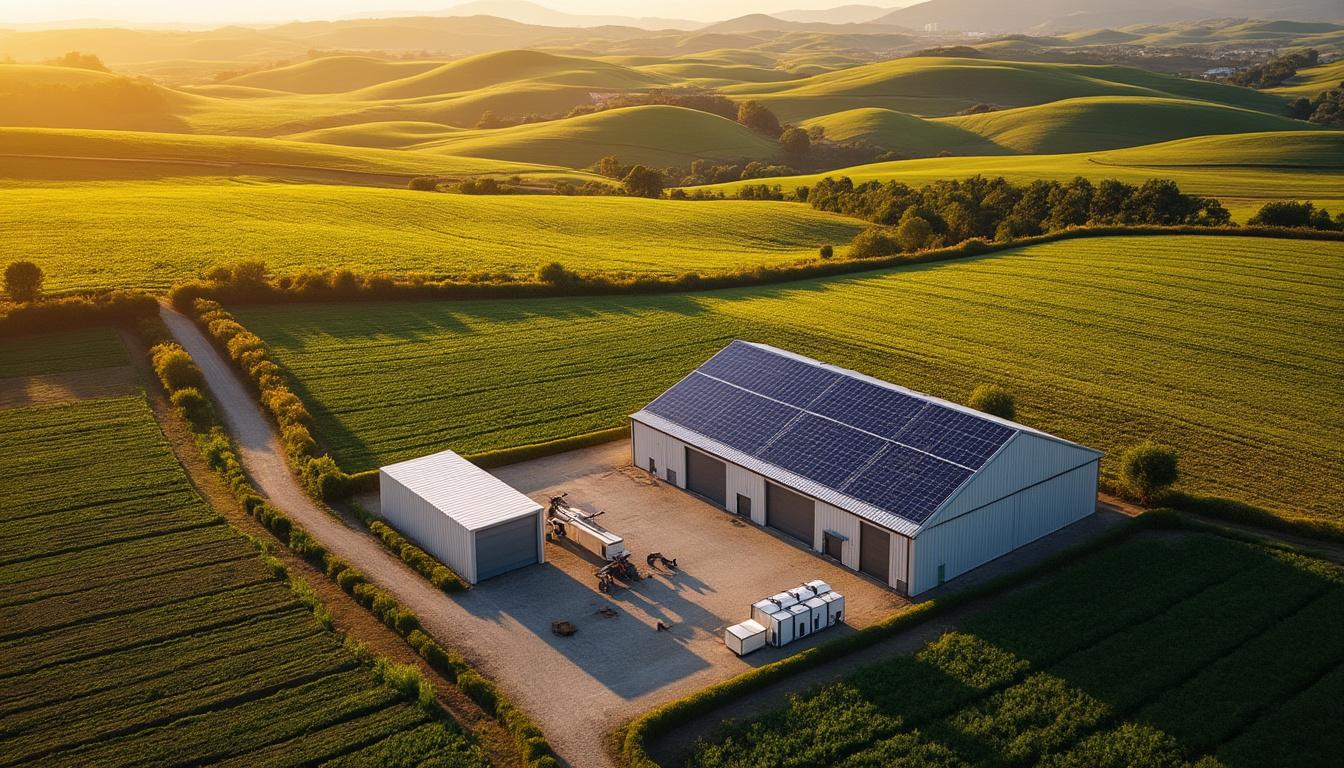
Reducing energy costs is not just about installing panels. It’s about combining solutions tailored to the consumption profile of the farm. The first step is to identify critical loads: pumping, refrigeration, greenhouse ventilation, and milking. With a consumption map by hour, priorities are defined and renewable production sized.
In terms of production, solar photovoltaic leads due to its maturity and compatibility with the seasonality of irrigation. In areas with consistent wind, microgeneration wind can complement, reducing dependency on the sun. For livestock operations, biogas from waste is a double asset: it manages waste and produces energy/heat for processes such as water heating or digesters.
Storage is the glue that binds the system. Batteries allow the shifting of solar energy to higher-value hours, ensuring autonomy in critical operations. In irrigation, moderate storage batteries (e.g., 1–2 hours of backup for priority pumps) already make a difference during peaks. In cold chambers, thermal storage using intelligent cooling cycles can shift load outside peak hours.
Outside of production, efficiency yields immediate gains. Speed inverters in pumps adjust flow to real needs, avoiding waste. Insulation and airtight sliding doors in cold chambers reduce losses. High-efficiency IE3/IE4 motors and LED lighting with sensors decrease hidden consumption. All of this is eligible for support and has quick returns.
Consider the case of the “Quinta das Ribeiras,” a fictional farm with 40 hectares of irrigated land and a cold room. With 60 kWp of photovoltaic, 60 kWh batteries, inverters on pumps, and enhanced insulation, the annual bill dropped by about one third. More importantly, the predictability of energy costs has allowed planning the expansion of the production area without fear of tariff shocks.
To maximize gains, a energy management system is indispensable. Circuit meters and a control panel with simple targets – kWh per m³ of water or kWh per kg of product – change the way of operating. When the team tracks these indicators, savings opportunities emerge that no single piece of equipment can deliver.
And the quality of energy? In rural areas, voltage fluctuations damage motors and electronics. Stabilizers, UPS for critical controls, and good grounding practices protect the investment. A maintenance plan with quarterly routines (filters, pump alignment, inverter checks) avoids performance losses that go unnoticed in daily operations.
In solution design, it is worth planning for flexibility: hybrid inverters ready for future batteries, photovoltaic structures sized for expansion, and electrical panels with spare space. Public support covers the essentials, but a vision for 5–10 years transforms a good project into an excellent one.
When all these align, the farm gains three things: controlled costs, reduction of emissions, and a sustainability narrative that enhances products in the market. This combination is the foundation of a stronger and more sustainable agricultural business.
Steps to apply for IFAP support without errors and with maximum approval
A strong application starts with diagnosis and ends with measurement. Between these points, documentation, alternative comparison, and realistic scheduling make all the difference. The goal is not just to obtain support, but to ensure that the investment delivers measurable results.
To organize, follow a simple and practical sequence. This approach helps meet the criteria of the Environmental Fund and streamlines the process on the IFAP portal.
- 🧭 Energy audit: assess hourly consumption profiles, critical loads, and reduction potentials.
- 📊 Clear goals: define indicators (kWh/m³ irrigation, kWh/kg, tCO₂e avoided) and annual objectives.
- 🧮 Sizing: cross-reference renewable production with consumption; simulate seasonality and peaks.
- 💶 Comparative budgets: request 2–3 quotes per solution; evaluate total life cycle cost.
- 🧩 Integration: ensure compatibility between inverters, batteries, SGE, and electrical protections.
- 📅 Work plan: foresee windows without impact on harvesting/irrigation; include testing and training.
- 📚 Licenses and standards: ensure compliance with network, safety, and environment.
- 🧪 M&V: plan measurement and verification to prove savings and avoided emissions.
Common errors? Four deserve attention. First, applications without a load study lead to oversized systems that do not deliver expected returns. Second, forgetting storage when there are night peaks in refrigeration. Third, neglecting maintenance and monitoring, which drains gains over months. Fourth, not planning for future expansion, limiting project evolution.
The technical file should include design drawings, equipment sheets, production simulations, and a simple M&V plan (for example, pre-intervention baseline and monthly readings per circuit). Documenting before and after is the most robust way to prove results, in addition to being useful for daily management.
In terms of deadlines, monitor the Environmental Fund and IFAP website for opening announcements. Prepare the application in advance to submit as soon as the period begins. In a dynamic market, proposals have a limited validity; aligning budget and submission windows avoids rework.
If you need technical support, there are companies specialized in energy solutions for agriculture. For information and quotes, you can contact SOLVENAG — RUA REGO DOS PINHEIROS 302, 4755-276 MACIEIRA DE RATES — [email protected] — 252 955 259 (landline) or 916 693 893 (mobile). Having experienced partners helps turn goals into consistent results.
With method and solid documentation, the probability of approval increases and the investment starts to work in favor of your business, with technical evidence and operational comfort.
Energy efficiency by type: vineyards, greenhouses, livestock, and irrigation under the new government support
Not all farms consume energy in the same way. By aligning technologies with the needs of each production system, the impact of public support multiplies. Below are strategies by type, focusing on practical gains and solution integration.
Vineyards and olive groves: pumping, cold, and mobility
In vineyards and olive groves, energy weighs heavily in pumping and, during harvest, in initial refrigeration. Photovoltaic with variable speed pumps reduces spikes and losses due to excess pressure. At grape reception, efficient pre-cooling and insulation of stainless steel tanks hold quality with fewer kWh.
Storage helps cover extended shifts on harvest days. Electric or lightweight hybrid tractors, when viable, reduce noise and emissions in the fields. A simple SGE with sensors in tanks and pumps allows for minute-by-minute operation optimization.
Greenhouses: controlled climate without waste
Greenhouses require ventilation, shading, and sometimes heating. High-efficiency motors in fans, inverters, and control by humidity/temperature prevent unnecessary continuous operation. Running thermal curtains at strategic times reduces heat loss and energy needs.
Solar can power ventilation and fertigation systems. When there is a need for heat, small-scale biomass boilers or utilizing residual heat from generator groups are options to consider. Simple sensors and algorithms create short operation periods focused on agronomic comfort rather than habit.
Livestock: biogas and animal welfare
In livestock, biogas is often the anchor solution. Digesters sized to the volume of waste generate electricity and heat for the unit, saving energy and waste management. Fans and lighting in barns should be high-efficiency, with automatic control by temperature and presence.
Hot water for washing and hygiene can be supplied by solar thermal or heat from biogas CHP. By integrating these systems with an SGE, it is possible to adjust washing times to lower cost periods without compromising routines and animal welfare.
Irrigation: precision and robustness
In irrigation, energy concentrates on pumping. Inverters, pressure sensors, and well-calibrated valves make a big difference. With photovoltaic, the rule is to match production with flow; with batteries, it deals with moments when weather fails. Low-loss materials and maintenance of screens and filters ensure that every kWh moves only the water that is truly needed.
An example: the “Vale Claro Irrigators Association” implemented a shared system with 250 kWp of solar photovoltaic and pressure management by sector. The reduction in consumption per irrigated hectare exceeded 30% in one season, with better uniformity in irrigation and fewer failures due to cavitation.
The transversal lesson? Prioritize compatibility between components and preventive maintenance. The right technology, poorly integrated, yields little. With aligned design and operation, public support translates to solid savings and consistent agronomic performance.
Non-repayable financing up to 100%: return, risks, and how to measure climate impact
The design of support as non-repayable up to 100% of eligible investment changes the project’s calculations. When the financed CAPEX is high, the return no longer depends solely on the bill and begins to reflect gains in resilience, lower tariff risk, and cash stability. It’s a logic of avoided costs with direct effects on competitiveness.
To assess returns, think in three layers. The first is direct savings (kWh avoided, self-consumption, reduction of contracted power). The second is operational optimization (fewer failures, less maintenance time, stable thermal quality). The third is market value (certifications, access to clients that require sustainability, low carbon narrative).
Methodologically, a simple approach works: establish a baseline of 12 months, implement the measures, and monitor indicators monthly. In agriculture, two are crucial: kWh per m³ of water (irrigation) and kWh per kg of product (processing and cooling). For emissions, convert avoided kWh into tCO₂e using updated emission factors to the national electricity matrix.
The risk analysis is also straightforward. The greatest technical risk is inadequate sizing, which is mitigated with auditing and simulation. The operational risk is lack of maintenance, addressed with O&M contracts and performance KPIs. The regulatory risk, currently low for self-consumption and efficiency, decreases with documentation and compliance from the outset.
A good practice is to include electricity price scenarios. Even with public support, modeling prices in three trajectories (stable, moderately high, volatile) helps assess robustness. Projects that remain advantageous under all scenarios are the ones that best utilize support funds and generate tangible savings in the long term.
For farms with strong seasonality, the emphasis is on demand management. Adjusting pumping schedules, pre-cooling chambers before peak hours, and using batteries for critical loads protects operation and extends equipment lifespan. The synergy between local production, storage, and efficiency is what truly creates a robust agricultural energy ecosystem.
Finally, measuring climate impact is not bureaucracy; it’s a management tool. Knowing how much was saved and what emissions were avoided guides the next investment decisions and strengthens communication with clients, partners, and financiers. With clear indicators, energy ceases to be merely a cost and becomes a field for continuous innovation.
Source: maissemanario.pt