Castelo Branco is at the center of an unprecedented energy transformation: the installed photovoltaic capacity jumped from less than 1 MW to 183 MW between 2017 and 2024, a growth of 33,500%. In 2025, new projects and decentralized models may strengthen the energy autonomy of families and businesses in the region.
| In a hurry? Here’s the essential: |
|---|
| ✅ Record growth ⚡: +33,500% in 7 years (2017-2024), with 183 MW installed and two large parks under evaluation. |
| ✅ Grid and location matter 🧭: the Fundão substation and auctions from 2019-2020 guided promoters to areas with available connections. |
| ✅ Avoid common mistakes 🚫: do not invest without analyzing shadings, energy class of the building, and hourly consumption profile. |
| ✅ Good practice 🛠️: prioritize roofs and waterproofed areas and bet on energy communities in the neighborhood or condominium. |
Solar Boom in Castelo Branco: 33,500% in seven years — what it means for your home
The leap from less than 1 MW to 183 MW in 2024 did not come from nowhere. The combination of excellent solar exposure, much lower module costs (a drop of nearly 90% in the last decade), and network-oriented auctions created the conditions for acceleration. In European terms, the trajectory follows the sixfold increase in photovoltaic capacity in the EU, which was around 250 GW at the end of 2024.
For those living in the region, what changes? Local solar electricity helps stabilize prices in the medium term, encourages investments in self-consumption, and opens doors to energy communities in villages and neighborhoods. At the same time, there is a growing demand to better evaluate where and how to deploy large plants to balance climate, landscape, and biodiversity.
From zero to 183 MW: understanding the numbers
The percentage is alarming — and exciting. But it is crucial to interpret it: the growth was enormous because the base in 2017 was practically null. Today, Castelo Branco does not lead the total capacity in Portugal — districts such as Faro (≈690 MW), Lisbon (≈618 MW), and Beja (≈588 MW) still top the list. The uniqueness of Beira lies in the startup pace and potential for expansion when the grid allows.
This boost has direct effects on the built environment. Buildings with good windows, insulation, and airtightness, combined with panels on the roof and heat pumps, can drastically reduce bills, especially when the consumption curve aligns with the sun. The classic mistake is to install excess power on poorly oriented roofs or with shading without prior analysis.
- 🌞 Take advantage of the radiation: south-facing roofs, 15º–35º incline, minimal shading between 10 am and 4 pm.
- 🔌 Optimize the profile: schedule washing machines, ACS, and EV charging during sunny hours.
- 🏠 Before the panels: address the thermal envelope and energy class of the property.
- 🛡️ Guarantees: modules with 25 years performance and inverters with local assistance.
- 🤝 Share: energy communities allow sharing surpluses with neighbors.
| Indicator 📊 | Castelo Branco 🔆 | Portugal 🇵🇹 | Europe 🇪🇺 |
|---|---|---|---|
| Growth 2017-2024 | +33,500% | Strong acceleration | ≈6x in 7 years |
| Capacity 2024 | 183 MW | Expanding | ≈250 GW |
| Cost decline | Significant | High | Up to −90% |
| Preferred models | Large parks + self-consumption | Mixed | Growing decentralization |
Immediate opportunity for families and companies
If the goal is to reduce bills and increase resilience, start with the simple: energy diagnosis, self-consumption simulation, and potential integration with a heat pump. In commercial buildings, the roofs of warehouses and parking lots are golden opportunities.
- 📐 Step 1: audit consumption (summer/winter, daytime/nighttime).
- 🔍 Step 2: shading and wind study (secure fixing).
- 🧮 Step 3: simulate 3 power scenarios (undersized, optimal, oversized).
- 📅 Step 4: plan operation and maintenance (annual cleaning, monitoring).
- 🧑🤝🧑 Step 5: assess energy community with neighbors.
If you have little time, focus on what you control today: the roof, the timings, and the efficiency of your equipment. This triad usually explains more than half of the result.
Electric grid, location, and costs: why the 33,500% happened in Castelo Branco
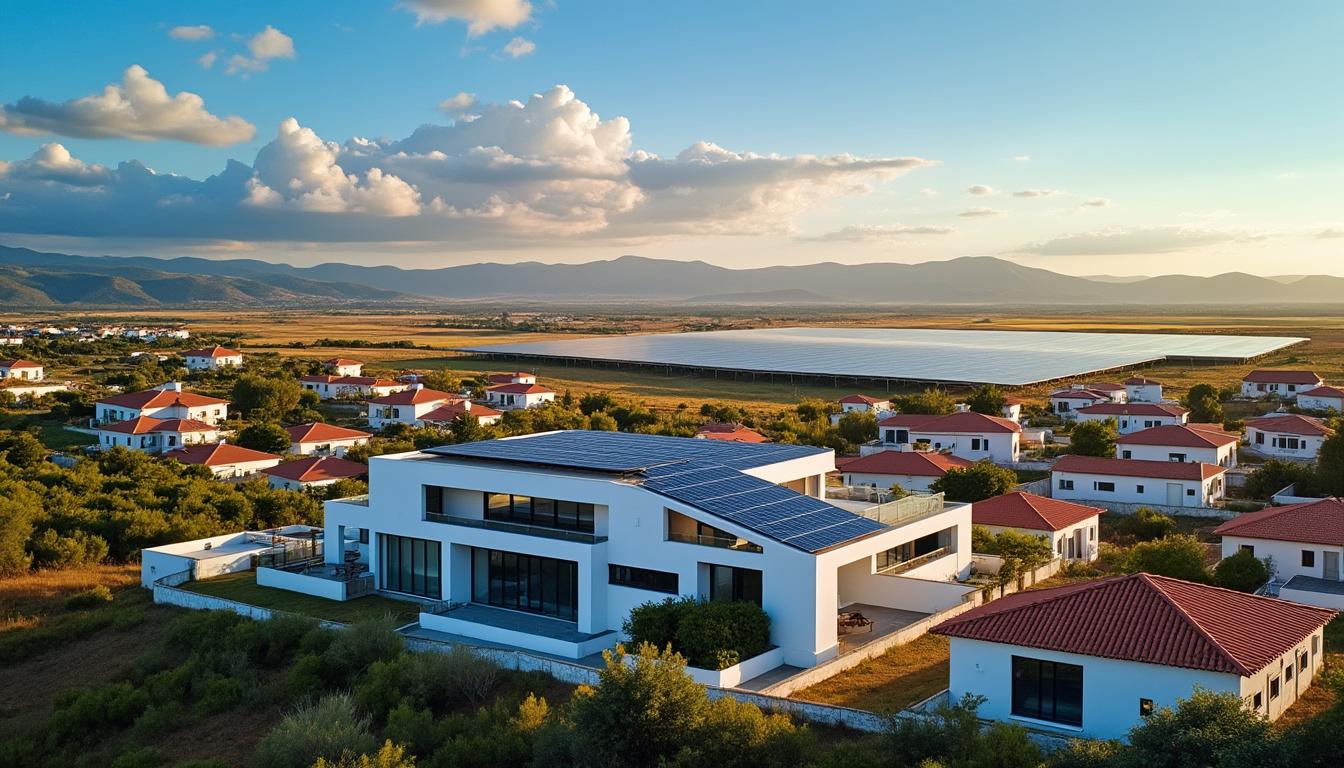
The large projects follow the grid. In 2019 and 2020, national auctions were designed to guide developers to available connection points, shortening deadlines and avoiding costly new lines. Proximity to the Fundão substation made the region particularly competitive, explaining why the Sophia project emerged at the border between Fundão, Idanha-a-Nova, and Penamacor.
In addition to the grid, factors such as the availability of large properties (simplified negotiation), good irradiation, and lower population density weigh in. However, the Portuguese grid is still limited at several nodes, and connection costs can be high, which affects schedules and sizing.
How the grid and auctions shaped the map
When the connection is the bottleneck, the map of options shrinks. Many developers first choose the REN post and only then adjust layouts and tracings to fit environmental and agricultural restrictions. The problem? In areas with natural values, the license may not come through, leading to frustration for all.
- 🧭 Factor 1: grid connection — reduces project risk and cost.
- 🏞️ Factor 2: available land — preference for continuous and less fragmented areas.
- 🌤️ Factor 3: solar resource — high and even irradiation.
- 📑 Factor 4: legal restrictions — REN, RAN, protected areas, servitudes.
- 💶 Factor 5: capital cost — windows of opportunity when funding is favorable.
| Factor 🧩 | Effect on the Project ⚙️ | What you can do ✅ |
|---|---|---|
| Connection point | Enables power and schedule | Follow public consultations and grid maps |
| Connection costs | Can make marginal projects unfeasible | Prioritize self-consumption and local sharing |
| Auctions 2019-2020 | Directed supply to eligible zones | Monitor new windows and rules |
| Current capacity | Limits at critical nodes | Size flexibly (phases) |
Practical tip: reduce costs and conflicts
In the built environment, the way to reduce connection costs is simple: produce to consume locally. For companies with large roofs, the combination of photovoltaic on the roof with shading for parking reduces vehicle temperature, cuts A/C consumption, and creates productive capex. In agricultural operations, solar for pumping with inverters replaces diesel generators and simplifies operation.
- 🏭 Warehouses: roof + park with solar covers.
- 🚜 Agriculture: photovoltaics for pumping and cooling.
- 🏬 Services: self-consumption + vehicle charging.
- 🏡 Residential: microgeneration + load management.
When considering investing, remember: the best kWh is the one you don’t consume. Efficiency first, generation next.
Sophia Project and Beira Plant in 2025: impacts, risks, and safeguards that matter
Two photovoltaic plants are gaining prominence in the district: the Sophia Solar Photovoltaic Plant and the Beira Plant, both promoted by Lightsource bp (fully acquired by bp in 2024). The Sophia, with proposed capacity in the hundreds of MWp, was designed near the Fundão substation, with a layout that, in published versions, covered hundreds of hectares and hundreds of thousands of modules. The plan foresees network connections and technical areas close to sensitive zones of the Geopark Naturtejo (UNESCO), RAN, and REN.
Local contestation has been unprecedented: over 12,000 participations in public consultation, catalyzed by digital platforms and activists who called on citizens to give their opinions. Among the concerns are the scale of the park, species protection, and landscape impact. The promoter expressed openness to adjustments, including replacing eucalyptus with tens of thousands of cork oaks and holm oaks and reforestation actions in areas over 200 hectares, measures that, if well executed, can bring ecological gains in the medium term.
Landscape, biodiversity, and soil: how to mitigate
Installations in agroforestry mosaics require fine design. The maintenance of ecological corridors, the implementation of slopes with native vegetation, and the restriction of works during nesting seasons are examples of effective safeguards. In RAN/REN perimeters, it is essential to avoid unnecessary impermeabilizations, prioritizing reversible solutions with low visual impact.
- 🌿 Fauna corridors: free passages and permeable fences.
- 🌱 Living soil: native vegetative covers and managed grazing.
- 👀 Visual impact: controlled heights, discreet palettes, living hedges.
- 🕊️ Sensitive seasons: work calendar compatible with nesting.
- 🧭 Monitoring: biodiversity indicators before, during, and after construction.
| Impact 🌍 | Mitigation measure 🧪 | Success indicator ✅ |
|---|---|---|
| Landscape | Green slopes and hedges | Reduction of visual cuts >50% |
| Soil | Implementation without extensive concrete | Preserved permeability |
| Fauna | Corridors and permeable fences | Wildlife traffic maintained |
| Flora | Native reforestation | Survival >80% of plants |
Public participation that works
When communities, municipalities, and environmental entities discuss location and design, the result improves. In areas like Naturtejo, the consideration should go beyond annual production: where and how to produce is as important as how much to produce. Public hearings are not a ritual; they are a project tool.
- 🗺️ Locational alternatives: analyze roofs, parks, and already impervious areas.
- 🧭 Proximity principle: generate near consumption when possible.
- 📣 Transparency: provide readable maps and impact studies.
- 🤝 Local benefits: funds for efficiency and energy communities.
Whatever the outcome of the licensing, one lesson stands: informed participation improves projects and reduces lasting conflicts.
Decentralization now: roofs, parking lots, and energy communities in Castelo Branco
While large parks advance, there is immediate and less conflicting potential: roofs of houses, schools, warehouses, and parking lot covers. Producing close to consumption reduces losses in the grid and strengthens local resilience. In 2025, rules for energy communities allow sharing kWh with neighbors, cooperatives, and small businesses.
Consider the case of a family in Alcains, with an annual consumption of 5,500 kWh. A 6 kWp system with microinverters, integrated with a heat pump and an ACS accumulator, covers a large part of the daytime consumption. If the profile is more nighttime, a storage of 10 kWh may make sense. In warehouses, 50–200 kWp on the roof, combined with fleet charging, usually presents solid returns when self-consumption exceeds 60%.
How to get started in 30 days
The short path includes diagnosis, design, simplified licensing, and installation. Do not skip steps: a good shading analysis is worth more than 1 extra kWp poorly placed.
- 🧭 Map surfaces: roofs, pergolas, seasonal shadings.
- 🧮 Simulate consumptions: tools with real hourly profiles.
- 🔗 Integrate loads: heat pumps, ACS, EV, local data centers.
- 📜 Verify rules: self-consumption and sharing in low voltage.
- 🛠️ O&M plan: cleaning, inspections, active monitoring.
| Scenario 🏠 | Typical size ⚡ | Self-consumption 🎯 | Fast track 💡 |
|---|---|---|---|
| T2 Apartment | 1.5–3 kWp | 50–70% | Load management and ACS |
| House | 4–8 kWp | 60–85% | Heat pump + EV |
| Warehouse | 30–200 kWp | 65–90% | Fleet charging |
Energy communities: the collective step
Neighborhoods and condominiums can share surpluses, reduce peaks, and generate revenues for the maintenance of common spaces. Schools and IPSS are great hubs, with compatible daytime loads. In practical terms, clear governance and a simple division of benefits are half the journey.
- 🏫 Anchor: school/market with a large roof.
- 📍 Perimeter: sharing radius agreed by members.
- 📈 Rules: consumption priorities and surplus redistribution.
- 💶 Financing: local cooperatives and municipal funds.
To know where to start, consult practical guides on reference platforms like Ecopassivehouses.pt, where you can find maps, checklists, and case studies focused on roofs, efficiency, and self-consumption.
Deciding well in 2025: criteria to reconcile clean energy and socio-natural values in Castelo Branco
With the advancement of projects, the key question is: where does it make the most sense to generate solar energy? A good decision balances grid, cost, landscape, biodiversity, and proximity to consumption. In areas with geosites, priority habitats, and high-value agricultural soils, technical rigor and public participation are decisive.
A practical decision framework helps municipalities, developers, and communities navigate conflicts and improve proposals. The goal is clear: maximize useful kWh, minimize impacts, and leave the door open for future reversibility of land use.
Objective checklist for solar projects
Use this list as a map before moving on to the next phase of design and licensing. The greener the responses, the more robust the project will be.
- 🏗️ Impervious area: roofs and parking lots first.
- 🔌 Proximity to load: avoid long lines and losses.
- 🧭 Territorial compatibility: outside RAN/REN and critically valued areas.
- 🌿 Biodiversity: corridors and defined mitigation measures.
- 👥 Local benefit: efficiency funds and community participation.
- 🔁 Reversibility: implement with low soil intervention.
| Criterion 🧭 | Questions to ask ❓ | Signal 🚦 |
|---|---|---|
| Location | Are there available roofs nearby? | Green if yes, red if no |
| Grid | Is there a viable connection point? | Yellow if with reinforcements |
| Environment | Does it involve RAN/REN or geosites? | Red if critical |
| Community | Are there clear local benefits? | Green with social background |
| Reversibility | Can it be removed without a scar? | Green if yes |
From strategy to action
Want to manage a project or simply decide better as a citizen? Follow three steps: prioritize already artificialized locations; integrate environmental monitoring from the first draft; and ensure benefit-sharing mechanisms in the neighborhood. With this approach, the impressive numbers from Castelo Branco become synonymous with good energy in the territory.
- 🗺️ Map: inventory public and private roofs.
- 🧪 Pilot: energy community pilots in schools.
- 📣 Publicize: semi-annual impact and performance reports.
- 🤝 Replicate: expand working models.
If you need to keep just one idea: start with what is already built, produce close to consumption, and share the benefits. It is the fastest, fairest, and most effective way to turn the solar explosion of Castelo Branco into comfort, savings, and vibrant landscapes.
Source: www.publico.pt