The mobilization of more than 15.5 billion euros by Europe to accelerate the renewable energy transition in Africa opens a realistic window for clean electricity, more robust grids, and local development. What does this change, in practice, for families, municipalities, and small businesses on the ground?
This guide translates the numbers into concrete impacts and actionable pathways, focusing on opportunities for efficiency, autonomy, and comfort — from the neighborhood to the home, from the mini-grid to the solar park.
| Short on time? Here’s the essential: ⚡ | 💡 |
|---|---|
| ✅ 15.5 billion € mobilized by the EU to accelerate renewables in Africa | 🌍 Expansion of access to electricity and more resilient grids |
| ✅ 26.8 GW of new clean capacity expected | 🏠 Energy for 17.5 million households |
| ✅ Global Gateway, EIB, EBRD, and partners mobilize public and private capital | 🤝 Opportunities for SMEs, cooperatives, and municipalities |
| ✅ Avoid common mistakes | 🚫 Do not underestimate grids, maintenance, and efficient use |
Europe mobilizes over 15.5 billion: real impacts of renewable energy in Africa
The European Union confirmed the mobilization of over 15.5 billion euros to accelerate clean energy in Africa, led by Ursula von der Leyen and Cyril Ramaphosa. The package gathers contributions from the Commission, member states, and institutions such as the European Investment Bank (EIB) and the European Bank for Reconstruction and Development (EBRD), aligned with the Global Gateway initiative.
At the final event in Johannesburg, on the eve of the G20, an additional 7 billion € was confirmed, adding up to bilateral contributions of around 4.9 billion €, including 113 million € from Portugal. This financial articulation aims to transform the continent’s potential and address an urgent reality: 600 million people still lack reliable access to electricity, despite Africa holding 60% of the best solar resources on the planet and receiving only 2%–3% of global energy investment.
The expected direct effect translates into 26.8 GW of new renewable capacity and electricity for 17.5 million households. In practice, this means more efficient lighting in schools, vaccine refrigeration in health centers, and predictable energy for small workshops and agricultural cooperatives. The African Development Bank (AfDB) committed at least 20% of its fund for clean energy, while Norway added ~53 million € for 2026–2028.
Why does this matter to your neighborhood, even if it is far from Africa? Scale drives innovation, reduces technology costs, and accelerates solutions that also reach condominiums, villages, and passive houses. Micro-grids, community storage, and smart management become more accessible when there is volume and political commitment.
Everyday impacts: from school to agricultural cooperative
To visualize, consider the “Luz de Maputo” Cooperative, which today depends on generators. With a solar mini-grid and batteries, it exchanges expensive fuel for predictability. Local production reduces transport losses, increases autonomy, and improves the income of families, who can now cook with efficient appliances and safely preserve food.
- 🔌 Reliability: fewer outages and spikes that damage appliances.
- 💼 Local employment: installation, O&M, and technical services create skilled jobs.
- 🏫 Education: schools with energy expand night study and technology use.
- 🩺 Health: cold chains and medical equipment operate without interruptions.
- 🌱 Agriprocessing: milling, drying, and refrigeration enhance product value.
| Benefit 🌟 | Practical indicator 📊 | Community impact 🤝 |
|---|---|---|
| Access to electricity | 17.5 million households | Fewer kerosene lamps 🚫🔥 |
| Installed capacity | 26.8 GW renewables | Stable supply for SMEs ⚙️ |
| Mobilized investment | 15.5 billion € | Bankable and scalable projects 💶 |
- 🧭 Start with essential needs: lighting, cooling, hot water.
- 🔋 Plan storage and smart metering before expanding loads.
- 🧰 Empower local technicians for O&M and periodic assessments.
Key idea: clean energy is social infrastructure; when it works, everything else works better.
Global Gateway and 15.5 billion: grids, mini-grids, and efficient homes that lower costs
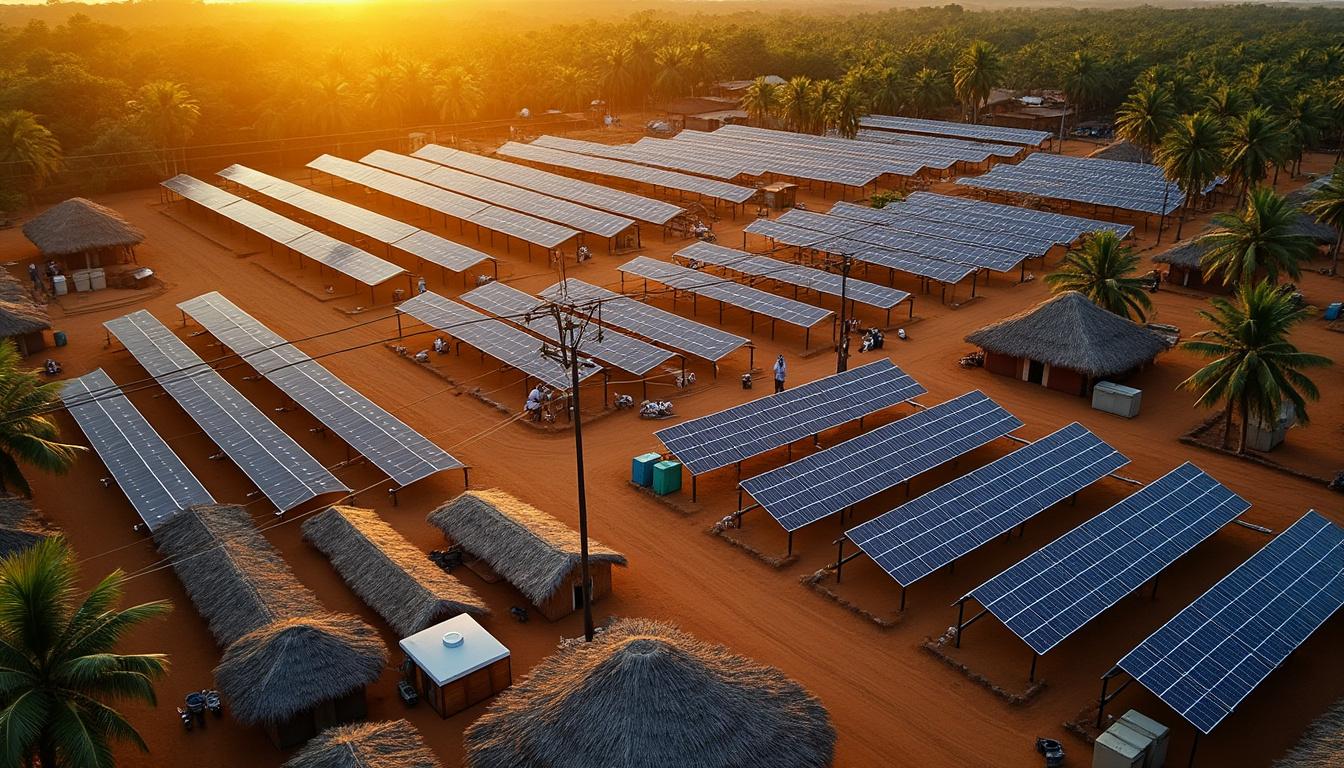
More than turbines and panels, the transition needs robust grids, demand management, and efficient buildings. The Global Gateway combines financing and technical assistance to strengthen infrastructure, while projects anchored by the EIB and EBRD support mini-grids, off-grid solar, and distribution modernization. Where do homes and neighborhoods come in? On the efficiency side, which reduces the load and cuts the cost of the usable kWh.
In warm climates, bioclimatic architecture and high-performance equipment have an immediate impact. Proper shading, cross ventilation, and thermal mass can reduce air conditioning use, while solar hot water heating decreases consumption peaks. Buildings that demand less energy free up capacity for hospitals, schools, and local production.
Mini-grids and home solar: what works and why
Community mini-grids with 100 kW to 5 MW combined with LiFePO4 batteries and managed by smart meters achieve service quality superior to generators, with declining LCOE. In homes, systems of 1–3 kWp with hybrid inverters and modular batteries create resilience for critical loads, such as lighting, refrigerator, and phone charging.
- 🧩 Integration: local generation + batteries + time-based pricing.
- 🌡️ Passive climate: shading, cross ventilation, light-colored roofs.
- 💧 Solar hot water: simple thermosiphon reduces electrical peaks.
- 📈 Smart metering: data to optimize consumption and tariffs.
| Solution ⚙️ | Main advantage ✅ | Good practice 🛠️ |
|---|---|---|
| Solar mini-grid + batteries | Reliability with predictable cost 💶 | Size peaks and critical loads 🔍 |
| Home solar | Autonomy for essential loads 🔋 | Hybrid inverter and electrical protection 🔒 |
| Efficiency in the building | Less energy for equal comfort 🧊 | Shading and natural ventilation 🌬️ |
- 📍 Identify load profiles (peak, base, seasonal).
- 🧮 Compare “efficiency first” scenarios before investing in generation.
- 🔗 Prepare the internal grid for metering and management by sectors (lighting, outlets, HVAC).
To deepen practices of mini-grids and updated case studies, check field references and recent local experiences.
Insight: every kWh saved is worth more than a kWh generated when the grid is fragile.
Financing and partnerships: EIB, EBRD, Global Gateway, and opportunities for Lusophone SMEs
This European package brings together public and private capital to reduce risk, accelerate permits, and attract long-term investors. An essential component: blended finance, combining grants, guarantees, and long-term loans. For SMEs and cooperatives, it opens space in engineering, O&M, asset management, training, and digitization.
In parallel, recent European learning with REPowerEU and national recovery plans (like Portugal’s) shows that regulatory reforms, one-stop shops, and technical standardization unlock projects. In Africa, partnerships with municipalities and local universities are a bridge to solutions adapted to climate and available materials.
How to navigate financial instruments and competitions
Companies that structure projects with solid feasibility studies, environmental and social management, and maintenance plans become preferred. The “SabiSol Cooperative,” for example, grows by providing measurement kits, training, and service contracts at three levels, reducing failures and commercial losses.
- 📝 Documentation: environmental and social assessment, grid and demand analyses.
- 🧪 Scalable pilots: start with 200–500 kW and plan for expansion.
- 🛡️ Guarantees: cover currency and payment risk.
- 🤝 Consortia: bring together local engineering + manufacturer + operator.
| Instrument 💼 | For what? 🎯 | Practical tips 🧭 |
|---|---|---|
| Grants (Global Gateway) | Studies, technical assistance, CAPEX 🧰 | Focus on innovation and social impact 🌍 |
| Loans (EIB/EBRD) | Grid infrastructure and generation ⚡ | Long term + performance clauses 📑 |
| Guarantees | Risk reduction for investors 🛡️ | Useful for local currency and PPAs 💱 |
- 🔎 Read the service specifications carefully; comply with technical standards from the start.
- 📊 Structure clear metrics: kWh, availability, service quality.
- 🌐 Connect to regional networks for the circulation of parts and technicians.
Key takeaway: bankable projects combine good engineering, social impact, and governance.
26.8 GW in projects: solar, wind, hydro, and geothermal gaining scale
The 26.8 GW expected is not an abstract number: it translates into a pipeline of solar photovoltaic, wind, modernization of hydropower, and geothermal where resources exist. In regions with high radiation and ample land, large-scale solar and agrivoltaics become dominant; in steady wind corridors, wind balances the mix; in existing reservoirs, floating photovoltaic reduces evaporation and avoids new land occupations.
Beyond generation, grid reinforcements, reactive compensation, and grid-forming inverters ensure stability. The goal is simple: deliver predictable and clean energy where it changes lives, from peri-urban areas to agro-industrial hubs.
How capacity reaches people and businesses
A recurring example is linking solar parks to economic corridors with firm demand and power purchase agreements (PPAs) that enable financing. Meanwhile, mini-grids in villages enhance social impact and reduce costs for public services. The coordinated design avoids congestion and losses.
- 🌤️ Solar: low costs and quick installation; ideal for Southern and Western Africa.
- 💨 Wind: complements at night; useful in coastal areas and plateaus.
- 💧 Hydro: modernization, sediment management, and repowering.
- 🔥 Geothermal: firm base in the African Rift for continuous load.
| Technology 🧪 | Ideal use 🌍 | Project note 📝 |
|---|---|---|
| Solar PV | High radiation, available land ☀️ | Mitigate dust, optimize orientation 🔧 |
| Wind | Stable wind corridors 💨 | Robust measurements for 12–24 months 📈 |
| Hydro | Existing reservoirs 💧 | Floating PV and sediment management ⚓ |
| Geothermal | African Rift 🔥 | Thermal profiles and controlled reinjection 🧪 |
- 🧭 Prioritize regional portfolios to diversify resources.
- 🛰️ Use satellite data and in situ measurement to reduce uncertainty.
- 🔌 Plan grid reinforcements, storage, and flexibility markets.
Want to see recent solutions like floating PV and network improvements in African reservoirs? Look for updated audiovisual references with technical data and field interviews.
Central message: capacity is only half the equation; the other half is service quality.
From continental policy to your home: efficiency, autonomy, and accessible comfort
Large-scale changes make sense when they inspire practical gestures in homes and neighborhoods. In warm climates, passive architecture is a powerful ally; in temperate climates, balanced insulation and well-dimensioned solar catch sustain comfort with low energy. In both cases, small steps create gains: less load, lower bills, healthier air.
What choices make a difference now? The answer lies in the combination of efficient envelope and right technology. A home that avoids excessive thermal gains needs less cooling; a solar water heater frees up electrical capacity for other loads; real-time metering changes consumption habits. And all of this connects to the African transition: local efficiency amplifies the impact of renewable generation.
Practical measures that work in everyday life
The path does not require expensive solutions, but rather informed decisions coherent with the climate and usage of the house. In neighborhoods with abundant sun and fragile grids, prioritize self-consumption with batteries for essential loads. In urban apartments, invest in efficient equipment and time management.
- 🪟 Shading: exterior shutters, eaves, and natural climbing plants.
- 🌬️ Cross ventilation: opposite openings and hygroscopic grids.
- 🧱 Materials: insulation in wood fiber, cork, or hemp.
- 🚿 Solar hot water: thermosiphon in the right climates, with annual maintenance.
- 🔋 Solar + batteries: reserve 1–2 kWh for critical loads.
- 📲 Metering: apps and smart plugs to manage peaks and standby.
| Measure 🧰 | Impact 🌟 | Good practices ✅ |
|---|---|---|
| Exterior shading | Less internal solar gain ☀️➡️🏠 | Orient by facades and seasons 🧭 |
| Solar hot water | Reduces electrical peaks ⚡ | Size by family profile 👨👩👧👦 |
| Solar + batteries | Resilience in grid outages 🛡️ | Protections, ventilation, and maintenance 🔒 |
- 🧭 Conduct a simple diagnosis of your home: where heat enters, where there are losses.
- 🧮 Apply the “efficiency first” rule and only then size generation.
- 🔌 Set load priorities (cooling, lighting, communication).
If you’re looking for clear references and practical cases of sustainable housing, explore guides and ideas at Ecopassivehouses.pt. Immediate action? Choose one measure to implement this week — for example, install shading on a critical window or put a timer on higher consumption loads. It’s the kind of gesture that prepares every home for cleaner, accessible, and reliable energy, at any latitude.
Source: www.jornaldenegocios.pt