Electricity consumption has risen and thermal comfort has returned to the center of the conversation: September heated the demand and October was marked by a historic drop in renewables, forcing more natural gas and imports. This is a key moment to understand the system and, above all, adjust the house to pay less and live better.
If you are looking for clear and applicable guidelines, here are the essential data and practical steps to transform your home into a more efficient, resilient, and comfortable space.
| Short on time? Here’s the essential: | |
|---|---|
| ✅ | In October, electricity consumption increased by 1.2% compared to the previous year; renewables covered 50% of the demand and fell to lows since September 2023 ⚡ |
| ✅ | Imports reached nearly 32% (yearly high), while natural gas gained weight in production 💨 |
| ✅ | Gas consumption to produce electricity rose by 121.7%; the electric segment represents 35.1% of total gas, the rest is conventional consumption 📈 |
| ✅ | To reduce the bill: shading, setpoints of 25–26°C, nighttime ventilation, load management, and photovoltaic self-consumption ☀️ |
September lights the way: heat drives consumption and renewables mark historic lows in October
The latest readings from the electrical system show a clear scenario: higher demand combined with lower renewable production. In October, electricity consumption rose by 1.2% compared to the same month last year, driven by increased economic activity and less favorable weather conditions for clean sources. The result? Renewables accounted for 50% of the demand, the lowest level since September 2023, and a increase in natural gas and imports to balance the situation.
According to operational data, renewable composition was distributed among wind (21.3%), hydropower (12.3%), solar photovoltaic (11.1%), and biomass (5.4%). This means that half of the system was supported by endogenous resources, but the other half required 18% from non-renewable sources and, above all, 32% from imports — the highest figure of the year. When the wind dies down, reservoirs are more constrained, and solar radiation decreases, the grid compensates with gas in combined cycle plants and with energy bought abroad.
The consumption behavior is not surprising. In southern Europe, heatwaves in September have been more frequent, as seen in Brazil, where demand spiked as air conditioning worked at its limits. The pattern repeats: supermarkets, services, and residences reinforce air conditioning to ensure comfort, shifting load peaks to the hottest hours of the afternoon. In Portugal, this effect extended into early autumn, amplifying the system’s need for flexibility.
Why does this matter for your home? With a system increasingly dependent on imports and gas, price sensitivity and volatility increase. Small daily decisions — like programming appliances outside of peak times or improving shading — can immediately curb the bill and reduce pressure on the grid on critical days.
- 🌬️ Less wind, more gas: when wind energy falls, combined cycle becomes prominent.
- 🌊 Limited hydropower: weak inflows restrict generation in October.
- ☀️ Seasonal photovoltaic: shorter days and cloudiness reduce solar production.
- 🔌 Daytime consumption peaks: air conditioning and refrigeration increase load during hot periods.
To visualize the weight of each component for the month, see the simplified breakdown below.
| Component ⚙️ | Share in October 📊 | Note 🔎 |
|---|---|---|
| Renewables (total) | 50.0% | Lowest since September/2023 |
| Wind | 21.3% | Dependent on wind regimes |
| Hydropower | 12.3% | Contained inflows in autumn |
| Solar photovoltaic | 11.1% | Fewer hours of sunshine |
| Biomass | 5.4% | Base support |
| Non-renewables | 18.0% | Thermal plants and cogeneration |
| Imports | ≈32.0% | Yearly high |
What does 32% of imports mean for the end user
Importing nearly one-third of electricity translates into greater exposure to the Iberian and European markets. During periods of thermal stress, neighbors also consume more, and prices tend to rise. For the domestic consumer, the response is to dilute consumption throughout the day and to invest in passive measures that reduce the need for air conditioning.
In summary, the system did what it should: ensured supply. Now, homes must reduce unnecessary demand and align habits with energy availability.
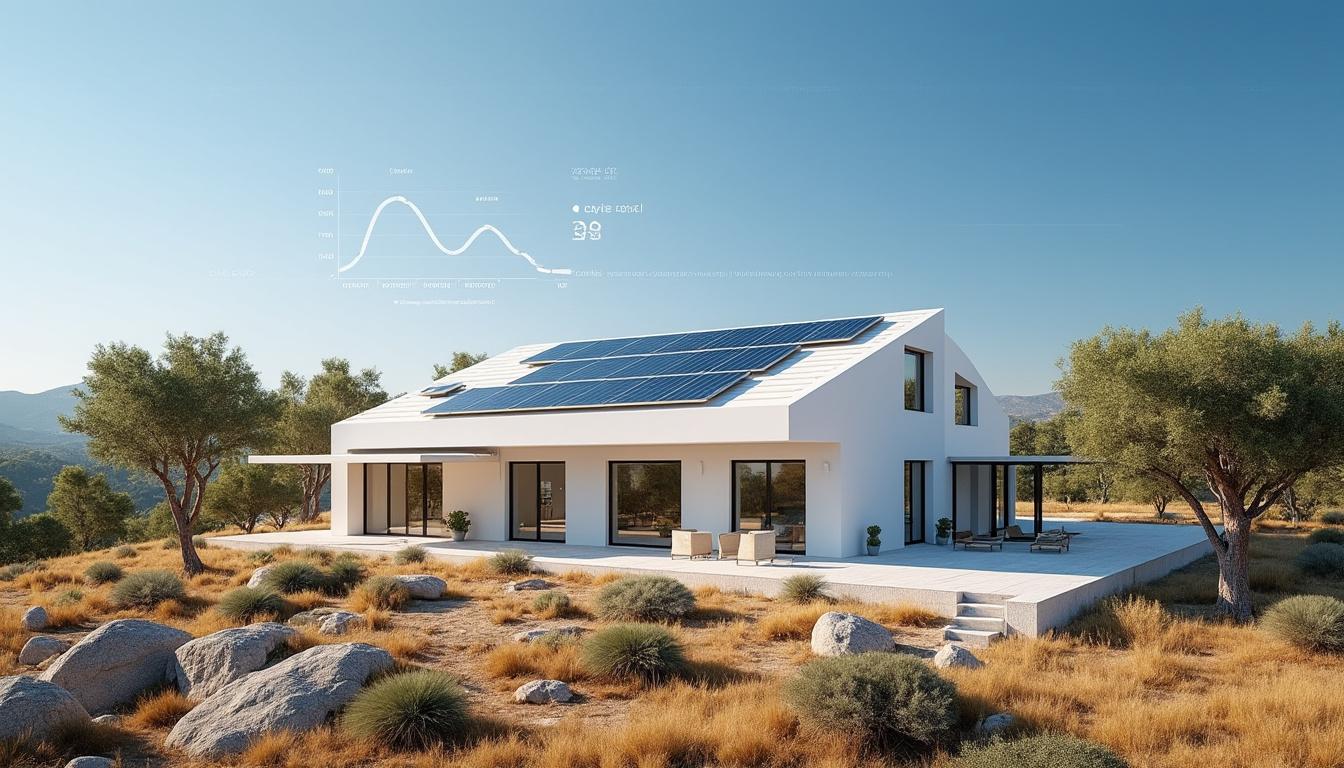
How to reduce air conditioning use and maintain comfort when the grid is under pressure
On hot late summer days, air conditioning spikes. The good news is that simple strategies in the environment and the use of appliances reduce electrical load without sacrificing comfort. A home that shades, ventilates, and insulates properly requires less mechanical cooling; if air conditioning is still necessary, it is advisable to operate it with smart setpoints and short cycles.
Imagine a T2 apartment in Setúbal with a southwest orientation. By applying exterior shutters, solar control films, and a ceiling fan, the indoor temperature can drop by 2–3°C without turning on the AC. Complementing with nighttime ventilation and dehumidification on humid days stabilizes comfort and lowers the bill.
- 🌡️ Setpoint at 25–26°C: every degree lower can increase consumption by 6–8%.
- 🌓 Nighttime ventilation: opposite windows open and interior doors unlocked create thermal sweeping.
- 🪟 Exterior shading: awnings, brises, and shutters on the outside cut solar gains before the glass.
- 💧 Dehumidification: 50–60% RH feels cooler without lowering the temperature as much.
- ⏱️ Scheduling: pre-cool occupied spaces and turn off when empty.
To guide quick decisions, the table below summarizes typical impacts, costs, and difficulty levels.
| Measure 🛠️ | Estimated savings ⚡ | Cost 💶 | Difficulty 🧩 |
|---|---|---|---|
| Exterior shading | 10–25% in cooling | Medium | Medium |
| Setpoint 25–26°C | 6–15% on AC | None | Low |
| Ceiling fan | Up to 30% less AC use | Low | Low |
| Film on glass | 5–10% | Medium | Medium |
| Nighttime ventilation | 3–7% | None | Low |
Load management: what to turn on, when to turn on
When the grid is under pressure, it is worth shifting consumption to outside of hot hours. Appliances like electric water heaters, washing machines, and driers work best during off-peak hours. Timers and smart plugs help to stick to the routine effortlessly.
- 🕒 Schedule washes for the early morning or late at night.
- 🌬️ Use “eco mode” and low speeds whenever possible.
- 🔌 Turn off standby loads with switched plugs.
If there is photovoltaic self-consumption, prioritize uses during solar peak (11 am–4 pm). This way, less energy is purchased during expensive moments, and the system “pays for itself” faster.
After fine-tuning the consumption side, it’s important to understand how the system is being supplied when renewables fail — and the role of gas becomes crucial.
Natural gas and imports: what changes in the electric mix and how this affects your bill
With renewables at 50%, natural gas has once again become the stabilizer of the system. Gas consumption in total increased by 18.0% in October, particularly usage in electricity production, which soared by 121.7%. In terms of distribution, the electric market — primarily combined cycle plants — represented 35.1% of the gas, while the conventional market (industry and thermal uses) accounted for 64.9%, decreasing by 5.8% compared to the same period last year.
On the supply side, the portfolio remained concentrated: United States (48.3%) and Nigeria (43.7%) dominate, with Spain (~8%) providing support. This geographical diversification reduces risks, but international volatility continues to influence marginal costs when combined cycle is heavily utilized.
For the domestic consumer, three implications are tangible. First, more sensitive prices at peaks, when marginal gas determines the cost. Second, the direct benefit of reducing consumption during expensive hours through load management. Third, the opportunity to take advantage of time-based tariffs — if that option exists with your supplier.
- 💡 Active management: moving laundry and heating to economical periods reduces costs.
- 🔁 Thermal flexibility: homes with good inertia tolerate range without turning on equipment.
- ☀️ Self-consumption: photovoltaic covers daytime base and cuts purchases at marginal price.
The table below helps relate gas behavior to its impact on daily life.
| Indicator ⛽ | Value/change 📈 | Practical impact 🏠 |
|---|---|---|
| Gas for electricity | +121.7% | Greater price sensitivity during peak hours |
| Total gas | +18.0% | More use of combined cycle plants |
| Electric market | 35.1% of gas | Marginal load determines cost |
| Conventional market | 64.9% (−5.8% y/y) | More efficient industry and seasonality |
| Source USA | 48.3% | Exposure to Henry Hub and LNG spot |
| Source Nigeria | 43.7% | Balanced African LNG portfolio |
| Spain | ≈8% | Iberian support and interconnections |
How to soften peaks without losing comfort
There are two immediate levers in the home: reducing coincident power and deferring thermal loads. A thermal accumulator with a timer, walls with exposed thermal mass, and a well-applied thermal curtain make a difference that can be felt in the wallet. In buildings with photovoltaic pre-installation, investing in 1.5–3 kW of peak can cover base daily needs, freeing the grid during critical moments.
Understanding the system is not an end in itself: it is the basis for smarter domestic decisions, especially when the architecture of the home comes into play.
Passive architecture and natural materials: reducing dependence on electric cooling
When the heat knocks on the door in September and renewable production disappoints in October, the best defense is a house that works in your favor. Passive architecture is simple in principle and rigorous in execution: orientation, shading, insulation, thermal inertia, and controlled airtightness. Adding natural materials — like wood, cork, and lime mortars — achieves stable comfort and healthier air.
In the most efficient residential projects, the east/west facade receives calibrated brise-soleils and overhangs, while the south has dimensional fins to block high summer sun and allow low winter sun in. The roof is insulated with expanded cork, and the carpentry features low-emissivity glass with airtight frames. The result: less heat entering when it is not wanted and less cold escaping when we need it.
- 🧱 Thermal inertia: walls with higher mass reduce temperature spikes.
- 🪟 The right glass, the right side: useful solar gains to the south in winter; control to the west in summer.
- 🌿 Natural materials: regulate humidity and enhance hygrothermal comfort.
- 🔁 Controlled ventilation: fresh air with heat recovery prevents losses.
An illustrative case: a semi-detached house in Évora, with 140 m², that replaced interior shutters with micro-perforated external screens, added 8 cm of insulation in the roof, and exposed a section of rammed earth wall as thermal mass. In the first autumn after the intervention, the need for air conditioning fell by about 28%, and the feeling of comfort increased, maintaining 25–26°C with humidity near 55% on very hot days.
| Passive solution 🧭 | Thermal effect 🌡️ | Electricity benefit ⚡ |
|---|---|---|
| West brise-soleils | −2 to −3°C at peak | Fewer hours of AC |
| Roof insulation | Reduces gains and losses | Lower peaks, lower power needs |
| Low-emissivity glass | Limits radiation and losses | More stable climate control |
| Ventilation with recovery | Renews air without cooling | Less use of resistors |
| Southeast seasonal shades | Sun in winter, shade in summer | Less energy year-round |
To delve into practical solutions and real project examples, it is worth exploring specialized content and self-consumption guides. A good entry point is the sharing of experiences on platforms dedicated to sustainable living, such as Ecopassivehouses.pt, where ideas and construction details are translated into daily decision-making.
With the environment working better, it’s time to look at active energy: production, storage, and intelligent management.
Preparing the house for autumn/winter: self-consumption, batteries, and load management
With imports at 32% and gas rising, every kilowatt hour saved counts. The combination of photovoltaics for self-consumption, a small home battery, and load management by time reduces purchases at expensive moments and stabilizes comfort. Even without significant investments, there are immediate gains from programming and consistent habits.
In a home with 2–3 kW of PV, heating water with a thermal accumulator can be scheduled for solar peaks, while washing machines and dishwashers operate between 2 pm and 4 pm. At night, the battery covers lighting and electronics, avoiding grid peaks. If there is no battery, a pre-heating strategy and good airtightness reduce the use of resistors during the first cold hours.
- 🔋 3–5 kWh battery: covers nighttime base and smooths peaks.
- 🗓️ Timers and scenarios: simple automations create efficiency routines.
- 🌞 Hot water to the sun: prioritize thermal consumption with PV production.
- 📶 Monitoring: measuring is the first step to optimizing.
The following table shows a typical load management routine to maximize self-production and minimize purchases during expensive hours.
| Time slot 🕘 | Recommended action ✅ | Objective 🎯 |
|---|---|---|
| 7 am–10 am | Efficient lighting, avoid resistors | Reduce morning peaks |
| 11 am–4 pm | Thermal accumulator, laundry, electric cooking | Consume solar production |
| 5 pm–9 pm | Use battery, defer non-critical loads | Avoid grid peak |
| 10 pm–12 am | Drying and remaining laundry | Cheaper rate / off-peak |
| 12 am–6 am | Replenish battery SOC if there is an economic tariff | Prepare for the next day |
Start small, get right quickly
It is not always necessary to have a large installation to reap benefits. A 1.5–2 kW kit already covers the basic daytime needs of an efficient T2. By combining this with draft sealing (sealants, treated shutter boxes) and thermal curtains, comfort increases while exposure to the grid during expensive moments decreases. The key is to excel at the basics and measure the impact to calibrate the next steps.
By adjusting habits, strengthening shading, and planning for small self-consumption, the home gains autonomy and the bill appreciates. A simple action to start today? Set the AC setpoint to 26°C, lower the blinds on the side of direct sunlight, and schedule washes for the solar period or off-peak. Small victories, when added together, make all the difference.
Source: dinheirovivo.dn.pt